Showing posts with label prayer. Show all posts

Sunday, September 22, 2024

End of the Day Tantrums and the wisdom of James


Rev. Molly F. James, Ph.D.

St. James’s, West Hartford, CT

September 22, 2024, Proper 20B

Psalm 1; James 3:13-4:3, 7-8a; Mark 9:30-37


May God’s Word be spoken. May God’s Word be heard. May that point us to the living Word who is Jesus Christ our Lord. Amen. 

There was an article in the New York Times recently that caught my eye: “End-of-day meltdowns are not just for kids.” Hmm. Oh, you mean that thing where I pick my kids up and am short tempered with them for no particular reason and just wish dinner would magically appear on the table and the laundry would all do itself is not just a me thing? Oh. 

The article went on to describe some helpful suggestions for how those of us parents (and really any adults) might alter our routines to help us have calmer transitions and more patience. Because of course the end of the day (or middle of the day) meltdown is not unique to working parents with small children. All of us get stressed and snap at those we love. 

All of us fail to live up to the wisdom we have in the Letter of James today: “Show by your good life that your works are done with gentleness born of wisdom. But the wisdom from above is first pure, then peaceable, gentle, willing to yield, full of mercy and good fruits, without a trace of partiality or hypocrisy.” 

Peaceable, gentle, willing to yield? Does that sound like how any of us feel when we are stressed out or melting down or dealing with a sense of overwhelm? I doubt it. 

So, what can we do? How might we help ourselves and those around us do better? Because I have certainly found it to be true that if I meet someone else’s grumpy with more grumpy that doesn’t serve either of us. If one of us can be centered and full of mercy then the whole situation changes. 

Fortunately that article had some helpful suggestions of a lot of small things we can do. 

First off, is to be able to recognize when we are feeling stressed. Hopefully we can learn to do this on our own, and sometimes we need help. I know I often need a friend or one of my children to say something to me like: “Hey you seem out of sorts. Are you okay?” A nice, polite and gentle way to say, “I really don’t like how you're behaving right now, and it feels like you are taking stuff out on me.

And then we need to de-stress. This doesn’t have to be a complicated regime. It can be some simple acts that take a few minutes. Take some deep breaths. Go for a walk. Pray. Especially saying a prayer that is familiar and grounding - Our Father, 23rd Psalm, one of those beautiful prayers from Compline. Or keep a favorite verse or two of scripture handy. Or have a cross or beads or a rock or something tangible you can keep in your pocket or your bag to help you reconnect with God. 

I know for me there is something important and profound that happens in prayer and worship. My mind is more focused. I have found my priorities again, and I no longer feel stuck in the swirling anxiety and stress of my own head. This is why worship matters. Why prayer matters. It actually makes a substantive, tangible difference in our bodies and our lives. 

The other thing that matters is that we have routines. We need to have habits to help us transition from one part of your day to the other. What if we don’t work right up to the last possible moment before we transition home for the evening? What if we are more intentional about putting our phone aside? What if we change our clothes when we get home? Or take a few minutes to listen to a song that always lifts our spirits? The possibilities are endless. 

And we need to be able to tell those around us what we need. Do we want to jump right into conversation the moment we walk in the door? Or do we need a few minutes of quiet? Are we 100 times more able to engage if the first thing we do when we get home is have a snack and a glass of water? And what about our kids? Are we asking them what works best for them too and then living into that together? 

This may seem like a long list or sound like a lot, and I hope you can see that they are small actions - just a few minutes, a few small changes here and there that can have a profound impact. 

No doubt the world and our lives need more of the “wisdom from above” that is “pure, then peaceable, gentle, willing to yield, full of mercy and good fruits, without a trace of partiality or hypocrisy.” It is the life of humility and grace that Jesus describes in our Gospel today. When we act more like an innocent, joyful child than the squabbling disciples who are far too focused on who is the greatest. 

Imagine a world where there is more gentleness and mercy than envy and selfish ambition? Sounds beautiful right? Well, we may not be able to change the whole world this week, but if we can change our own hearts and habits it will make a difference in our lives. And who knows what the ripple effects of that could be? 

AMEN. 


Tuesday, March 1, 2022

Reflections on feasting and fasting


Rev. Molly F. James, PhD

Shrove Tuesday Homily

DFMS Noonday Prayer

March 1, 2022


May God’s Word be spoken. May God’s Word be heard. May that point us to the living Word who is Jesus Christ our Lord. Amen. 


So my friends, it is Mardi Gras. Fat Tuesday. Shrove Tuesday. A day for pancakes or beignets or some sort of feasting. A day for eating way more sugary deliciousness than we might normally eat. All in preparation for the beginning of Lent. Quick let’s get all our gluttony in befor our fasting in the season of Lent or at least on Ash Wednesday.


Here's the thing, friends, I am not good at fasting. I am sure it comes as no surprise that the priest who loves to bake cookies and always has a basket of snacks in her office doesn't like fasting. Intellectually I get it. It seems like a great way to cleanse your body and to focus on God, on all things spiritual. But here's my difficulty, as everyone who has ever taken a trip with me can attest, I am less fun to be around if I don't eat regularly. I get tired and cranky. I don't feel good, and I usually end up with a headache. And since I get enough of those because my left shoulder is missing a bone, it all conspires to have fasting be a pretty unpleasant experience. And I am pretty sure that is not what God intended. 


Jesus came that we might have life abundant. Not misery abundant. Now, of course, some of you may find fasting to be a glorious way to deepen your relationship with God. That is wonderful! I hope you fast as often as is meaningful to you, whether it's Lent or not. 


I just think it's important for those of us for whom fasting is not an enriching experience are reassured that we are not lesser Christians nor have we failed at Lent before it's even started. Nor do I think that not fasting tomorrow means there can be no feasting either. I think feasting (in moderation) is good for our souls. And I don't just mean eating more fat and sugar than we usually do. Occasionally, a special dessert or an extra cookie might just be the thing. Most of the time though, I think feasting doesn't need to be about overconsumption of food. I think it is about the quality of what we eat, how it nourishes our bodies and souls, and how good it feels to savor a delicious meal.


I also think that it is important to remember that our feasting and fasting don’t necessarily even have to be about food. Many of us have complicated relationships with food or medical realities that dictate what we can and cannot eat. Many years ago a colleague shared a wonderful quote from Presiding Bishop Arthur Lichtenburger (and if his name seems familiar, it’s because its on the wall in the lobby of 815). He was Presiding Bishop when it was built. He invites us to:


“Fast from criticism and feast on praise; 

Fast from self-pity, and feast on joy; 

Fast from ill temper, and feast on peace;  

Fast from resentment, and feast on contentment; 

Fast from jealousy, and feast on humility; 

Fast from pride and feast on love; 

Fast from selfishness, and feast on service; 

Fast from fear, and feast on faith.”


Indeed. Our feasting and fasting do not have to be about what we eat. They can be about the disposition and habits of our hearts. I think especially this year, when we are exhausted and stressed when the world seems to be either on the brink of descending into chaos or the brink of returning to some kind of normalcy depending on the day or hour or who are talking to or which news outlets you follow. And given all the supply chain issues, it is probably best if our feasting  is not contingent on what what we can find on our grocery shelves. 


So in the days and weeks ahead, I hope there is plenty of feasting, even though it will be Lent. I hope we all keep finding moments and practices that deepen our faith, fill us with peace, and help us to remember that we are surrounded by love. Today and always. Amen. 


Wednesday, April 21, 2021

Carrying (and Sharing) our Burdens


Rev. Molly F. James, PhD

DFMS Noonday Prayer via Zoom

Anselm of Canterbury, April 21, 2021


May God’s Word be spoken. May God’s Word be heard. May that point us to the living Word who is Jesus Christ our Lord. Amen. 


“‘Come to me, all you that are weary and are carrying heavy burdens, and I will give you rest.” 

Anyone else breathing a little more deeply after hearing those lines from Matthew? I am weary. We are all carrying heavy burdens. Sometimes I think more than we even realize. I was reflecting a bit on this past year, and the image came to mind of walking with a heavy backpack. I certainly feel like I am. And in some ways I feel like I have only begun to realize what it is that I am carrying. So much grief over all that we have lost in the last year - lost lives, lost opportunities. The fear and anxiety of rising case numbers. Another mass shooting in a grocery store. What will the aftermath be of the guilty verdict in the Chauvin case? And the knowledge that no matter what happens in the days ahead we still have so much work ahead of us to undo the systemic realities of oppression in our nation and our society. 


And while we may share many of these burdens, we each have our own. Burdens particular to our circumstances, our family or community. Burdens we carry because of race, gender, sexual orientation, or another category society has placed upon us. Those burdens may weigh on us in different ways at different times. Even though I think Atticus and Scout Finch in To Kill a Mockingbird were on to something, we cannot fully know what it is like to walk a mile in someone else’s shoes. We cannot fully know each other’s burdens. 


But here’s what we can know. We ALL have them. We are ALL carrying them. No matter how peaceful someone may seem on the outside. No matter how “all figured out” or “put together” they may seem, the burdens are there. So there is our first invitation of the day, an invitation to compassion, for ourselves and for others. We don’t need to beat ourselves up about the burdens. We don’t need to get trapped in a cycle of comparison about who has more or whose are heavier. Let’s just stipulate that everyone’s got them, and we are all weary.


So, I think oh good, thank you Jesus, we are going to get to rest. But then we keep reading in Matthew, and out comes my argumentative self. What? Jesus, you just promised rest, but now you are talking about yokes, and learning, and more burdens. Did you miss the part about how we are weary? And by weary, we mean bone tired, exhausted, sacred, anxious, worried, and all the rest of it. 


Then I pause. I breathe. I think. Would the Jesus I know really say, “Oh I see you are carrying a lot of burdens there. Here let me give you some more stuff to carry.” No. That doesn’t actually sound like Jesus. Could I imagine Jesus saying, “Oh, I see you are carrying a lot of burdens. How about we take that backpack off and look through them together and see what we can put down?” That I could imagine. 


So, my friends, there is our second invitation. An invitation to learning, an invitation to lay some burdens down or to ask for help carrying whatever it is that has to stay in the backpack. 


I hope that for many of us there has been a gift buried in all the challenges of the past year; it is the gift that comes with being confronted with the fragility of life. The gift of having our priorities clarified. The gift of being able to see and know with certainty what really matters in life. We can indeed lay some burdens down. We can let go of those things that no longer serve us. We can let go of those things that have been barriers to connection, barriers to a deeper relationship with God and with each other. If this year has shown us nothing else, it has shown us the primacy of community, of connection, of belonging. 


So, in this week, in this Easter season, I invite you to take some time in your prayers to unpack whatever it is you are carrying. To see if you might lay some of it down. And then to ask for help, from Jesus, from those who are beloved to you, to pick up whatever it is that you need to keep carrying. We may not be able to fully understand the particularities of each other’s burdens, but we can certainly bear them. We can carry them together. And I trust, my friends, that as we move forward together sharing the load and leaving some behind, we will no longer be quite so weary. We will be energized with hope and possibility for the future. Amen. 


Wednesday, October 21, 2020

Peace in the midst of chaos


Rev. Molly F. James, PhD

DFMS Noonday Prayer via Zoom

October 21, 2020

Eph. 3:4-12; Psalm 122; Luke 12:39-48

May God’s Word be spoken. May God’s Word be heard. May that point us to the living Word who is Jesus Christ our Lord. Amen.

Verse 7 of our Psalm for today says, “Peace be within your walls * and quietness within your towers.” Ha! I thought when I read this. Peace? God, you are funny. Home life is slightly organized chaos while we all try to work from home and educate children in the midst of a pandemic. Life in our wider communities seems unstable and worrisome as cases are rising again in so many places, including my own state. Our national life seems to be in turmoil as there is bitter division and deep fears as we approach Election Day. And the whole world is still in the grips of a pandemic.


And that list did not include any of the challenges and difficulties that were around before we went into quarantine, like systemic racism or climate change or the ever widening gap between rich and poor. Peace? Really God, I want to say, You have got to be kidding me. How can we possibly find peace at a time like this.


But blessedly I have some wise people in my life whose voices intervene in moments like these. “Molly,” they say, “Take a deep breath. Pause. Reflect. You are getting yourself in a frantic state that is not actually going to help anything. Remember that story about Mary and Martha? You are doing your Martha thing. Time to find your Mary. Sit. Rest. Trust.” Ah. Right.


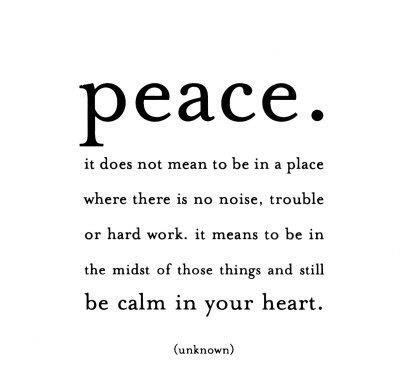
And I think of that oft quoted wisdom pictured above.


Oh, I think, maybe that is what God means. “Peace be within our walls” is not about some magical other world where nothing bad happens. It is not about all our present difficulties just disappearing at the snap of a finger. It is about us finding peace in our souls in the midst of it all. It is about us holding on to that peace, that strength, that resilience to get us through this time.


C.S. Lewis writes of this same kind of experience in A Grief Observed. He writes, “When I lay these questions [of why his wife died or why he is suffering] before God I get no answer. But a rather special sort of ‘No answer.’ It is not the locked door. It is more like a silent, certainly not uncompassionate, gaze. As though He shook His head not in refusal but waiving the question. Like, ‘Peace, child; you don’t understand.’”


In the midst of everything that is going in our world, we, like Lewis, are given a gift of peace that we may not fully understand, but here is the important thing for us to remember - it is God's peace. It is bigger than all of us, bigger than the things of the world, bigger than our fear.


It is not a peace of easy answers or simple solutions. It is the peace that comes from letting go. The peace that comes when we stop trying to figure everything out. It is the peace that comes when we choose trust over fear. When we chose love over indifference. When we chose possibility over certainty.


That is what God offers us. A gift of peace. It is not a gift that will always come easily to us. It is far too easy for us to be sucked into the 24 hour news cycle or find ourselves catastrophizing all the what ifs of tomorrow or next week or next year.


And so we need to keep up the practices that help us slow down. That center us. That remind us we are beloved of God and that we can indeed find peace amidst the chaos. We need time for prayer. Time to nourish our bodies. Time for rest. Time for laughter. Time for that which brings us joy. Time for that which restores our souls and connects us to the grace that is the “foundation of everything.”


The world may seem frantic and harried. There are times when it can seem like the fear is going to get the best of us. But it need not. We have a choice. We have an invitation, an opportunity to experience the beautiful gift of knowing the peace of God in our hearts. It is my prayer that in the midst of all the challenges and the struggles of these days we remember that the peace is not contingent on what happens out there. It can always be found in our hearts, when we are connected to God and each other. Amen.

Thursday, August 27, 2020

When Miracles Don't Happen


Rev. Molly F. James, PhD

DFMS Noonday Prayer 

Thomas Gallaudet & Henry Syle, August 27, 2020


May God’s Word be spoken. May God’s Word be heard. May that point us to the living Word who is Jesus Christ our Lord. Amen. 

Our Diocesan Offices used to be located in a large house on Asylum Avenue in Hartford. I always thought this was an odd name for a street, as I assumed it referenced some long ago insane asylum in Hartford. The Asylum Hill neighborhood is a notable one, it contains the homes of Harriet Beecher Stowe and Mark Twain. But the Asylum in the name is not for an insane asylum, it is for the “The American Asylum at Hartford for the Education and Instruction of the Deaf & Dumb Persons” founded in the early 1800s. That school is now known as The American School for the Deaf and is located a few blocks from my house in West Hartford. It is actually quite fitting that our Diocesan Offices used to be on Asylum Ave, for the School for the Deaf and the history of the Episcopal Church in CT (and beyond) are very much linked. Today we remember and honor two priests, Thomas Gallaudet (whose father founded the School for the Deaf) and Henry Syle, who was the first deaf priest in The Episcopal Church. 

Our Church has a long history in ministering with the deaf community through education and various parish based ministries. I am finding that history and the examples of Thomas and Henry to be helpful in nuancing my reading of today’s Gospel. Of course, as one might expect today we get a story of Jesus healing a deaf man. I will admit to finding these healing stories challenging. They are wonderful and glorious, of course. But I cannot help but think of people I know who have been blind or deaf who would have loved to have such a miracle cure. They never did. 

How are we supposed to sit with that? How are we supposed to sit with any seemingly insurmountable problem for which we desperately desire a quick and simple solution? If only Jesus were here to instantly fix whatever is wrong. Don’t we wish that were true! 

This is where I think the lives of Thomas and Henry are so helpful. No doubt we (and probably they too) wish for miraculous solutions to the difficulties we face. And yet they do not always happen. So what did Thomas and Henry do? Did they sink into a deep depression and give up? No, they did what they could. And what they could was a lot. Their ministries educated and empowered people who were often at the margins of society, particularly in a time when there was no technology for hearing aids or cochlear implants. 

So I think sometimes we get to be Jesus. Sometimes we encounter challenges that we have exactly the skills to handle. I feel extraordinarily grateful that my children are still at the age where almost all their difficulties can be solved with a conversation and a lot of hugs. I know the days will come (no doubt sooner than I would like) when that will no longer work or even be a welcome solution. They will face difficulties that I cannot fix. 

On those days, and whenever any of us encounter a problem that is beyond our skill set. I hope we will remember Thomas and Henry. We are not always called to make a problem disappear. Sometimes we are called to educate and empower. Sometimes we are called to walk with people and support them in learning to live with a new reality. 

This can be a struggle for those of us who love to fix things and have neat and tidy solutions. It can feel like a failure for us to be unable to make everything better. Thomas and Henry invite us to reimagine our definition of success. They invite us to remember that healing is about wholeness and the fullness of life, not necessarily about erasing a disease or impediment. Thomas and Henry remind us that the fullness of life is possible, even in the face of personal challenges or conditions that society would label as “other.” It is possible because we are a people of faith, and because we are blessed with teachers, mentors, friends and companions on the way who will help us figure out our own version of thriving. 

God is always inviting us to be a people of hope, to find new life. May we always have the grace and courage to accept that invitation. Amen. 


Friday, July 31, 2020

An Ignatian Invitation to Gratitude and Reflection


Rev. Molly F. James, PhD

DFMS Noonday Prayer via Zoom

Feast of St. Ignatius, July 31, 2020


May God’s Word be spoken. May God’s Word be heard. May that point us to the living Word who is Jesus Christ our Lord. Amen. 


Connect to God.

Give Thanks. 

Review the Day. 

Face Shortcomings. 

Look to Tomorrow. 


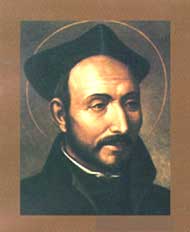
Those are the five elements of the Ignatian Examen. It seems fitting to revisit that practice today on the feast of Ignatius. Perhaps this practice is a familiar one to you? Perhaps it is one of the center parts of your spiritual life? In which case, I hope that today will be an opportunity for you to bask in the gift of that practice. If it is new to you, then I hope it will be fruitful and inspiring to think about how this practice or elements of it might be helpful to you in your own faith life. 


Of course, St. Ignatius is known for his spiritual exercises and for founding the Jesuits. But the particular, personal nature of the Examen seemed worthwhile for us to sit with, together, today. It seems a real gift to us in this time when we are facing so many challenges, as individuals, as communities, as the world. The Examen is grounded in hope. And I would wager we could all use a little more hope these days. 


Now for some of us it might be possible to find the uninterrupted time to do the Examen in one fell swoop at the end of our days (there is even an app to help us). For others of us that might be a bit challenging. So, I want to give us collective permission to honor the spirit of it, even if we are not able to honor the letter of it. Because really, if we can just find a bit more time, a few more ways to honor these practices, our lives will be enriched.


We begin with “Connect to God.” Well, I think we got at least some of that covered. We are here, after all. Connecting to God and each other in Chapel. Perhaps there is an invitation to us to find more of what we love about Chapel in our daily lives. Maybe that just means building more prayer time into our days (it is amazing what a minute or two of deep breaths and reflection can do). Or maybe it means reading more Scripture or more spiritual writings that inspire us. The news headlines will all still be there. They don’t always need to be the first and the last thing we look at on our phones.


“Give Thanks.” Remember that mystic and theologian Meister Eckhart said that if the only prayer we ever say is “Thank you” it will be enough. Giving Thanks to God is always a good idea. At various points in my life, particularly when I have been facing a challenging time, I have done the practice of keeping a gratitude journal. Just a short list, some notes each day about things for which I feel grateful. Even on the really hard days there are things, for which we can give thanks. Keeping our focus on gratitude helps us keep our perspective too. And it feeds our souls to be reminded that blessings abound, even in the midst of struggles.


“Review the Day & Face our Shortcomings”

I put these two together, because likely the act of giving thanks has already helped us to see all the joyful spots in our day. The challenge comes in facing the things that we feel we have not done well today. Oof. As many of you know, I consider myself a recovering perfectionist. I am very skilled at finding my shortcomings. The hard part is not focusing solely on them or letting them define me. I am grateful to the patient companions on the way who work with me to keep reframing the things I label as “mistakes” or “failures” as opportunities for growth and learning. That is an essential piece of this - we need to be sure that when we “face our shortcomings” we do not make it about berating ourselves, but rather about looking back through the day to see how we might learn from it. A wonderful mentor of mine had me keep a journal while I was doing an internship. Each day I was to reflect on two questions: “What did I teach myself today?” and “What would I still like to learn?”. Those are good questions for us to reframe the challenges of the day into opportunities for personal growth.


“Look to Tomorrow.” Indeed. Our Gospel today tells us that we cannot put our hand to the plow and look back. We cannot be a past oriented people. We must be a future oriented, hope filled people. We cannot know with any certainty what tomorrow will look like. We are particularly aware of that truth in these times, and of course, if we are honest, we realize that we have actually never had any guarantees. That is why we need faith, why we need hope, why we need each other. To be a people of faith means that we trust in that which we cannot see. Jesus does not promise us certainty or long lives or easy lives. Jesus promises us an abundant life. Jesus promises to be with us until the end of the age. And so that is where we put our trust, our faith. We put our trust in that which is eternal. We can follow Ignatius’ command to look to tomorrow because we know that no matter what may come our way, we will not be alone. The truth about who God is. The truth that we are beloved children of God. The truth that God is with us always. All of those truths will still be true tomorrow. 


Saint Ignatius invites us to reflect on our days, on our lives that we might be drawn more deeply into relationship with God and brought more fully into the full stature of who God is calling us to be. I hope that you might find the elements of this Examen not a burden or another task to be completed, but rather as an invitation. An invitation to take from it what will serve you well. An invitation to learning, an invitation to growth, and an invitation to be more fully present to the abundant blessings which surround us each and every day. AMEN.


Tuesday, April 7, 2020

Tuesday in Holy Week

Embed from Getty Images

Rev. Molly F. James, PhD
DFMS Noonday Prayer, via Zoom
Tuesday in Holy Week, April 7, 2020

May God’s Word be spoken. May God’s Word be heard. May that point us to the living Word who is Jesus Christ our Lord. Amen.

“God, save me from this hour.” No doubt all of us have prayed this prayer many times in our lives. God save me from the evils of this world. God save me from disease or hardship. God save me from myself. God save me from the seemingly insurmountable challenge in front of me. No doubt many of us would join in Jesus’ prayer in the Garden of Gethsemane, the prayer to let this cup pass from me. To avoid the challenge, to avoid the pain and suffering.

Of course, we would. Especially in the midst of pain and suffering, we desire nothing more than healing and wholeness. We desire a different way forward. And sometimes that is granted. Sometimes, we do indeed get a reprieve and a different path opens up. But most of the time we, like Jesus, have to follow the path that is set before us.

Now, whenever I talk about the particular challenges of pain and suffering, I think it is very important to draw a distinction between the suffering that is endemic to the human experience versus the suffering that is the result of injustice. When we encounter suffering that is the result of injustice, that is suffering we, as followers of Jesus, are called to work against. We are called to be agents of change and transformation. We are not called to merely “accept” that suffering as a part of life.

The suffering that we do have to accept is that which is endemic. It is the suffering that is the result of having mortal bodies, illness, injury, disease, and death are a given part of our life. But even though we can expect them, I don’t think any of us expected them on the scale which we are currently facing. There is a different sort of grief that comes with the enormity of this experience. Our grief is multi-layered. We are dealing with the grief of the numerous changes and losses in our own individual lives. We are also dealing with a societal and global grief as we watch the news.

So, what do we do with this reality, what insight does this Holy Week and today’s Scriptures in particular, have to offer us? Note what Jesus says after his prayer. He asks God to be glorified. He calls his followers to be the children of the light. I think there is a profound invitation for us in that. It invites us to be looking for light, looking for hope, looking for ways in which God’s glory can be made manifest even in the midst of suffering that is on an overwhelming scale.

Sometimes the journey through Holy Week is a largely intellectual one. We hear the stories, and we can imagine playing different parts in them. We can choose to enter the story as lightly or as deeply as we want. Other times, like our present circumstances, we experience the fullness of Holy Week in our own lives. The story of Jesus’ betrayal, death, suffering and crucifixion has deep meaning, not because we have chosen to enter into it as an intellectual exercise. The story of this week has meaning because the Passion Narrative resonates on a visceral level with our own experience. I imagine that is true for many of us this week.

Given that many of us may feel as though we are living out the realities of Holy Week in a profound way that makes it different from other years (and not just because we are doing our worship online), it is all the more important for us to remember that this week, that the crucifixion itself, that the worst humanity can do to each other, is not the end of the story. Death, suffering and pain never have the last word in the Christian story or in our own lives. As our Collect for today so beautifully says, “O God, by the passion of your blessed Son you made an instrument of shameful death to be for us the means of life.” A means of life. Indeed. Life, love, hope, and possibility are what follow from the Cross. Even out of the darkest moments, even out of the moments where it seems that all is lost, know that we are never lost. We are never separated from God’s love. God is our hope, and we can trust in that amazing truth. Today and everyday. AMEN.


Thursday, July 11, 2019

Homily on Benedict of Nursia


Embed from Getty Images


Rev. Molly F. James, PhD
Chapel of Our Lord, Episcopal Church Center
July 11, 2019, Feast of St. Benedict

May the words of my mouth and the meditations of our hearts be always acceptable in your sight O Lord. Our Strength and our Redeemer. Amen. 

Today we celebrate St. Benedict, famous for founding monasteries and authoring a Rule of Life for them that bears his name and has been deeply influential on the spiritual lives of many, inside and outside the monastery. Benedict is perhaps best known for the way he structured the day for his monks: “ An average day includes about four hours to be spent in liturgical prayer (the Divine Office), five hours in spiritual reading and study, six hours of labor, one hour for eating, and about eight hours for sleep.” Sounds like a pretty nice day actually. But where is the commuting? The wrangling of children? The laundry? Paying bills? All the mundane and necessary tasks of daily life. Also, I am not sure we could actually accomplish the jobs we have been hired to do if we only worked six hours. Also I think I would like to have longer than 20 minutes to eat at least some of my meals. But imagine being able to spend four hours a day in prayer. Wouldn’t we be spiritually centered and grounded. Presumably everything would be better if we could spend that much time in prayer. Imagine being able to read the whole of the Book of Psalms every week, as Benedict and his monks did. 

Well, I doubt many of us are going to completely follow Benedict’s Rule. Nor the literal admonition in our Gospel reading for today to give up all our possessions. If you are ready to do so, more power to you. I applaud you. I think that level of sacrifice and the daily regimen really only works in a monastery. Yet there are valuable insights for those of us who are striving to live more faithful lives in the midst of the busy-ness of the world and work and family life. The gift for us is in the attitude and approach that Benedict offered. Even if we do not literally give up everything we have and move to a monastery, we can honor the spirit of Benedict’s life and the ways  in which he calls us to be more faithful followers of Jesus.  

In some ways separating out the day as he did into separate blocks of prayer time, work time, study time, etc. is a bit of a misnomer. The separations could lead us to think that prayer has to somehow be separate from the rest of our lives. Actually in Benedict there is an invitation to intricately weave and connect prayer to everything we do. Indeed our work can be prayer, our mundane tasks can be prayer, our meals can be prayer, everything we do in a day can be done prayerfully. 

Even if you know me only a little bit, you might be able to guess that I am not particularly good at Centering Prayer or any kind of prayer practices that requires long periods of sitting in silence. It doesn’t fit well with my personality nor with family life with small children. I used to bemoan my failings on this front, because I had somehow gotten it in my head that quiet, meditative prayer was somehow THE superior form of prayer. But what Benedict’s life and work teach us that prayer does not only need to happen in moments of silence and contemplation, it can happen as we fold the laundry, do the dishes, sit at our desks, commute home, exercise, etc. Prayer is really about deepening our relationship with God and paying attention to how God is at work in our lives and in the world. The question is not about what we are DOING at any given moment, the question is about our own hearts and minds. What is our attitude? What is our disposition? Are we moving through our day with an openness to what God is up to in our lives and in the world?

A number of years ago, I read a book that I found to be very helpful in incorporating spiritual practices in daily life. It is called Sabbath in the Suburbs. It is written by Mary Ann McKibben Dana, a Presbyterian Pastor who lives in suburban DC. She and her engineer husband have three kids in elementary and middle school. They undertake the goal of practicing a sabbath every week for a year. They choose Saturdays because that is the only common day off. The book chronicles their efforts. There is a moment from the chapter on Advent that has stayed with me. Mary Ann looks at her combined to do list of church and family tasks and realizes that a full on sabbath where you stay home and really rest is just not possible that day. So, she decides she is going to go through her task list “sabbathly.” Mary Ann reminds us that it is our attitude, our disposition that matters. Real life happens. We are not always able to live up to the lofty goals we set for our own spiritual journeys. But the realities of life do not mean we have to beat ourselves up for failure. We can simply adjust our mindset and seek to carry the spirit of sabbath with us. If our mindset is in the right place, even our tasks can be prayer.

So, I hope that today is an opportunity to refresh our spiritual lives and to be reminded that just like Benedict and Mary Ann, we can integrate prayer into our daily lives. In fact our whole lives can be prayer. AMEN. 

Thursday, May 30, 2019

Ascension Day Homily

Embed from Getty Images

Rev. Molly F. James, PhD
Chapel of our Lord, Episcopal Church Center
Ascension Day, May 30, 2019
Acts 1:1-11; Luke 24:44-53; Psalm 47


“Thus it is written . . . that repentance and forgiveness of sins is to be proclaimed in his name to all nations, beginning from Jerusalem.”

Repentance and forgiveness of sins. Wait. Isn’t it still Easter? Why does it feel like we're going back to Lent. Why is this one of the last things Jesus tells his followers? Because it matters. Repentance matters. Forgiveness matters. They both matter a lot to our own faith journeys and to our lives as a community. If we are not practicing repentance and forgiveness then we are not following Jesus, and we are not building authentic community.

I believe our Gospel today offers us an invitation to check in on our own spiritual lives. How are we doing? Are we practicing repentance and forgiveness? Notice that the two of them are lumped together. I don’t think this is an accident. Think about some of the most familiar words of our tradition. Think of the Lord’s Prayer. What very important conditional statement do we pray nearly every time we gather as followers of Jesus? We pray that our sins, our trespasses will be forgiven AS we forgive those who sin against us. Our forgiveness is contingent on our ability to forgive other people. There is a complicated dialectic there. Our relationship with Jesus is not a solo endeavor. It is not just about how we as individuals relate to Jesus or whether or not we have accepted Jesus as our personal lord and savior. The only way this works, the only way we grow more deeply into relationship with God is through community. It matters how we treat each other.

It is a subtle thing and the language of the Lord’s Prayer is so familiar we can lose track of the importance of single words or turns of phrase. We are called to live daily into this cycle of repentance and forgiveness. I am guessing many of us don’t struggle with the first part so much. Repentance can come easily. In our performance driven society that seems to thrive on competition and comparison, it is all too easy for us to be aware of our own shortcomings.

What can be far more challenging is the practice of forgiveness, the spiritual practice of letting go of our anger, our frustration, our guilt, our shame. Remember, our call to forgiveness is not just about how we treat each other, it is also about how we treat ourselves. Notice there is no asterisk, no brackets on Jesus statement that the disciples are to proclaim the forgiveness of sins to ALL nations. Jesus doesn’t say, “Except you. Or except this person or that person.” God forgives everyone who repents. Everyone who owns up to their own challenges and struggles.  Everyone who falls short. Everyone who gives into temptation. God forgives. Period. So who do we think we are to withhold that grace from ourselves or from others? God makes no exceptions, so neither should we.

Archbishop Desmond Tutu wrote a book about his experience of chairing the Truth and Reconciliation Commission in South Africa. It is entitled No Future Without Forgiveness. If you have not read it, I recommend it highly. It is a challenging, beautiful, and inspiring book. And its title applies just as much to us as it did to post-Apartheid South Africa. Indeed, there is no future without forgiveness. If we cannot let things go, if we cannot choose Love, if we cannot be open to the healing redemptive power of God’s love in the world, in our communities, and in our own hearts. If we cannot do those things, then we will be stuck. We will be stuck looking back and holding on to the past. To move into the future, we do indeed need to practice forgiveness.

Now, I think it is important for us to remember that practicing forgiveness does not mean condoning evil. It does not mean we are excusing or approving of sinful behavior. If we have been the victim of an injustice, the truth, the reality of that injustice still stands. The choice for forgiveness means that we are taking back control of our own lives. We are subverting the power dynamic. Think of Jesus on the Cross. What does he say? “Father, forgive them.” The powers and principalities wanted to have domination over Jesus. They wanted to punish him. They wanted to come out on top. But rather than fighting back, Jesus forgave them. He sucked the wind out of their sails, and flipped the whole situation on its head. Jesus took back the power by claiming his right to offer forgiveness to his persecutors.

That is what they did in the Truth and Reconciliation Commission in South Africa too. They broke the cycle of hate by changing the power dynamics. The process allowed victims to claim back their power through the act of forgiveness. Practicing forgiveness is about claiming our freedom and claiming our dignity. May we always have the courage to do so. AMEN.


Wednesday, May 15, 2019

Chatting with God

Embed from Getty Images


Rev. Molly F. James, PhD
Chapel of our Lord, Episcopal Church Center
May 14, 2019
Acts 11:19-26; Psalm 87; John 10:22-30


May the words of my mouth and the meditations of all our hearts be acceptable in your sight O Lord, our Strength and our Redeemer. Amen.


The people said to Jesus: “‘How long will you keep us in suspense? If you are the Messiah, tell us plainly.’ “Tell us plainly.” Isn’t that the truth? Don’t we so often wish for that to be true? Couldn’t we just have a clear pronouncement from God? A clear revelation about what God thinks and what we should do in a given situation? Perhaps could we have a voice from the heavens or a letter that arrived in our mailbox? Actually, it’s the 21st century, perhaps God could just send us a text?

Wow. Wouldn’t that be nice? Wouldn’t it be great to have that sort of clarity whenever we need it. It would be like those chat windows that pop up when you are trying to make a customer service inquiry with a company, except it would be God, so you would get instantaneous help that actually answered your questions. No wait time. No long winded explanations. No please provide all the possible identifying information we might need to solve this problem. Just help and clarity.

The disciples must of had that, instant clarity and help. I mean there they were walking around with Jesus. They had the Lord himself. Right in front of them. They could talk to him. They could touch him.

But what does Jesus say to them, when they ask him to “Tell us plainly.” He said, ‘I have told you, and you do not believe.” Hmm. I wonder if that applies to us too?

“I have told you, and you do not believe.” I think that might very well apply to us. I know it applies to me. Jesus has told us. God has told us. In so many ways, we have been told who God is, and what God expects of us.

But just like St. Paul, we (individually and collectively as the whole of humanity) fall short again and again. We do those things which we know we ought not to do. We have our moments of thinking we have the answers or we are in control. Or we are just tired or short on patience, and so we seek what seems like the easier path.

Funny thing about that. Why is it that we are tempted to follow our own way? Or tempted by laziness or tempted to lash out at someone we love? We are tempted to do this, even when we know on some level that it is not the right thing to do?

For me, this cycle is most evident in parenting. Take the end of a long day when we are all hungry and tired and trying to get home to start dinner. One of our kids could ask a simple question or just be slow in getting their seat belt on. I snap an answer or a command. I am not being my best self. I know that. Pretty much as soon as the words are out of my mouth. But somehow it still happens.

But it does not always happen, and that is where the hope is. There are days when I can keep my voice even, and I am able to delve into their question or just wait while they struggle to get buckled. What is it that makes those days different?

I will offer my experience, in the hopes that it is something of value to you all as well, whether your moments of frustration come in parenting or some other facet of life.

I have noticed that I have more patience. I am more able to follow on the path that I know I should follow, the Way of Love. I am more able to be my best self, to live more fully into who God is calling me to be, when I am grounded. What does being grounded look like?

It looks like taking care of myself - body, mind, and spirit. It means getting enough sleep and exercise. It means eating foods that taste good and are good for me. It means having regular time for worship and prayer. It means have sabbath time. Now that does not always mean a whole 24 hours “off” in a week. It might. Or it might just mean that I take a day in which I do the tasks I have to accomplish at a less hurried rate, with a sabbath mindset. And it means actually taking vacation with my family. It also means making use of the myriad of opportunities we have to learn something new. Finally, it means making sure I am making good use of the support system I have developed. Regular time for in depth conversation with my husband, so that we talk about more than all the logistics of family life for the next. Time with my therapist, my spiritual director and an invaluable group of colleagues with whom there is a covenant that we will support each other and tell each other the truth (even when it is hard) for the rest of our lives.

So that is my list of what keeps me healthy, grounded, filled up, so that I can live more fully into who God is calling me to be. So that I can at least more often avoid the temptation to ignore what Jesus has told us about who is and how we are supposed to live. If you have not made that list for yourself recently, I would encourage you to do so. And I would encourage you to make a habit of checking in on it every few months. Indeed, Jesus has told us and shown us our Way. The challenge is in having the self-discipline and the capacity to follow it. The good news is, Jesus is also really clear that we are not meant to do it alone. AMEN.