Showing posts with label joy. Show all posts

Monday, December 25, 2023

Christmas Day Homily 2023


St. James’s, West Hartford, CT

Rev. Molly F. James, Ph.D.

Isaiah 9:2-7; Titus 2:11-14; Luke 2:1-14(15-20); Psalm 96

In the name of God, Father, Son and Holy Spirit. Amen.

In the hallway at the Holy Family Retreat Center just up the road, there is a small painting that caught my eye years ago and has stayed with me. It is an image of Joseph cradling the baby Jesus while Mary sleeps behind him. 

It is an image that seems to pick up where our Gospel story ends. It has been quite a night. Mary has given birth. There has been a multitude of the heavenly host in the countryside. The shepherds have come to visit. It is just what you want when you are two new parents trying to take care of a baby in a barn - a whole crowd of visitors you have never seen before! 

Of course, this is no ordinary baby. Mary and Joseph already knew that, so they aren’t surprised to see the shepherds, and Mary treasures all the words in her heart. She knows who this baby is and what a difference he will make in the world. 

So there she is peacefully sleeping after all the hub-bub. I imagine Joseph is rejoicing that he finally got Jesus to sleep too. Ah, he thinks, a few minutes of quiet. The painting captures this beautiful, peaceful moment. And we know it is only a moment. 

Our Gospel tells us that just a little while earlier there was joyful chaos and the stable was full of visitors. And anyone who has spent time around an infant knows that it does not stay endlessly quiet. Sleep does not come in glorious eight hour chunks in the beginning. Soon Jesus will wake up and need to be fed or changed or soothed. 

That bit about being fully human and fully God - yup, he needed milk and diapers like every other baby ever. Of course Jesus had his blissfully peaceful moments where everyone just oohed and ahhed at the beautiful baby. And he had his very loud and upset moments where no doubt Mary and Joseph wondered what they were doing wrong and when was this baby going to stop screaming. 

I think it is that both/and that is so important for us to hold on to this Christmas. That peaceful moment captured by that painting could make it seem all perfect and divine. And yet that doesn’t tell the whole story. It is much more complicated. Christmas was messy. Birth is messy. Babies are messy. They are also beautiful and inspire in us a level of love we did not know we had. 

The Christmas story is one of breathtaking beauty and life-changing truths. It is also a story of the mess of human existence, of suffering, exclusion, and oppression. 

No doubt our own Christmases have been, are, and will be complicated too. There will be those moments where we wish we could just stop time and savor all the beauty and love around us. There will be moments where it seems like chaos reigns or nothing is going as we had hoped or we are just profoundly aware of what or who is missing in our lives. 

It is okay. Christmas doesn’t have to look like the perfection on someone else’s Christmas card or Instagram feed. It can be messy and complicated and beautiful - sometimes all at once. That’s the thing. That’s life. That is the world into which Jesus was born. That’s what God chose. God chose to come be right there with us in the complicated and the messy. 

God chose to come into the mess. That is the Good News of great joy. God is with us. Emmanuel. God’s love is with us. And God’s love is more powerful than any pain or suffering we might encounter. God’s love is louder than the chaos. It is stronger than our grief. 

Maybe that’s why Mary was sleeping so soundly. She knew who Jesus was and that his presence, God’s love incarnate, would make all the difference for the whole world.

So however your Christmas is going and however it continues, I hope you will hold the mess and the beauty together. I hope you will remember that God’s love is as real in our lives as it was for Mary and Joseph that first night. I hope you will remember that Love makes all the difference. Today and always. Merry Christmas. Amen. 


Friday, May 27, 2022

Homily for my Dad

The altar at Cathedral of St. Luke. The kneeler was given in memory of my Dad's mom.
                                            

Rev. Molly F. James, PhD

Homily for Eliot Field

Lamentations 3:22-33; Psalm 46; 1 Corinthians 13:1-7; Luke 24:13-35


In the name of God, Father, Son, and Holy Spirit. Amen.


“Then they told what had happened on the road, and how he had been made known to them in the breaking of the bread.” The Road to Emmaus is the story of the holy, of God’s very person and presence, being made manifest in the midst of ordinary life. Jesus meets the disciples while they are walking on the road. But they are so self focused, so distracted that they do not realize the resurrected Christ is walking along with them. It is not until they stop to rest and eat at the end of the day, that they realize who had been their companion on the way. 


For all of us who had the privilege of traveling with my Dad - walking, hiking, sitting on a train or boat, bus or plane - or the gift of sitting next to him at a dinner table, we know something of what the disciples experienced. We know how God can be made manifest in the course of conversation and a meal. My Dad was someone who lived with gratitude for the present moment. He paid careful attention to the beauty of his surroundings, and especially to the people he was with. I like to think if he had been walking with the disciples on that road, it might not have taken him so long to recognize Christ’s presence among them. Because even in the midst of the ordinary moments and interactions of daily life, my Dad was always on the lookout for the holy, for the extraordinary. He knew that God - God’s very being and love - were most evident to us in the midst of our interactions with each other. 


And there is a far more profound truth being communicated in the story of the disciples on the road. It is not only that God’s love and presence are made manifest to the disciples that day. It is the fact that the resurrected Christ is walking with them. There in their midst is the truth at the heart of the Christian faith. The truth that God is always at work, even in the midst of the most difficult of circumstances. Even in the midst of tragedy and loss and pain and heartbreak. God is present. The horrors of life, the evil realities of this world, never have the last word. Hope is real. New life is possible. Love is stronger than death. That is the beautiful truth of Easter morning. And the glorious reality is that truth was not just for the disciples. It was not just for that first Easter. It is a truth that continues to be manifest again and again in our lives and in the world. 


The best compliment I think we can give to a person of faith is that their life pointed us to God. Their life pointed us to hope, to beauty, to love, to the reality that there is more to life than we can comprehend. My Dad was such a person. A person willing to embrace the mystery, that there is so much we cannot fully understand. Remarkably acknowledging all that is beyond the limits of human comprehension can be a source of comfort. It is an act of surrender, of turning it over. 

An act of faith to trust that even in the midst of that which we cannot fully understand, even as we are going through life, at times like the disciples, distracted, afraid, grieving, or uncertain, God is with us - pointing us to the future with hope and love. 


That was what my Dad did. Pointed us to the future with hope and love. It was especially evident in the care and attention he took for each conversation. Whether you had come to him for legal advice or life advice or for help on a worksheet from school or just had the opportunity to sit next to him at dinner, he was fully present to whatever questions you had, whatever might be weighing on your heart or your mind. You would feel as though sitting with you and your question was the most important thing he had to do all day. This joy of conversation, of connection, of learning together, were central to who he was and how he lived.


All of us gathered here, all of us who have had the privilege of sharing some piece of our journey, walking some portion of the road of life with the remarkable human being who was Eliot Field, have benefited from his wisdom and grace. Whether it was because he taught us some scientific fact, helped us out of a sticky legal situation, invited us to marvel at the splendor of creation, or inspired us to be more graceful and pay more attention in the present moment. 


He has left us a multifaceted legacy. You can find his name in legal briefs and court cases. His influence in improved processes and more compassionate, rational municipal governments. In the speed of Jesse’s backhand. In the napkins and first aid kit in my car. In the fact that all his grandchildren know how to ski and hit a tennis ball. In the fact that meals on that Dresden hilltop still stop so we can all stand in awe as the sun sinks slowly behind the White Mountains. We will remember him in so many actions and places. Perhaps most of all, though, we will remember and honor him in how we are in the world. When we hold on to the lessons of the Road to Emmaus and all the meals and conversations we have shared. When we slow down and pay attention. When we trust that hope is real and love always has the last word. When our first reactions are patience, grace, and good humor. When we look for the holy in the midst of the ordinary. 


Whenever you have one of those moments in the days and weeks and years ahead. I hope you will pause. I hope you will remember. I hope you will smile. And I hope you feel that my Dad is smiling right there with you. Amen. 


Tuesday, March 1, 2022

Reflections on feasting and fasting


Rev. Molly F. James, PhD

Shrove Tuesday Homily

DFMS Noonday Prayer

March 1, 2022


May God’s Word be spoken. May God’s Word be heard. May that point us to the living Word who is Jesus Christ our Lord. Amen. 


So my friends, it is Mardi Gras. Fat Tuesday. Shrove Tuesday. A day for pancakes or beignets or some sort of feasting. A day for eating way more sugary deliciousness than we might normally eat. All in preparation for the beginning of Lent. Quick let’s get all our gluttony in befor our fasting in the season of Lent or at least on Ash Wednesday.


Here's the thing, friends, I am not good at fasting. I am sure it comes as no surprise that the priest who loves to bake cookies and always has a basket of snacks in her office doesn't like fasting. Intellectually I get it. It seems like a great way to cleanse your body and to focus on God, on all things spiritual. But here's my difficulty, as everyone who has ever taken a trip with me can attest, I am less fun to be around if I don't eat regularly. I get tired and cranky. I don't feel good, and I usually end up with a headache. And since I get enough of those because my left shoulder is missing a bone, it all conspires to have fasting be a pretty unpleasant experience. And I am pretty sure that is not what God intended. 


Jesus came that we might have life abundant. Not misery abundant. Now, of course, some of you may find fasting to be a glorious way to deepen your relationship with God. That is wonderful! I hope you fast as often as is meaningful to you, whether it's Lent or not. 


I just think it's important for those of us for whom fasting is not an enriching experience are reassured that we are not lesser Christians nor have we failed at Lent before it's even started. Nor do I think that not fasting tomorrow means there can be no feasting either. I think feasting (in moderation) is good for our souls. And I don't just mean eating more fat and sugar than we usually do. Occasionally, a special dessert or an extra cookie might just be the thing. Most of the time though, I think feasting doesn't need to be about overconsumption of food. I think it is about the quality of what we eat, how it nourishes our bodies and souls, and how good it feels to savor a delicious meal.


I also think that it is important to remember that our feasting and fasting don’t necessarily even have to be about food. Many of us have complicated relationships with food or medical realities that dictate what we can and cannot eat. Many years ago a colleague shared a wonderful quote from Presiding Bishop Arthur Lichtenburger (and if his name seems familiar, it’s because its on the wall in the lobby of 815). He was Presiding Bishop when it was built. He invites us to:


“Fast from criticism and feast on praise; 

Fast from self-pity, and feast on joy; 

Fast from ill temper, and feast on peace;  

Fast from resentment, and feast on contentment; 

Fast from jealousy, and feast on humility; 

Fast from pride and feast on love; 

Fast from selfishness, and feast on service; 

Fast from fear, and feast on faith.”


Indeed. Our feasting and fasting do not have to be about what we eat. They can be about the disposition and habits of our hearts. I think especially this year, when we are exhausted and stressed when the world seems to be either on the brink of descending into chaos or the brink of returning to some kind of normalcy depending on the day or hour or who are talking to or which news outlets you follow. And given all the supply chain issues, it is probably best if our feasting  is not contingent on what what we can find on our grocery shelves. 


So in the days and weeks ahead, I hope there is plenty of feasting, even though it will be Lent. I hope we all keep finding moments and practices that deepen our faith, fill us with peace, and help us to remember that we are surrounded by love. Today and always. Amen. 


Sunday, May 9, 2021

Complete Joy


Rev. Molly F. James, Ph.D.

St. Matthew’s, Wilton, CT

May 9, 2020

Acts 10:44-48; Psalm 98; 1 John 5:1-6; John 15:9-17

May God’s Word be spoken. May God’s Word be heard. May that point us to the living Word who is Jesus Christ our Lord. Amen. 

I was always that kid who needed to do their homework first before they could go out to play. And I like to work ahead. Always wanted to be sure I had an assignment done early and handed in on time. Procrastinating made me nervous. I wanted to have all my tasks completed, and then I could have fun. This strategy worked well until about middle school. Once there started being long term projects, where there was always something I could be working on, it became much more difficult. Once I hit college and grad school, where part of the learning was about discerning priorities - I was assigned more work than could be accomplished and needed to sort out what was essential - it really became impossible to try to finish work before I could play. This was a struggle. I really wanted to be able to have a completed to do list I could put down, relish my sense of accomplishment (yes, I am an achievement oriented Enneagram 3 for those of you are into that), and then celebrate with time outside with friends, a good book, a movie, a special meal, etc. 

I thought I could keep those things nicely separated. Work and tasks over here. Fun and celebrations over here. And I thought real fun and joy were only possible when I finished my work. “I have said these things to you so that my joy may be in you, and that your joy may be complete.” That your joy may be “complete.” I know that complete joy. It’s what would be possible if only I could have that magical fully completed to do list. It would be what is possible when all the tasks are done, and I have nothing left to worry about. 

That’s not how life goes. We do not live in some mythical universe where all the tasks can actually be accomplished. There will always be more to do, more that could be done. 

That realization, that truth could have been the source of great stress and anxiety (and some days it still is!). Instead I am learning (slowly), thanks to wonderful people in my life who are kind and patient teachers who care deeply about my well being, that joy is not contingent. 

Joy is not something I earn when I finish my tasks. It is not my reward. It is not dependent on my productivity. It just shows up. It shows up with the beauty of springtime blossoms. It shows up with the embrace of a loved one we have not hugged in far too long. It shows up in the laughter of children. In the first bite of a delicious meal. It shows up in the sound of a voice or a smile. A surprise phone call or text - just to say someone is thinking of us. A favorite piece of music. A card in the mail. A few extra minutes to put our feet up and breathe deeply. 

Except, how can we talk about joy being “complete” in this time? How do we talk about joy when our news headlines are so full of suffering? How do we talk about joy when we are all grieving all that has been lost in the past year? How do we talk about joy when we are this tired, or maybe weary or exhausted would be more accurate? How can we talk about joy when even some of the most joyous moments of our lives are tinged with sadness - for that loved one who is not there to celebrate with us, for the what ifs of the path not taken, for knowing it won’t be like this again? 

Here’s the thing though. If joy is not contingent on my completion of tasks, then it is also not contingent on how much energy we have or what the news headlines say or whether we have been able to fully compartmentalize our grief. The joy is not contingent on anything. And joy being “complete” is not about the absence of grief. Like so many things in our faith lives, when we would like clear lines and tidy boxes, God is inviting us into abundance. 

I think Eugene Peterson’s Message translation is helpful here. In this passage, he does not call joy “complete,” rather he calls it “fully mature.” Yes. Fully mature. Like a delicious cheese that allows for complexity and depth, for a fullness of texture and flavor. It’s okay for it to be complicated. Life is complicated. Our experiences, our feelings, do not fit in tidy little boxes. It is not as though we do grief on Mondays, so we can have joy on Tuesdays. 

Life is messy. Life is wonderful. God is inviting us into the fullness of it all. The joy is a gift - one that will just show up in our lives, if we are paying attention. It is not contingent on anything. And the thing is, if we can open our hearts to the joy, if we can let it in to sit alongside the grief we feel, something remarkable will happen. Our joy will deepen because our grief reminds us how precious, beautiful, and fragile life is. We can pay attention more fully to the joy because we know the realities of loss. And the grief will lessen because the joy has come - we have again been reminded that Easter is real - pain and suffering never have the last word. Love is stronger than death. Today and always. Amen. 


Monday, April 5, 2021

The both and of Easter


Rev. Molly F. James, PhD

DFMS Noonday Prayer via Zoom

Easter Monday, April 5, 2021

Psalm 16:8-11:Acts 2:14, 22b-32; Matthew 28:9-15 


May God’s Word be spoken. May God’s Word be heard. May that point us to the living Word who is Jesus Christ our Lord. Amen. 


Alleluia. Christ is risen. Happy Easter, friends. There is joy today. Joy in this season. Joy in all that we have to celebrate. Spring. Warmer weather. Sunshine. More and more people getting vaccinated. But I also think it is important to honor the fact that the resurrected Christ still had his wounds. The resurrection did not erase the crucifixion. It transformed it. Easter reminds us that death and suffering do not have the last word. But Easter does not ignore the realities of suffering or pretend they are not there. 


So even on this day, and even in the midst of all the causes for rejoicing, I want to give us collective permission to hold our grief alongside our joy. The grief is real. I bet that most of us did not get to have the Easter celebrations we long for. Hopefully there was meaningful worship and beautiful music. Hopefully there was chocolate and a delicious meal. But no doubt there are people we wanted to hug and could not. People with whom we wanted to sit and linger over the last bit of desert. Even in the midst of celebrations, even in the midst of hearts that are full of gratitude for the transformational truth that love is stronger than death, even in the midst of that we grieve. We grieve for what we are missing in our own immediate lives and neighborhoods. We grieve for our nation, for the realities of systemic racism and injustice that continue to plague us. We grieve for our world and the tragic loss of life from this pandemic and so many other preventable causes. The grief is personal, and it is global. 


We need to honor that grief. We need to acknowledge it. To feel it. Trust me, this WASP with lots of Puritan ancestry has tried the whole “keep  a  stiff upper lip, I can just keep going and pretend it’s not there” thing. It never turns out well. We need to grieve. And we are in good company. Think of the emotions and actions identified in the Gospels on Easter morning. Mary Magdalene weeping. The disciples running home. The women being afraid, as they are at the end of Mark, and in today’s Gospel in Matthew. There is not a lot of rejoicing in our Easter Gospels. What we see is the grief and the fear of the women and the disciples. 


Not a big surprise really, if you think about it. Nothing is going the way they thought it would. Their beloved leader and teacher is dead. Brutally executed as a criminal. They go to do one final gesture of love and care for him, and his body is gone. Talk about adding insult to injury. They are deprived of the ritual caring of the body that would have brought them some sense of solace and comfort. They start home and are completely surprised to meet Jesus on the way. Over and over again in the past few days their hopes have been dashed and their expectations have been overturned. No wonder they are afraid when they meet Jesus. But here’s the thing. The line just before our Gospel passage today is: “So they left the tomb quickly with fear and great joy, and ran to tell his disciples.” The women have just been told by the angel that Jesus is not there because he has been raised from the dead. They leave with fear AND great joy. There it is. The both and of Easter. It is okay. We get to hold it all. We get to feel both the great joy of the resurrection and the fear and grief of it. The realization that we do not know what the future holds, only that it will not and cannot look like the past. 


As we grieve what is lost, what has ended, what is missing, let’s hold on deeply to hope, to the conviction that while we might not be able to hold on to him, Jesus is present with us still. Let’s hold on to the hope, to the conviction that we are being invited into a future that is indeed different, and it just might be more wonderful, if we can trust in the power of God’s love. 


As C.S. Lewis ends his Chronicles of Narnia, “ . . . the things that began to happen after that were so great and beautiful that I cannot write them. And for us this is the end of all stories, and we can most truly say that they all lived happily ever after. But for them it was only the beginning of the real story. All their life in this world and all their adventures in Narnia had only  been the cover and the title page: now at last they were beginning Chapter One of the Great Story which no one on earth has read: which goes on forever: in which every chapter is better than the one before.”


Beauty and possibility await today and always, if our hearts are open. Amen. 


Monday, January 4, 2021

Meaningful, Abundant Life


Rev. Molly F. James, PhD

DFMS Noonday Prayer via Zoom

Commemoration of Elizabeth Seton

January 4, 2021


May God’s Word be spoken. May God’s Word be heard. May that point us to the living Word who is Jesus Christ our Lord. Amen. 


It is four days into the New Year, Verse 18 of our Scripture says: “But they all alike began to make excuses.” I am not sure whether to laugh or cry. Does the lectionary committee or the Holy Spirit really know human nature that well? That four days into the New Year we might already be making excuses for why we are not following through on our new year’s resolutions? 


Actually, I think this Scripture points to an important truth about human nature, about how we live our lives, about how we live out our faith that is applicable on any day of the year whether we made a new year’s resolution or not. The truth that is at the heart of today’s Gospel reading is that it is far too easy to make excuses, far too easy to get distracted, and far too easy to lose sight of what really matters. 


We can puff ourselves up. We can think we are different. We can think, if we were invited to a banquet with Jesus, we could not possibly think anything was more important than that. We would not possibly miss God’s message to us. But if we are honest, we easily could. We could think our possessions or our human relationships are more important than God. Or we could just think that we will do that tomorrow. We can go next week when we have more time. 


Of course this is not to say our possessions or our human relationships are inherently problematic. The issue is only when our possessions or our relationships become a barrier rather than a conduit for deeper relationship with God. 


We are reminded again and again in our Scriptures, and in the life story of Elizabeth Seton, who we remember today that we are called to lives that are rich, that are deep, that are meaningful, and fulfilling. That meaning is not found in simply accumulating more stuff or more superficial relationships. 


It is found in connecting with others, with God. It is found in caring for others. It is found when we expand our vision and reach out our hands in love. It is found when we keep our focus on God, first and foremost. 


That’s the thing. When we can do that, when we can keep our focus on God, when we are focused on what really matters - on the actions, the relationships that give life meaning, on the practices that draw us closer to God and lead us to live more fully into who God created us to be - when we do that, all the other stuff just seems to sort itself out. 


So as we live into this new year, this year that is filled with hope and promise, and most assuredly a few more challenges too, may we take a moment to pause. A moment to remember that God invites us to the abundant life - not the frantic life, not the disordered life, not the carefree life - the abundant life. We are invited to live well. To connect deeply. To give generously. To seek out joy and laughter. 


So whatever other disciplines we may be taking on in this new year, may we also find more ways to live well, to live abundantly, to live with meaning and purpose. In so doing, no doubt we will find our hearts filled and our souls refreshed. Amen. 


Thursday, October 29, 2020

Meaning and Joy

Dawn


Rev. Molly F. James, PhD

DFMS Noonday Prayer via Zoom

Martyrs of Uganda, October 29, 2020

Psalm 124; 1 Peter 3:14-22; Matthew 10:37-42


May God’s Word be spoken. May God’s Word be heard. May that point us to the living Word who is Jesus Christ our Lord. Amen. 

On occasion I teach Christian Ethics classes and in the course of that look at a variety of Christian perspectives on life and death. One of the passages that has stayed me with me from that work is from the writing of scholar and ethicist Stanley Hauerwas. He writes:


“As a matter of fact, Christians do not believe life is sacred. I often remind my right-to-life friends that Christians took their children with them to martyrdom rather than have them raised as pagans. Christians believe there is much worth dying for.”


I could not help but think of that passage today as we remember Bishop James Hannington and the Martyrs of Uganda. Hannington and so many others are in a long line of forbearers in the faith who have been willing to give their lives. Those who have believed that faith is something worth dying for. 


I don’t know about you, but that thought and the stories of the martyrs give me pause. At first, of course, I want to push back on those stories. I want to say did they really have to die? I want to find a happier ending to the story. Or I want to flag the story with a cautionary note. I want to say there is a really problematic strand in the Christian tradition that has glorified suffering and martyrdom at the expense of those on the margins. A tradition that has told women, people of color, LGBTQ people, the poor, anyone who is different from those in power that they should be grateful for their suffering because it brings them closer to God. No. That is not a message we want to reinforce. That kind of systemic injustice is what we are supposed to change and transform as Christians, not passively accept. 


Okay, now that I have gotten my resistance and my caveats out of the way. I am still left with the all important question of these stories of martyrdom - “What do I believe is worth dying for?”


That is a hard question. Of course it is. None of us wants to think that we would ever be asked to die for our faith. I certainly hope it does not come to that for any of us. 


There is something compelling about the stories of the martyrs. They seem to have such a clear sense of priorities, such a clear sense of what really matters. Their depth of faith and clarity of mind and heart are inspirational. Even if we are not likely to have to follow in their footsteps, perhaps we can still draw on that inspiration. 


Perhaps, rather than asking ourselves what is worth dying for, we should be asking ourselves what is worth living for? What is it that gives our life meaning? 


As you all know, I am fond of quoting Jeremy Taylor, the 17th century Bishop best known for his book Holy Living, Holy Dying. In a funeral sermon for Lady Carberry, he told the congregation, “Go home and think to die, and what you would choose to be doing when you die, that do daily.” He wanted them to remember that life is precious and short. We never know how long we have. So, we should be thoughtful about where we spend our time, our energy, and our resources. 


If we do not have some time each day, even if it is a small window, a tiny glimpse, where we feel connected to God, where we experience joy, where we have a sense that we matter and what we do matters, then perhaps it is time to reassess our calendars and our practices? 


We probably cannot get rid of all the things in the calendar that do not bring us joy - bills need to be paid, garbage needs to be taken out, difficult conversations will need to be had - but we can be attentive to the balance. We can be attentive to always allowing the mundane or menial tasks to crowd out the meaningful and the life giving. 


In these days, when there is so much stress and anxiety and the To Do list seems never ending, may we have the grace to remember that it is okay - actually it is more than okay - it is essential - to set aside time in our day for joy and meaning. We need it. It is what is going to get us through today and whatever lies ahead. Amen. 


Wednesday, October 21, 2020

Peace in the midst of chaos


Rev. Molly F. James, PhD

DFMS Noonday Prayer via Zoom

October 21, 2020

Eph. 3:4-12; Psalm 122; Luke 12:39-48

May God’s Word be spoken. May God’s Word be heard. May that point us to the living Word who is Jesus Christ our Lord. Amen.

Verse 7 of our Psalm for today says, “Peace be within your walls * and quietness within your towers.” Ha! I thought when I read this. Peace? God, you are funny. Home life is slightly organized chaos while we all try to work from home and educate children in the midst of a pandemic. Life in our wider communities seems unstable and worrisome as cases are rising again in so many places, including my own state. Our national life seems to be in turmoil as there is bitter division and deep fears as we approach Election Day. And the whole world is still in the grips of a pandemic.


And that list did not include any of the challenges and difficulties that were around before we went into quarantine, like systemic racism or climate change or the ever widening gap between rich and poor. Peace? Really God, I want to say, You have got to be kidding me. How can we possibly find peace at a time like this.


But blessedly I have some wise people in my life whose voices intervene in moments like these. “Molly,” they say, “Take a deep breath. Pause. Reflect. You are getting yourself in a frantic state that is not actually going to help anything. Remember that story about Mary and Martha? You are doing your Martha thing. Time to find your Mary. Sit. Rest. Trust.” Ah. Right.


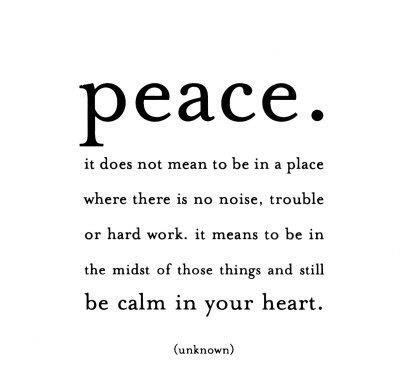
And I think of that oft quoted wisdom pictured above.


Oh, I think, maybe that is what God means. “Peace be within our walls” is not about some magical other world where nothing bad happens. It is not about all our present difficulties just disappearing at the snap of a finger. It is about us finding peace in our souls in the midst of it all. It is about us holding on to that peace, that strength, that resilience to get us through this time.


C.S. Lewis writes of this same kind of experience in A Grief Observed. He writes, “When I lay these questions [of why his wife died or why he is suffering] before God I get no answer. But a rather special sort of ‘No answer.’ It is not the locked door. It is more like a silent, certainly not uncompassionate, gaze. As though He shook His head not in refusal but waiving the question. Like, ‘Peace, child; you don’t understand.’”


In the midst of everything that is going in our world, we, like Lewis, are given a gift of peace that we may not fully understand, but here is the important thing for us to remember - it is God's peace. It is bigger than all of us, bigger than the things of the world, bigger than our fear.


It is not a peace of easy answers or simple solutions. It is the peace that comes from letting go. The peace that comes when we stop trying to figure everything out. It is the peace that comes when we choose trust over fear. When we chose love over indifference. When we chose possibility over certainty.


That is what God offers us. A gift of peace. It is not a gift that will always come easily to us. It is far too easy for us to be sucked into the 24 hour news cycle or find ourselves catastrophizing all the what ifs of tomorrow or next week or next year.


And so we need to keep up the practices that help us slow down. That center us. That remind us we are beloved of God and that we can indeed find peace amidst the chaos. We need time for prayer. Time to nourish our bodies. Time for rest. Time for laughter. Time for that which brings us joy. Time for that which restores our souls and connects us to the grace that is the “foundation of everything.”


The world may seem frantic and harried. There are times when it can seem like the fear is going to get the best of us. But it need not. We have a choice. We have an invitation, an opportunity to experience the beautiful gift of knowing the peace of God in our hearts. It is my prayer that in the midst of all the challenges and the struggles of these days we remember that the peace is not contingent on what happens out there. It can always be found in our hearts, when we are connected to God and each other. Amen.

Thursday, September 3, 2020

Joy through Generosity


Rev. Molly F. James, PhD

DFMS Noonday Prayer via Zoom

Commemoration of Phoebe, September 3, 2020

May God’s Word be spoken. May God’s Word be heard. May that point us to the living Word who is Jesus Christ our Lord. Amen. 

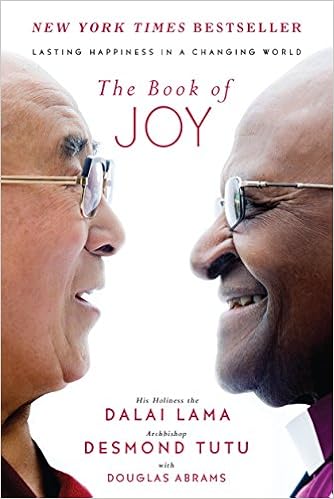
I have been re-reading the Book of Joy lately. It is a record of a week of conversation between Archbishop Desmond Tutu and His Holiness the Dalai Lama. Two remarkable spiritual leaders who are also the best of friends. A mere transcript of their conversation would be joy-filled, yet the book also includes background information, wonderful stories, and much of the latest scientific research on how and why we experience joy. 


If you are not familiar with this book, it is really good reading at any time, and especially during a pandemic. There is such wisdom and perspective in it. And some of it is just exuded through the remarkable lives of these two men. One of their convictions is that if we can find perspective, a wideness of vision, a connection and sense of solidarity in the midst of our own trials our own suffering will be decreased. These two men certainly help with that. They have known no shortage of trials in their own lives, Aparthied, Cancer, an Exile of more than 50 years. Yet in their 80s they sit and laugh together. They exude joy. Their mere presence brings joy, even before they say a word. They each have a smile that gives you a sense of sheer delight. 


Well, if they can do it, so can we. And that is indeed their point. Joy is not something that is reserved for a select few or someone who is particularly enlightened. Joy is meant for all of us. It is foundational to our very existence. And here is the key, joy is found in caring for others, in relationship, in connection. A fitting insight for this day on which we remember Phoebe the Deacon, a servant by nature and calling, one who Paul says was a benefactor to many, including himself. And whose commemoration gives us the Gospel from Luke where Jesus reminds the disciples that they, like he, are here to serve. The glory, the joy, the blessing, the fulfillment is not found in being the most powerful person in the room. It is not about garnering attention or accolades. It is found in caring acts of generosity that connect us to another human being. 


Like so much wisdom, this is something we know intrinsically. We know it whenever we have been blessed to receive the care of another. And we know how deeply meaningful it is to be able to be present in the midst of a crisis for someone we care about or how our soul is blessed by the smile of stanger responding to a simple act of kindness. 


We know this truth. And yet, we also need to be reminded of it. Because sometimes it can be hard to get out of our own heads and hearts; we can get stuck in the mire of stress or grief or sadness, longing for someone else to notice and fix it. But what the Archbishop and the Dalai Lama remind us of, what Jesus is teaching the disciples and us, is that we have the key, or at least the foundation, to our own thriving. We need only reach out and make a connection with others. 

The Dalai Lama finds solace in knowing that he and his people are not alone in experiencing suffering. He noted that when we can see our suffering as a point of connection to so many other human beings, and “when we look at the same event from a wider perspective, we will reduce the worrying and our own suffering.”


The Archbishop said, “that ultimately our greatest joy is when we seek to do good for others . . . We are wired to be caring for the other and generous to one another. We shrivel when we are not able to interact. I mean that is part of the reason why solitary confinement is such a horrendous punishment. We depend on the other in order for us to be fully who we are.”


And the remarkable thing is that there is a wonderful cascading effect in widening our perspective and seeking out more joy. As the book notes, “The more we turn toward others, the more joy we experience, and the more joy we experience, the more we can bring joy to others. The goal is not just to create joy for ourselves but, as the Archbishop poetically phrased it, “to be a reservoir of joy, an oasis of peace, a pool of serenity that can ripple out to all those around you.”


So, if we find ourselves turning inward, if we find ourselves struggling under the weight of the world, or the weight of the challenges in our own lives or those dear to us, there is a way out. We can take heart. We can have hope. Always. We are never alone in our suffering. God knows our suffering. The Archbishop and the Dalai Lama know what it is to suffer. Our experiences of suffering connect us deeply to each other. Suffering is a mark of our shared humanity. And our shared humanity, our connection to others, is also our salvation. It is the way out of the darkness of our own pain. We need only reach out. A kindness, an act of compassion, a moment of generosity will start us out on the road to our own healing. 


We need not grin and bear it. We need not muscle through. There is no glory there. The way forward is never a solitary path. It is the one where we are caring for and being cared for by the wise and generous souls whose presence brings us joy. May we daily know the blessing and gift of community. Amen.  


Thursday, August 20, 2020

A little more light


Rev. Molly F. James, PhD

DFMS Noonday Prayer

Bernard of Clairvaux, August 20, 2020


May God’s Word be spoken. May God’s Word be heard. May that point us to the living Word who is Jesus Christ our Lord. Amen. 

In my senior year of college, I took an art history course on Cathedrals and the Arts. We looked at lots of religious history and architecture, and how it changed over the centuries. The abbey churches of the Cistercians stood out as a turning point from the heavy, dark architecture of Romanesque churches to the lofty light filled cathedrals of the Middle Ages. There is a particularly notable feature about Cistercian windows. While they are often still “stained glass” they are usually far more translucent than we might expect. There is far more light than color.

Today we celebrate the feast day of St. Bernard of Clairveaux, a notable monk who significantly expanded the Cistercian order. There are lots of things we could focus on about Bernard and his order - their rule of life, their particular place on the landscape of monastic Christianity (they are a stricter version of the Benedictines), or the way Bernard’s sermons inspired the Crusaders. Hmm. Lots of deeply problematic and tragic history associated with the Crusades. We have enough tragedy in the world right now, I don’t think we need to think about more. And all of us have had to adopt a new “rule of life” in recent months, but unlike those monks, it is not one we have chosen for ourselves. And while no doubt we have found opportunities to connect with God because of it, our current rule is not one we want to become permanent. We long for the time when in person gatherings will be the norm again. 

So, given the state of the world at present, I think there is far more value in us reflecting on the simple beauty of Cistercian architecture and the invitation in today’s beautiful Gospel passage from John. There is no doubt each of us, our communities and the world could use more light and more joy in our lives. Jesus said to the disciples, “I have said these things to you so that my joy may be in you, and that your joy may be complete.” Full disclosure, John is my favorite Gospel. I love the poetic language, the imagery, the themes of light and darkness. And today’s passage is no exception. Jesus is inviting us to abide in God’s love, to know his joy, to find a joy that is complete. 

Here is the thing my friends. Joy and love can be words that we use lightly or easily. They are familiar. They adorn greeting cards, and we talk about enjoying a good meal or loving some new gadget we bought. I almost want to put an asterisk by those words today. I want a footnote that says, “But not in the usual sense.” The enjoyment of a thing or an experience can be wonderful and meaningful, but it is fleeting. The love and the joy of which Jesus speaks is not fleeting or temporal. It is not attached to any material thing or any particular experience. It is foundational to our very being. 

That’s the thing. The very important thing. It is there. Always. The question is whether or not we are letting it in. It is like the light and those cistercian windows. We have a choice. We can have tiny windows that let very little light inside. We can close ourselves off from the world and from each other. We can focus too much in our heads and get ourselves stuck on all the scary “What ifs.” We can lose ourselves in our tasks and our desire to be productive, allowing the cultivation of relationships to keep falling to the bottom of the list. 

Or we can put connection first. Jesus tells the disciples that they will abide in God’s love by following the commandments. At their heart, those are really about maintaining connection, about maintaining a right relationship with God and with each other. That is how we access that love and that joy of which Jesus speaks. We find it by staying connected to God and to all those whose presence points us to God. To those who embody God’s love. To those whose presence fills us with joy. 

I hope that as we remember Bernard today, as we hear our Scriptures, as we hear Jesus’ invitation, we will find more and more opportunities to let the light into our lives. It is there. Always, even on the days when we feel exhausted, overwhelmed, frustrated or just plain sad. Sometimes we might just need to take a walk outside and look around. Sometimes we might just need to call a friend. Or look at a favorite piece of art. Or read a good book or a favorite poem. Or do something silly with a child. Or cook a favorite food. Or listen to music that heals our soul. There are a myriad of ways to bring more joy and more love into our lives. And the most marvelous thing is that when we connect with that joy and that love, when we connect more deeply to God, we are connecting to that which endures. It can never be taken from us. Thanks be to God. Amen.