Showing posts with label resurrection. Show all posts

Tuesday, December 21, 2021

St. Thomas and the truths we know in our bones


Rev. Molly F. James,  PhD

DFMS Noonday Prayer

December 21, 2021

Psalm 126; Habakkuk 2:1-4; John 20:24-29

May God’s Word be spoken. May God’s Word be heard. May that point us to the living Word who is Jesus Christ our Lord. Amen. 

Ah, St. Thomas. He feels like an old friend. I would guess the same true  is for many clergy across the Church. Somehow in its wisdom, the Lectionary Committee decided that it would be appropriate for this story of “Doubting Thomas” to be the Gospel for the Sunday after Easter, every year. So those of us who spent years as an assistant or an associate or serving a small parish where there are no other clergy have a personal library of sermons on this text. They pair nicely with our sermons on the prologue of the Gospel of John which is the Gospel for every year for the Sunday after Christmas. 

While I have certainly had my moments of feeling frustrated by the repetition in our lectionary, those moments where I want to say, “Thomas? Again? Really? How am I supposed to come up with something new to say about him?” But of course if I pause and breathe and sit with it, and I feel differently. I think about my time in Exeter in the UK when I got to sit in the Cathedral for evensong day after day. And you know what is true about that service, the Magnifcat is sung. Pretty much daily. We only get Thomas twice a year: 1 Easter and his feast day. We get the Magnificat everyday. Why? Because the Magnificat is always a good idea. It is, indeed, a text, a message we need to have be central to our lives, to the daily practice of our faith. It is a message that speaks powerfully into whatever kind of day we are having. 


And I believe that the same is true of Thomas. His story speaks powerfully to us again and again. I think it especially speaks to us in this present time. How often, in recent days especially, have we felt like Thomas? Which story, which news headline, which study, which infographic or chart are we supposed to believe? How do we trust information when it seems to be changing on a daily or hourly basis? Do we need to change our plans for the holidays? What is the best way forward for us in our particular circumstances?


The uncertainty and anxiety are swirling all around us. Again. And we are exhausted. We are disheartened and frustrated. If we wanted to find reasons to doubt, reasons to fear, reasons to give into that same sense of foreboding and disillusionment that tempted Thomas. It would be easy to join him, “See, everything is terrible. They have killed my Lord. And to make matters worse someone stole his body, The world is out to get us. Nothing we hoped for is going to come true. All our dreams have been dashed.” Thomas requires actual proof, an actual incarnational experience to believe that his fears are not true. To believe that the tomb is empty because resurrection is real. Because God’s love is stronger than everything, even death. 


And we cannot blame him. The fundamental truths of our lives are not ones that we know just because we hear them or read them. Think about how we talk about them. We talk about knowing them “in our bones.” The most important truths of our lives are not merely intellectual. They are not just information. They are experiential. They are incarnational. 


That’s why we can still feel disquieted after we read the news headlines or the latest CDC briefing or the latest study on any of the myriad challenges our society is currently facing. Even if it is good news, it is just information. We need to be reminded of the fundamental truths of our lives and our faith, and that doesn’t happen through information. It happens through experience. 


So my friends, in these days, when you find yourselves joining Thomas in fear and doubt, reconnect to the experience of faith. Light a candle. Pray with an icon. Walk in the splendor of creation. Call that friend whose voice is a balm to your weary spirit. Hug your loved ones more often. Listen to the music that restores your soul. Attune your senses to all the signs of light and hope in our world. In gathered community. In more hours of daylight. In smiles and small acts of kindness. In the gift of quiet moments. In laughter. In meals shared, even on Zoom. The affirmations of God’s love. Of hope and possibility are all around us. We just need to be listening with our hearts  as well as our ears. AMEN.


Thursday, September 9, 2021

Caring for our well being


Rev. Molly F. James, PhD

DFMS Noonday Prayer via Zoom

September 9, 2021

Martyrs of Memphis

Psalm 116:1–8; 2 Corinthians 1:3-5; John 12:24-28


May God’s Word be spoken. May God’s Word be heard. May that point us to the living Word who is Jesus Christ our Lord. Amen. 


Today we remember Constance and her companions. We remember those who stayed in Memphis to care for those who were ill in the midst of a yellow fever epidemic in 1878. It is a week for remembering and honoring those who are called to places of tragedy and disaster. On Saturday we will honor the 20th Anniversary of 9/11 and all the lives lost that day. It seems particularly meaningful and important to honor all those first responders who walked into the building that day. All those who sought to help. All those who willingly put their lives at risk to help others. 


And of course there are thousands and thousands of first responders and health care workers who do this everyday. Thankfully the advent of PPE and advances in medical technology have meant that nurses and doctors can care for people with infectious disease and have a very low risk of infection. Don’t we wish we could send some PPE and an infectious disease handbook back in time to Constance and her companions. 


So in addition to the value of medical advances and PPE, what else might we learn from Constance and her companions? I think we can certainly be inspired by their sense of call and dedication. It is indeed noble and holy to see a need and respond, to give what we can to help others. There is that oft cited quote from Frederick Buechner about how our vocation is found where our passion meets the needs of the world. 


And yet, I do not believe we are called to mimic or follow in their footsteps of martyrdom, despite the Gospel’s talk of losing one’s life. While it is certainly true that there are things worth dying for, I do not believe we need to seek them out or continually put ourselves at that level of risk. Thankfully, I think most of us are not in daily situations with anywhere near the level of risk that Constance and her companions faced.


Of course, I do not think that makes us immune from the more metaphorical sort of martyrdom or the slow martyrdom that can come from pushing ourselves too hard for too long. There are real risks to our health and well being in not getting enough sleep, enough water and good food, enough exercise, in not taking care of our bodies and our souls. 


I think we all know the surge of adrenaline that gets us through a crisis. When it matters. When the need is urgent. When we are inspired, we can do more than we thought possible. That is a wonderful gift of evolution and biology. But that is not a reality or a pace that is sustainable for the long term. We need to pace ourselves. 


We have a long road ahead of us. We are not going to be able to put COVID behind us as quickly as we might have hoped. And the realities of systemic injustice in our society and our world are not going to go away overnight either. The world needs us. It needs our gifts and skills. It needs our passion. It needs our faith. It needs the truth of the Incarnation and the truth of the Resurrection. It needs to know that God is with us. It needs to know that Love always has the last word. 


But we are not going to serve anyone if we work to the point of exhaustion. Or if we become so overwhelmed by the headlines or the magnitude of what lies ahead of us. Side note, that if you feel overwhelmed, Nadia Bolz-Weber had a great blog post recently about why we feel overwhelmed: https://thecorners.substack.com/p/if-you-cant-take-in-anymore-theres


So my friends, let us take inspiration from our faith, from the reminder that our consolation is in Christ, it is not contingent on anything in this world. The truths of our faith stand no matter what the headlines say. We can carry those truths with us as we go about the work to which we are called. And as we go about our work in the days ahead may we honor Constance and her companions by seeking to care for our well being. May we strive to find time each day to do something that strengthens our faith, that reconnects us to God and to each other. And may doing so keep us grounded and filled with hope. AMEN. 


Monday, April 5, 2021

The both and of Easter


Rev. Molly F. James, PhD

DFMS Noonday Prayer via Zoom

Easter Monday, April 5, 2021

Psalm 16:8-11:Acts 2:14, 22b-32; Matthew 28:9-15 


May God’s Word be spoken. May God’s Word be heard. May that point us to the living Word who is Jesus Christ our Lord. Amen. 


Alleluia. Christ is risen. Happy Easter, friends. There is joy today. Joy in this season. Joy in all that we have to celebrate. Spring. Warmer weather. Sunshine. More and more people getting vaccinated. But I also think it is important to honor the fact that the resurrected Christ still had his wounds. The resurrection did not erase the crucifixion. It transformed it. Easter reminds us that death and suffering do not have the last word. But Easter does not ignore the realities of suffering or pretend they are not there. 


So even on this day, and even in the midst of all the causes for rejoicing, I want to give us collective permission to hold our grief alongside our joy. The grief is real. I bet that most of us did not get to have the Easter celebrations we long for. Hopefully there was meaningful worship and beautiful music. Hopefully there was chocolate and a delicious meal. But no doubt there are people we wanted to hug and could not. People with whom we wanted to sit and linger over the last bit of desert. Even in the midst of celebrations, even in the midst of hearts that are full of gratitude for the transformational truth that love is stronger than death, even in the midst of that we grieve. We grieve for what we are missing in our own immediate lives and neighborhoods. We grieve for our nation, for the realities of systemic racism and injustice that continue to plague us. We grieve for our world and the tragic loss of life from this pandemic and so many other preventable causes. The grief is personal, and it is global. 


We need to honor that grief. We need to acknowledge it. To feel it. Trust me, this WASP with lots of Puritan ancestry has tried the whole “keep  a  stiff upper lip, I can just keep going and pretend it’s not there” thing. It never turns out well. We need to grieve. And we are in good company. Think of the emotions and actions identified in the Gospels on Easter morning. Mary Magdalene weeping. The disciples running home. The women being afraid, as they are at the end of Mark, and in today’s Gospel in Matthew. There is not a lot of rejoicing in our Easter Gospels. What we see is the grief and the fear of the women and the disciples. 


Not a big surprise really, if you think about it. Nothing is going the way they thought it would. Their beloved leader and teacher is dead. Brutally executed as a criminal. They go to do one final gesture of love and care for him, and his body is gone. Talk about adding insult to injury. They are deprived of the ritual caring of the body that would have brought them some sense of solace and comfort. They start home and are completely surprised to meet Jesus on the way. Over and over again in the past few days their hopes have been dashed and their expectations have been overturned. No wonder they are afraid when they meet Jesus. But here’s the thing. The line just before our Gospel passage today is: “So they left the tomb quickly with fear and great joy, and ran to tell his disciples.” The women have just been told by the angel that Jesus is not there because he has been raised from the dead. They leave with fear AND great joy. There it is. The both and of Easter. It is okay. We get to hold it all. We get to feel both the great joy of the resurrection and the fear and grief of it. The realization that we do not know what the future holds, only that it will not and cannot look like the past. 


As we grieve what is lost, what has ended, what is missing, let’s hold on deeply to hope, to the conviction that while we might not be able to hold on to him, Jesus is present with us still. Let’s hold on to the hope, to the conviction that we are being invited into a future that is indeed different, and it just might be more wonderful, if we can trust in the power of God’s love. 


As C.S. Lewis ends his Chronicles of Narnia, “ . . . the things that began to happen after that were so great and beautiful that I cannot write them. And for us this is the end of all stories, and we can most truly say that they all lived happily ever after. But for them it was only the beginning of the real story. All their life in this world and all their adventures in Narnia had only  been the cover and the title page: now at last they were beginning Chapter One of the Great Story which no one on earth has read: which goes on forever: in which every chapter is better than the one before.”


Beauty and possibility await today and always, if our hearts are open. Amen. 


Thursday, August 27, 2020

When Miracles Don't Happen


Rev. Molly F. James, PhD

DFMS Noonday Prayer 

Thomas Gallaudet & Henry Syle, August 27, 2020


May God’s Word be spoken. May God’s Word be heard. May that point us to the living Word who is Jesus Christ our Lord. Amen. 

Our Diocesan Offices used to be located in a large house on Asylum Avenue in Hartford. I always thought this was an odd name for a street, as I assumed it referenced some long ago insane asylum in Hartford. The Asylum Hill neighborhood is a notable one, it contains the homes of Harriet Beecher Stowe and Mark Twain. But the Asylum in the name is not for an insane asylum, it is for the “The American Asylum at Hartford for the Education and Instruction of the Deaf & Dumb Persons” founded in the early 1800s. That school is now known as The American School for the Deaf and is located a few blocks from my house in West Hartford. It is actually quite fitting that our Diocesan Offices used to be on Asylum Ave, for the School for the Deaf and the history of the Episcopal Church in CT (and beyond) are very much linked. Today we remember and honor two priests, Thomas Gallaudet (whose father founded the School for the Deaf) and Henry Syle, who was the first deaf priest in The Episcopal Church. 

Our Church has a long history in ministering with the deaf community through education and various parish based ministries. I am finding that history and the examples of Thomas and Henry to be helpful in nuancing my reading of today’s Gospel. Of course, as one might expect today we get a story of Jesus healing a deaf man. I will admit to finding these healing stories challenging. They are wonderful and glorious, of course. But I cannot help but think of people I know who have been blind or deaf who would have loved to have such a miracle cure. They never did. 

How are we supposed to sit with that? How are we supposed to sit with any seemingly insurmountable problem for which we desperately desire a quick and simple solution? If only Jesus were here to instantly fix whatever is wrong. Don’t we wish that were true! 

This is where I think the lives of Thomas and Henry are so helpful. No doubt we (and probably they too) wish for miraculous solutions to the difficulties we face. And yet they do not always happen. So what did Thomas and Henry do? Did they sink into a deep depression and give up? No, they did what they could. And what they could was a lot. Their ministries educated and empowered people who were often at the margins of society, particularly in a time when there was no technology for hearing aids or cochlear implants. 

So I think sometimes we get to be Jesus. Sometimes we encounter challenges that we have exactly the skills to handle. I feel extraordinarily grateful that my children are still at the age where almost all their difficulties can be solved with a conversation and a lot of hugs. I know the days will come (no doubt sooner than I would like) when that will no longer work or even be a welcome solution. They will face difficulties that I cannot fix. 

On those days, and whenever any of us encounter a problem that is beyond our skill set. I hope we will remember Thomas and Henry. We are not always called to make a problem disappear. Sometimes we are called to educate and empower. Sometimes we are called to walk with people and support them in learning to live with a new reality. 

This can be a struggle for those of us who love to fix things and have neat and tidy solutions. It can feel like a failure for us to be unable to make everything better. Thomas and Henry invite us to reimagine our definition of success. They invite us to remember that healing is about wholeness and the fullness of life, not necessarily about erasing a disease or impediment. Thomas and Henry remind us that the fullness of life is possible, even in the face of personal challenges or conditions that society would label as “other.” It is possible because we are a people of faith, and because we are blessed with teachers, mentors, friends and companions on the way who will help us figure out our own version of thriving. 

God is always inviting us to be a people of hope, to find new life. May we always have the grace and courage to accept that invitation. Amen. 


Monday, August 3, 2020

Proclaiming love and resurrection in the midst of fear


Rev. Molly F. James, PhD

DFMS Noonday Prayer via Zoom

Joanna, Mary & Salome

August 3, 2020


May God’s Word be spoken. May God’s Word be heard. And may that point us to the Living Word who is Jesus Christ our Lord. Amen.


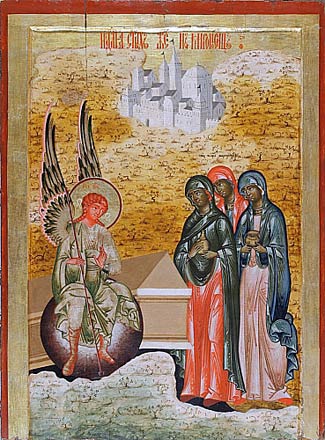
Today we get a little bit of Easter. I am sure it will come as no surprise that I love Easter. I love our Easter story. I even love today’s version of the Easter story. The complicated one where “afraid” is the last word of the text. 

I love it because it is stark, honest, and truthful. It doesn’t sugarcoat the situation or try to tie it up in a neat little package. It is real. Everything in our lives does not go swimmingly or brilliantly. Fear is real. Especially in this time. It is good to be reminded that if we are afraid, we are in good company. 

It is also important to note the context of their fear. No doubt they were afraid because of the significance of what they witnessed. And yet our pericope, our passage, for today is misleading if we think it means that fear has the last word. We know that the story does not end with the women being afraid. The story continues, because even though they are afraid they do go and share the news of Jesus’ resurrection. They live into my favorite definition of “courage” or “brave”: being afraid and doing it anyway. 

And we know the story does not end with their proclamation either. The story continues with us. I believe there is actually an important truth to discover about ourselves at the heart of this Easter story of the women at the tomb.  Now, in order to uncover that truth, it may help to know a bit of background about the culture of Jesus’ time. First off, the society of Jesus’ time was not democratic or egalitarian.  Hierarchy abounded. The Jews were subject to the authority of the Romans, and then Jewish women were subject to the authority of Jewish men. There were clear divisions and in Jewish society things were also divided by what was considered clean and holy or what was unclean and bad. Most of what related to the holy - worship, sacrifice, etc. was the purview of men.  That which was unclean - like birth and death were the purview of women.  This was not unique to Jewish culture. Much of the ancient world relegated the roles surrounding the beginning and the end of life to women.  It seemed logical.  Women gave birth after all, so why should they not also attend to the dead.  

So it is not notable that the women go to the tomb. What is notable is that WOMEN become the messengers of the Resurrection. Jesus doesn’t first appear to Peter or John or any of the other disciples, he appears to the women. He gives them the good news - and I mean the GOOD NEWS - to tell.  In fact, Mary Magdalene has often been referred to as the Apostle to the Apostles, for it is she who first proclaims the reality of the resurrection.  It is women who announce to the disciples the profound and beautiful truth that is at the heart of our faith: God’s love is stronger than death.  The authors of the Gospels should be given a lot of credit for being willing to tell this story, for it is quite a counter-cultural story.  It is a story that puts the figure of women (who would normally have been on the margins of society) into the center of the story and vests them with the powerful task of proclaiming the central message of the Christian faith.
This should come as no surprise of course, for the central theme of Jesus’ life and teachings was to share God’s love with everyone.  He ate with tax collectors and sinners. He healed lepers.  Again and again in his life and ministry did he reach out and bring in those on the margins of society.  Jesus was all about overturning the cultural norms.  He was all about proclaiming the profound truth that God’s love was meant for ALL people, EVERYWHERE - it wasn’t just for the men or for the wealthy or the powerful.

And so what does this mean for us? What does it mean for us that women are tasked with proclaiming the joyful news that Jesus has been raised from the dead?  It means that the truth of Easter and the reality of resurrection applies to all of us. God’s transforming love reaches out to all of us - no matter who we are, no matter where we are.  AND perhaps most importantly it means that ALL of us are called to proclaim the truth of God’s love with our words and our lives, just as the women did. 

No doubt we have stories of how God’s love has been a transformative force in our lives, and I hope that is true particularly in the midst of these challenging times.  I hope we have stories of ways God’s love has shown through the moments that have seemed very dark indeed or stories of how new life has been brought forth when we felt overwhelmed by the realities of death and suffering in the world. I hope we have stories of new opportunities that have surprised us when we had given up hope and all the doors seemed closed. I hope we have stories of the gift of love or new friendship when we were least expecting it. I hope we have stories of the sustaining support of a community of faith when we have faced hardship or struggle.  God’s love shines forth in our lives in countless ways. 

And today God calls us to follow the example of Joanna, Mary and Salome. God calls us to go forth and share that story, even when we may feel afraid. We are called to share the story that God’s love is more powerful than anything - even death.  And the stories of how that love has been transformative in our lives. The world is hungry for stories of love and joy. May we always have the courage to tell them.

AMEN.