Showing posts with label fear. Show all posts

Sunday, January 9, 2022

Reflections on Baptism, Judgment, and Hope


Rev. Molly F. James, PhD

Grace, Hartford, CT

Baptism of our Lord, January 9, 2022

Psalm 29; Isaiah 43:1-7; Acts 8:14-17; Luke 3:15-17, 21-22


May God’s Word be spoken. May God’s Word be heard, and may that point us to the Living Word who is Jesus Christ our Lord. Amen. 


“Do not fear, for I have redeemed you; I have called you by name, you are mine. When you pass through the waters, I will be with you; and through the rivers, they shall not overwhelm you; when you walk through fire you shall not be burned, and the flame shall not consume you.” These lines from our first reading from Isaiah are heartening and comforting in the midst of all the challenges we are facing - in our own lives, in our community, and in the world. Rising case numbers - practically everyone we know is ill, quarantining because of an exposure or recovering from COVID. There are real worries about whether essential services will continue to be available in the days ahead with so many people out sick. And then there are all the systemic issues that we were already facing as a world before this current surge - climate change, poverty, injustice, systemic racism . . . the list goes on. 


I would really like to just stop right there in that passage and hold on to those affirmations. The rivers will not overwhelm us. The flames will not consume us. I need those truths because there are moments, and there are days when it feels overwhelming. How can we possibly deal with one more thing, one more challenge, when we are already exhausted from the last two years?


I was doing okay, until I got to the Gospel. At first I am thinking, Feast Baptism of our Lord, that’s good. Always good to be reminded of our baptism. Always good to be reminded that just like Jesus, we are beloved of God. Goes well with our passage from Isaiah, an affirmation of God’s love and care for us. And then we get this line: “He will baptize you with the Holy Spirit and fire. His winnowing fork is in his hand, to clear his threshing floor and to gather the wheat into his granary; but the chaff he will burn with unquenchable fire.” And I want to start arguing with God with the author of Luke, with our Lectionary Committee, with whoever might listen.


Wait a minute! What is this bit about unquenchable fire and judgment in the midst of a happy story about Jesus baptism? Lines about fire and judgment make me nervous. As many of you know, I consider myself a recovering perfectionist. I take my mistakes, my errors, my sins very seriously - a bit too seriously most of the time. I don’t find passages like this helpful because they feed my perfectionist tendencies . . . after reading a passage like this my perfectionist self can say “See! It does matter how you behave! Watch out, you better be the wheat or else!” NOT HELPFUL! I am quite capable of giving myself a good guilt trip without adding on the fear of judgment and fire and punishment. 


I have often struggled with the theme of judgment and punishment in our Scriptures. Especially since the passages seem to show up right alongside times of joy and hope. Advent is quite a mix of joyful expectation and stories of judgment. It is tempting to just focus on the comforting parts, like those lines from Isiah, but the questions of judgment and punishment are right there in the Gospel, and I believe in facing my fears, so I can’t just let them slide by. 


Shortly after 9/11 I read a book of essays by Eugene Kennedy that helped me think about these passages of judgment differently. As you likely remember there was lots of talk of judgment in the days and weeks following 9/11 - who was to blame? who was now burning in hell for their sins? But Kennedy says that we have got it all wrong if we think that the wheat or the fruitful trees are one set of people and the chaff or the unfruitful trees are another. 


Kennedy writes of those who died on 9-11: “Their voices, taken from phone calls and emails and the recollections of friends, blend now into one message, one voice like a canyon echo coming back to us out of the ruins: ‘I love you,’ said in a thousand ways the true harvest of these good people’s lives. The good grain so overflowed that it covered over the patches of human stubble in their lives . . . They defined themselves and what life and faith are all about in the commitment to the relationships in their lives.”  When we look at all those people from all sorts of walks of life - a real cross section of humanity - who perished on that day, we should see the good - the overwhelming good in them, for as Kennedy goes on to say, that is what ultimately matters to God.  Kennedy writes, “What is good and bad in us grows together. On judgment day, God harvests only what is good in us, for that is what is eternal, and ignores the weeds that belong to time.” 


Reading these words lifts a weight from my shoulders. They comfort me because they remind me that God can see the big picture - and God pays much more attention to who we are and how we live a life of love - than to the times we messed up. They also give me a much more hopeful picture of Judgment Day. I have always struggled with the idea that God sends people to hell as a punishment. The image Kennedy offers fits more with the understanding of judgment that I have developed over the years, with thanks to theologians like Julian of Norwich, C.S. Lewis, and Rowan Williams. While there may be a moment of reckoning, a moment of cleansing when we come face to face with God at the end of our lives, we need not fear it. God is not some arbitrary judge. God is the God we know and love. God is loving and merciful - ALWAYS. Hell is not eternal damnation for our sins; hell is a choice we make. God is always reaching out to us, always offering mercy. Always willing to remind us that we are beloved - just as we are. We are beloved because we belong to God. And God has given us free will, so we have the option to accept that mercy or to reject it. If we choose to turn our back on God, then we will know hell, for hell is the only place where God is not. 


In the end, there actually is solace and hope for us in all our readings today. We can trust that the fire will not consume us, nor will the river overwhelm us. Rather they will merely take away that which does not serve us. That which does not serve God. That which is not eternal. We can indeed trust in the truths of our faith. The beautiful truth we celebrate this day is that we are beloved of God. God is with us. Always. May moments of struggle or challenge or tragedy never blind us to all the good there is in the world, and in each of us. May we always remember that the good, the light, the beauty will last, for our faith affirms again and again that nothing in this world is stronger than the love of God. 


AMEN.


Wednesday, May 12, 2021

Anxiety, Lilies, and staying connected


Rev. Molly F. James, PhD

DFMS Noonday Prayer via Zoom

May 12, 2021

Psalm 119:97-120; Baruch 3:24-37; Luke 12:22-31


May God’s Word be spoken. May God’s Word be heard. May that point us to the living Word who is Jesus Christ our Lord. Amen.


“And can any of you by worrying add a single hour to your span of life?” Oh my. I struggle with this passage and this line in particular. In fact, it is enough to inspire worrying about worrying. Jesus is right. Worrying doesn’t DO anything. But it is not as simple as just deciding not to worry. It does not seem to just be a switch I can turn off.

And there is so much anxiety just floating in the air right now. What are the most recent guidelines? What can I do now that I am vaccinated? What will life be like this summer? When can we travel to see family? What is it going to be like when we go back to the office? How do we keep from being on pins and needles, waiting for the other shoe to drop, waiting for things to shutdown again because of another surge? How do we know that we will be safe? How do we keep our loved ones safe?

Like all of you, I am no stranger to fear and anxiety. My most profound experience of them was in the months following the end of my chemotherapy treatments. Once I had finished them and was sent back to my “normal” life, I felt adrift. I did not know what normal was anymore. I was out of survival mode, and I finally had the emotional and mental space to begin to process the magnitude of what I had just been through. I began to really grapple with the reality of my own mortality. And I was scared. The recurring question was, “If cancer, this terrible thing I never thought could happen, did, what was there to protect me from all the other terrible things in the world?” I wanted someone to promise me that I would have a long, full life with no more tragedies in it.

Of course, no one could give me that promise. There are no guarantees about how long we have. Whether we are in the middle of a pandemic or not. It is just that the realities of the pandemic have brought all of us face to face with mortality more often than we might like.

So what do we do? It would be easy to get ourselves all stirred up or feel like we are in knots in the midst of everything. And no doubt there are times that we do. But we are not powerless. The anxiety does not have to be the dominant narrative in our lives.

We can remember the rest of the passage - remember the flowers and the birds. Remember all the ways God is present in the world and in our lives. God is with us. We are never alone. And we can seek out the resources that help us to be grounded and connected. While it can be tempting to withdraw and isolate ourselves when we feel anxious, connection is the key. Relationship is the key. We need each other. We need conversation. We need support and care. We need the people whose wisdom widens our perspective, who remind us of all the sources of hope that surround us. What are the lilies in our lives? Where is the beauty that takes our breath away? We need the people who help us laugh at ourselves, at life, at the world. We need the people whose presence brings a smile to our face. We need people whose very being helps us remember that no matter what happens today, we are a beloved child of God.

It is true that we cannot add hours to our life by worrying. We can add quality to our lives by taking care of ourselves. By seeking out all the resources that help us to care for our whole selves. By seeking out the relationships that restore our souls. By ensuring we have enough time with the people who make us laugh, keep us humble, and inspire us to be more faithful followers of Jesus. Amen.


Thursday, November 5, 2020

Beloved Sheep


Rev. Molly F. James, PhD

DFMS Noonday Prayer via Zoom

November 5, 2020

Phil. 3:3-8a; Psalm 105:1-7; Luke 15:1-10


May God’s Word be spoken. May God’s Word be heard. May that point us to the living Word who is Jesus Christ our Lord. Amen. 

“Which one of you, having a hundred sheep and losing one of them, does not leave the ninety-nine in the wilderness and go after the one that is lost until he finds it?”

Okay, so my first thought on this passage was, really, God? Don’t you understand we are weary. We are anxious. We do not yet know how things will go. There is much to be fearful about and most of us have not had anything that would qualify as a true vacation since 2019. Now you want us to do more? You want us to go off searching for someone. Isn’t 99 enough? I mean on most grading scales that is still at least an A if not an A+. 

But then I took a deep breath. I turned the text over in my mind. I thought, Oh. I think I might have it all backwards . . . What if in this story we are not the shepherd? What if we are the sheep? Things look very different then. 

If I am the one who is lost, then, yes, please God, seek me out. Please forget everything I said about 99 being good enough. 

I feel like I needed this passage this week. I needed to be reminded that I matter that much to God. I needed to be reminded that God is indeed our shepherd. I needed to be reminded that I belong to a flock. 

It would be so easy to get ourselves down any number of roads, possibly very scary roads of what ifs about what could happen tomorrow or next week or next month. We could tie ourselves up in knots and skyrocket our blood pressure. That does not serve us or our communities right now. 

What we need today is to breathe a little more deeply. We need to be present. We need to rest in the truth that we are beloved of God. Really. So beloved that God would seek us out. We are that beloved. 

We need to remember that we are in a flock. We do not travel this journey alone. We are safer together. We are happier together. We can do more because we have each other. 

And then we also need to remember that God is not partisan. We are all one flock. We are one people. One human race. Even those people with whom we might vehemently disagree on issues of policy or on who the best candidate is. They too are beloved of God. 

My friends, this election has put in stark relief the divisions that are present in our nation right now. There is much work ahead of us. We have not yet realized the Beloved Community. God’s Kingdom has not come. But it is coming. It is our daily prayer. And we - all of us together, the whole flock - are part of making that happen. 

I am convinced that it is possible for us to journey together into a different future. It is possible because we are beloved of God. It is possible because we do not journey alone. 

May we hold fast to the love God has for each one of us, and may that love flow through our words and actions into our communities and the world. Today and everyday. Amen.


Tuesday, September 29, 2020

Fear Not


Rev. Molly F. James, PhD

DFMS Noonday Prayer via Zoom

St. Michael and All Angels, September 29, 2020


May God’s Word be spoken. May God’s Word be heard. May that point us to the living Word who is Jesus Christ our Lord. Amen. 


Today is the feast of St. Michael and All Angels, and so of course we get readings about angels. I am particularly intrigued by our reading from Job. I must say this reading comes from my favorite part of Job.  I love God’s answer to Job out of the whirlwind.  Of course, it does leave one feeling rather small since God basically says “Who do YOU think you are? Where were WE when God created the world?” Ultimately I find it comforting because it is a passage that reminds us that we are NOT in charge - God is.  But I digress . . . today is about angels.  And although this is one of my favorite passages, I have not paid much attention to the angels in the passage.  Yet of course they should be there - the heavenly chorus on the sidelines shouting for joy and singing God’s praises. And that is certainly a part of the job description of being an angel - when we celebrate the Eucharist we join with Angels and Archangels in praising God - yet it is important for us to remember that being an angel is about more than singing God’s praises. They are not background figures.  In fact it is somewhat surprising that on this feast day we don’t get readings that have angels as the central characters - doing what they do best - being messengers for God. 

Our Gospel text is not as cheery as Job - we have a prophecy of the end times, and things are, literally, quite dark.  We are reminded that in fact angels can actually be quite scary figures. We often hear talk about angels as though they are so nice - always joyful like in our passage from Job - and Hollywood usually portrays them as the polar opposite of the devil. But we should remember that in Scripture passages where an angel is a messenger, the first words out of the angel’s mouth are usually “Fear not.”  The fact that they have to say that is probably a pretty good indication of how terrified the people’s faces were.

For those of you have experience being a hospital chaplain, you can probably commiserate with the angels.  So often in the hospital when someone realizes you are the chaplain, their faces get that look - the look of sheer terror.  They assume you are there to deliver bad news and that you most certainly know something they don’t.  When I worked as a chaplain, I found I often couldn’t get the words out fast enough to explain that no, I was not the angel of death, no, I did not know something they didn’t and really I was just there to be helpful and supportive.  

Actually I think all of us can relate to the angels in a way.  We are all, by virtue of our baptism, called to praise God and to share God’s message with the world. And I think in this particular time we need the message of the angels, and the message of our Scriptures today. Job reminds us that it is not all up to us. In fact, very little is up to us. We are not in charge. There is far more to the world than we can see or know. So in those moments when we feel overwhelmed trying to do all the things, then we can pause, we can think of Job. We can think of God’s admonition, “Where were you when I laid the foundations of the earth?” Not as a critique, not as more admonition of our shortcomings, but as a statement of fact meant to reassure us that this whole thing is a lot bigger than whatever we are fretting about in the current moment. If God can lay the foundations of the earth, then it is probably pretty likely that God could help us solve our current difficulty too, if only we would get off our high horse and stop thinking we had to do it all ourselves. 

We also need that message of the angels. We need to be reminded to “Fear not.” Oh my friends, it would be so easy to get caught in a cycle of fear right now. There are so many news headlines that would help us do that. But nothing will be served by filling our hearts and our heads with fear and anxiety. Like we are taught as hospital chaplains, it is our job to be the non anxious presence in the room. The fear and anxiety is all around us. No doubt we have people around us or with whom we are in regular contact who could use that message: “Fear not.” The world needs that message right now. 

So let us ground ourselves in that Truth. Let us do whatever it is that we need to do to hold on to that truth in the midst of the challenges we face. Whatever we need to be able to carry that truth and share it with others. Perhaps we need a picture of St. Michael or Gabriel or another favorite angel. Perhaps we need to keep God’s question to Job on a sticky note near our computer to be reminded that we are not responsible for the entirety of creation. Or perhaps today is the day we need to hear the message anew, so we just need to call our own angels, those people in our lives who incarnate God’s love for us and whose voices can always speak the truth so we hear it. We call them. so they can say to us, “Fear not.”

Whatever practices or tools we might need, let us hold fast to the assurance of the angels. God is here. God is with us. We need not be afraid. Not today. Not ever. 

AMEN. 


Monday, August 3, 2020

Proclaiming love and resurrection in the midst of fear


Rev. Molly F. James, PhD

DFMS Noonday Prayer via Zoom

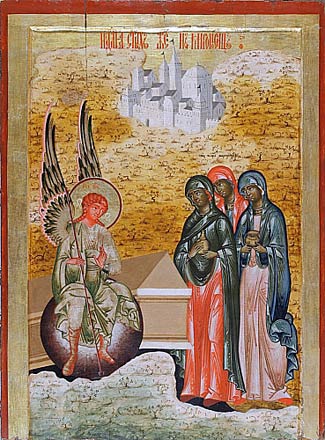
Joanna, Mary & Salome

August 3, 2020


May God’s Word be spoken. May God’s Word be heard. And may that point us to the Living Word who is Jesus Christ our Lord. Amen.


Today we get a little bit of Easter. I am sure it will come as no surprise that I love Easter. I love our Easter story. I even love today’s version of the Easter story. The complicated one where “afraid” is the last word of the text. 

I love it because it is stark, honest, and truthful. It doesn’t sugarcoat the situation or try to tie it up in a neat little package. It is real. Everything in our lives does not go swimmingly or brilliantly. Fear is real. Especially in this time. It is good to be reminded that if we are afraid, we are in good company. 

It is also important to note the context of their fear. No doubt they were afraid because of the significance of what they witnessed. And yet our pericope, our passage, for today is misleading if we think it means that fear has the last word. We know that the story does not end with the women being afraid. The story continues, because even though they are afraid they do go and share the news of Jesus’ resurrection. They live into my favorite definition of “courage” or “brave”: being afraid and doing it anyway. 

And we know the story does not end with their proclamation either. The story continues with us. I believe there is actually an important truth to discover about ourselves at the heart of this Easter story of the women at the tomb.  Now, in order to uncover that truth, it may help to know a bit of background about the culture of Jesus’ time. First off, the society of Jesus’ time was not democratic or egalitarian.  Hierarchy abounded. The Jews were subject to the authority of the Romans, and then Jewish women were subject to the authority of Jewish men. There were clear divisions and in Jewish society things were also divided by what was considered clean and holy or what was unclean and bad. Most of what related to the holy - worship, sacrifice, etc. was the purview of men.  That which was unclean - like birth and death were the purview of women.  This was not unique to Jewish culture. Much of the ancient world relegated the roles surrounding the beginning and the end of life to women.  It seemed logical.  Women gave birth after all, so why should they not also attend to the dead.  

So it is not notable that the women go to the tomb. What is notable is that WOMEN become the messengers of the Resurrection. Jesus doesn’t first appear to Peter or John or any of the other disciples, he appears to the women. He gives them the good news - and I mean the GOOD NEWS - to tell.  In fact, Mary Magdalene has often been referred to as the Apostle to the Apostles, for it is she who first proclaims the reality of the resurrection.  It is women who announce to the disciples the profound and beautiful truth that is at the heart of our faith: God’s love is stronger than death.  The authors of the Gospels should be given a lot of credit for being willing to tell this story, for it is quite a counter-cultural story.  It is a story that puts the figure of women (who would normally have been on the margins of society) into the center of the story and vests them with the powerful task of proclaiming the central message of the Christian faith.
This should come as no surprise of course, for the central theme of Jesus’ life and teachings was to share God’s love with everyone.  He ate with tax collectors and sinners. He healed lepers.  Again and again in his life and ministry did he reach out and bring in those on the margins of society.  Jesus was all about overturning the cultural norms.  He was all about proclaiming the profound truth that God’s love was meant for ALL people, EVERYWHERE - it wasn’t just for the men or for the wealthy or the powerful.

And so what does this mean for us? What does it mean for us that women are tasked with proclaiming the joyful news that Jesus has been raised from the dead?  It means that the truth of Easter and the reality of resurrection applies to all of us. God’s transforming love reaches out to all of us - no matter who we are, no matter where we are.  AND perhaps most importantly it means that ALL of us are called to proclaim the truth of God’s love with our words and our lives, just as the women did. 

No doubt we have stories of how God’s love has been a transformative force in our lives, and I hope that is true particularly in the midst of these challenging times.  I hope we have stories of ways God’s love has shown through the moments that have seemed very dark indeed or stories of how new life has been brought forth when we felt overwhelmed by the realities of death and suffering in the world. I hope we have stories of new opportunities that have surprised us when we had given up hope and all the doors seemed closed. I hope we have stories of the gift of love or new friendship when we were least expecting it. I hope we have stories of the sustaining support of a community of faith when we have faced hardship or struggle.  God’s love shines forth in our lives in countless ways. 

And today God calls us to follow the example of Joanna, Mary and Salome. God calls us to go forth and share that story, even when we may feel afraid. We are called to share the story that God’s love is more powerful than anything - even death.  And the stories of how that love has been transformative in our lives. The world is hungry for stories of love and joy. May we always have the courage to tell them.

AMEN. 


Tuesday, May 26, 2020

Do not be afraid

Embed from Getty Images

Rev. Molly F. James, PhD
DFMS Noonday Prayer via Zoom
Augustine of Canterbury, May 26, 2020

May God’s Word be spoken. May God’s Word be heard. May that point us to the living Word who is Jesus Christ our Lord. Amen.

“Then Jesus said to Simon, ‘Do not be afraid; from now on you will be catching people.’” Do not be afraid, from now on . . . Well, my friends, those might be words to live by in these days. I imagine this is a familiar passage to many of us - the story of where Simon is called away from his boat to follow Jesus, to become a “fisher of men.” And even though it is familiar, I believe it has something new to say to us in this time and this place. Think about Simon. He knew all about fishing. It was his profession, his life, his livelihood. He probably never ventured far. His life centered around his home and his boat. Then comes Jesus. This new teacher. This charismatic leader. There is something powerful, something so inspiring in who Jesus is and the message he shares, that without hesitation Simon leaves behind everything that is familiar and goes to follow him into an unknown and uncertain future.

Ah, an invitation to follow Jesus into an unknown and uncertain future. Yes, we have that too don’t we? It is becoming clearer and clearer as the weeks go by that we will not be “going back” to life as it was before. We cannot return to what is known and familiar. The way things have been. No, we are being invited into an uncertain future. The change and the “not knowing” can feel overwhelming. When and how will we travel again? What will our work lives look like in the coming months? What will our home lives look like? When will we get to have sustained opportunities to visit with family and friends? How long will it be before we can gather in large groups again?
It is easy to get our brains going on all the fear and uncertainty. There are so many rabbit holes of wondering that we can go down. But all that worrying does not serve us. There are indeed too many unknowns. We cannot figure it all out yet. For now, we have to be like Simon. We have to trust.

There is so much that is new and different in this time, I think it can make us forget that actually we know how to do this “stepping out into an uncertain future” thing. We have done it time and time again in our lives. From that first day at a new school to that first day at a new job. From moving to a new town or embarking on a new relationship. We have done change over and over again. We have moved into a future where we did not know what was going to happen. When it comes right down to it, of course, we actually do this everyday. There are, actually, no guarantees ever that tomorrow will look like yesterday. No guarantees of how long we have or how our lives will go.

Blessedly, we can often settle into predictable routines that allow us to put our trust in the regularity of our schedule, our tasks, the people we see, and the places we go. So, establishing a routine can be one of things that can help us find comfort and confidence in the midst of uncertainty. We may not have control over the big questions, but we can set our schedule and choose what we have for lunch. The little things really do help.

Creating a routine and finding the areas in which we do have freedom and control is one way to help us move forward in the midst of anxiety and uncertainty. I would guess we have many other things that have also helped us over the years. Don’t sell yourself short. We do actually know how to do this change thing. Those tried and true habits that have served us well can come to our aid again. Grounding ourselves in prayer and worship. Keeping up the spiritual practices that keep us connected to God and keep our perspective wide. Having a friend to call with whom we can process all that we are learning in our new adventure and who also can help us remember who we are when it seems like the uncertainty might expand to include our very self. Whatever has helped us before can be useful in this time too.

And it will help us also to remember Jesus’ words to Simon, “Do not be afraid.” Just like Simon we are not heading off on some solo adventure, we are following Jesus. We are not in charge of it all. Thank God! And so we can trust in God, trust in Jesus, trust in the leading of the Holy Spirit.

We do in fact have what we need to move forward. What a blessing indeed! Amen.

Monday, May 4, 2020

Monica: God is never far


Rev. Molly F. James, PhD
DFMS Noonday Prayer
Monica, May 4, 2020

May God’s Word be spoken. May God’s Word be heard. May that point us to the living Word, who is Jesus Christ our Lord. Amen.
Today we remember Monica, the mother of St. Augustine. Her life and faith are worth remembering in their own right, not just because of who her son became. Interestingly, she actually has a lot of hope to offer us. There is hope in her story because it is a very human one. She struggled as a mother. She wanted her son to become a Christian early in life. If you know much about Augustine, he had quite an interesting and complicated life and did not come to faith until much later in life.

Side note here, when I spent a summer working with a chaplain in a juvenile detention center, I had a group read some excerpts of Augustine’s Confessions. He has a great story of stealing bags and bags of pears from an orchard with a group of friends in his teenage years. The pears aren’t even good. He just does it for the joy of stealing. And yet he went on to become a Saint in the Church. Made for some interesting conversation.

Back to Monica. Her parenting did not go the way she wanted. She wanted her son to change his life, but it did not happen in the time frame she desired. And yet it happened. She also had hoped to be buried in Africa, but she did in Italy and managed to make her peace with that. In fact, she told Augustine, “You will bury your mother here. All I ask of you is that, wherever you may be, you should remember me at the altar of the Lord. Do not fret because I am buried far from our home in Africa. Nothing is far from God . . . ‘

Monica’s faithfulness is an example to all of us. A willingness to trust in God, to trust that God is never far from us. A willingness to trust that hope and faith are stronger than fear.

Our readings for today can be somewhat of a challenge on this front. Hannah prayers for a child, and Samuel is born. In Luke’s Gospel today, a mother is miraculously given back her son whom she thought had died. These lessons taken on their own can be problematic. No doubt we all have things we have hoped for and wished for, sometimes so deeply it hurts. And yet they do not happen as we wish they would.

If we had only our readings for today that could leave us feeling discouraged and desolate. For our lives so often do not match up to what we wish for. So it is good that we also have the example of Monica’s life and the rest of Scripture to remind us that we are not alone in things not going the way we might hope or desire.

From Rachel weeping for her children to Joseph being sold by his brothers to the Israelites slavery in Egypt to Job’s suffering and countless psalms to the Prophets to Jesus’ own family and life experiences, we know that we are not alone in experiences not going according to our plans or our hopes.

I would guess that none of us planned or hoped to be quarantined for all these weeks. None of us wished for a pandemic. None of us wished to lose dear friends and colleagues in the midst of it. None of us wished to have our lives turned upside down or so much fear and anxiety swirling. And so it is important for us to remember that we are not alone in our struggles. It is important to remember Monica’s wisdom that nothing is far from God. Indeed, God is with us in the midst of all of this. God is very near. We need not fear the future. We do not journey alone. God is always with us.

No matter how uncertain things may seem, no matter how often things do not go according to plan, we can find comfort in knowing that we are not alone. And we can trust that God is always at work. God’s redeeming love is bringing forth hope and new life even in the midst of whatever challenges we face. That is the Easter story. That is the heart of our faith. Thanks be to God. Amen.

Monday, April 13, 2020

Mary Magdalene and Easter Monday

Embed from Getty Images

Rev. Molly F. James, PhD
DFMS Noonday Prayer via Zoom
Easter Monday, April 13, 2020

May God’s Word be spoken. May God’s Word be heard. May that point us to the living Word who is Jesus Christ our Lord. Amen.

You know that feeling when you wake up after something significant has happened in your life. There is that first moment when you wake up, and it is as though nothing is different. Your mind is slowly orienting itself to the day. Then realization comes. You remember. Sometimes that means you are filled with joy. You have a new job. Today is the first day of vacation. You are going on a trip. Today is a milestone for you or someone you love. A day of celebration. Other times you are filled with sadness. There was a brief moment where everything was okay, but then the awareness came. Now what you feel are waves of sadness or anger or frustration. You are feeling the weight of the loss all over again.

I was thinking today about that moment when we first wake up. I was thinking about Mary Magdalene and wondering what it was like for her to wake up on this Easter Monday morning. I am sure it was better than waking up on Easter morning. On Easter she woke up in the dark, if she even slept at all. She gathered her things and went to the tomb to anoint Jesus’ body. She went to do that thing that women have done for centuries. She went to care for the dead. She went to do one final act of loving service for her Lord and teacher. Of course, we know how the story goes. Many of us likely heard it yesterday. Jesus isn’t there and although it takes a little while for Mary to understand what had happened, she becomes the first person to see the resurrected Jesus. She is the first to witness and know the truth of the resurrection. Easter Day did not go at all how she was expecting. Everything changed, for the better.

So what must it have been like for her to wake up on this Easter Monday? Did she have that moment of realization? Did she wake up first remembering the horrors of Friday? Did she wake up filled with grief and sadness? How long did it take for her to remember what happened yesterday? How long before she could be comforted by the conviction that everything had changed, that Jesus had risen from the dead? No doubt she got to a place of joy and hope, replaying that moment of recognition in the Garden outside the tomb. Jesus was alive again!

And yet, along with that sheer joy and sense of celebration, there is a tinge of heartache and sadness. Mary knows that the resurrection did not erase the events of Good Friday. Jesus still has his wounds. The Roman authorities are still angry and will likely be seeking out Jesus’ followers to persecute them. Our Gospel reading reminds us how scared the authorities were of what would happen if people knew that Jesus had been raised from the dead.

Mary knows that everything is different. She knows that God has the power to do transformational things for her and for the world. She knows that death is not the end. She knows that hope and love are stronger than death. And yet, she does not know how the story will end. Jesus has told her that she cannot hang on to him. He will not be staying with her. There is joy, so much joy, and there is also sadness and perhaps even a little fear for the future.

Well, that resonates for me today. I am finding a lot of comfort in the story of Mary Magdalene on this Easter Monday. We are in a similar state. Easter has happened, although the day probably did not go at all how we might have thought it would or wanted it to go. We have received wonderful news. We have had the powerful, inspiring, comforting truth of the primacy of God’s love, of the sheer power of God’s love in the face of humanity’s worst. We have had that truth affirmed for us. And now it is a new day and a new week. We want to hold onto that truth with the same fierceness with which Mary wanted to grab Jesus’ feet and keep him with her.

But neither Mary’s life nor our lives are stagnant. We cannot just stop everything and stay there. There is work to do. There is living to do. Even though we do not yet know what the future holds. We do not know when we will see the end of rising infection rates and death tolls, although there seem to be glimmers that all our collective efforts are having an impact. We do not know when we will see an end to our quarantines. We do not know when we will go back to work in our offices, to worship in our churches, to gather with friends and family, to simply be able to do an errand because we wanted to and without any personal protective equipment.

And so here we are on Easter Monday, in the very good company of Mary Magdalene and the other women, feeling grounded and filled with hope that we know the reality of resurrection. We know it is true. We know it is real. And we are waiting, with a little (or maybe even a lot) of anxiety for the future to unfold. We are waiting to see how the story will go.

I wish I knew already, as I am sure Mary did. I do know two important truths, which I hope comforted Mary as they can comfort us. First, is that God is at work. We may not know what tomorrow will bring, but we do know that God is here. God is with us. God’s life giving, loving Spirit is present with us through whatever challenges come. Second, we are not alone. Mary did not go to the tomb alone. We do not travel this journey alone. We have each other. And what a difference it makes to know that we do not travel alone. We are blessed with companions on the way who will comfort and inspire us. Who will share our burdens and encourage us.

It is Easter Monday. It is a joyful day. It is a complicated day. It is a day of waiting. And yet we can find solace in the truths of our faith and draw strength from the reality that we are not alone. AMEN.

Monday, March 23, 2020

Salt, Light, and Gregory the Illuminator

Embed from Getty Images

Rev. Molly F. James, PhD
DFMS Noonday Prayer via Zoom 
Gregory the Illuminator, March 23, 2020

May God’s Word be spoken. May God’s Word be heard. And may that point us to the living Word, who is Jesus Christ our Lord. Amen.

“You are the salt of the earth.” “You are the light of the world.” “Let your light shine before others.” Today I am grateful for these familiar lines of Scripture. We need salt and light right now. We need that which gives hope, depth, and richness to life. The fear and uncertainty are swirling. Many of us are in states that are now in a virtual or actual states of lockdown. We can make quick trips out for essential items, but we have basically been asked to stay home. In a matter of a few short days our daily routines, how we do our jobs, how our children go to school, how we get our basic necessities, and possibly even how we understand the world, has changed. Things look so very different than they did. 

And we may know many others for whom the impact of this pandemic is far more immediate and severe - those who are ill, those who are healthcare workers or first responders, those whose dire financial circumstances are represented in the ever increasing numbers at feeding programs and in unemployment claims. So much has changed, is changed, and will change. It is indeed a blessing to be gathering daily with you all for a time of prayer.

I always find the practice of communal worship to be grounding. It reorients me and helps me keep my priorities straight. I find myself in need of that all the more in these days. I need to be reminded to take a deep breath, to let go of my desire for certainty or definitive answers. I need to be reminded that God is here. God is with us. We will indeed get through this, together.

Indeed, the Gospel for today is so apropos. We are the light of the world. The fear and the uncertainty can feel overwhelming. And we cannot let them paralyze us from acting. Nor can we let the fear trick us into thinking we are powerless. Don’t get me wrong, there are moments when this whole thing is like a tsunami and I am just standing on the beach waiting to be caught up in its tumult. But then I pause. I breathe. I pray. I check in with a friend, and I am pulled back to the truths of our faith.

We are salt. We are light. We have power and agency. We can do good works in the midst of all of this. We can keep connecting with each other. In whatever ways are appropriate given our various contexts, we can do what the Church has always done in times like these - we can care for those who are most vulnerable. We can ensure that the light of God shines in the darkness. We can ensure that the flame of hope is never extinguished in our own hearts and homes and in our wider communities as well.

It is important for us to remember that we are not alone in this effort to embody light and hope for the world. We can do it together. We can bolster each other in our faith and in our work. And we can remember that we follow in a long line of saints who have struggled through challenging times, who faced difficulties and yet did not waiver in their faith. Gregory the Illuminator, who we remember today was imprisoned in a well for 13 years because he refused to participate in pagan rituals. Thirteen years! That is a long time. A few weeks or even months largely confined to our homes is not looking so bad after all. In Gregory’s shoes, it could seem easy to give up, and yet he did not. He persevered and was able to share the light of his faith (he is Gregory the Illuminator after all) with people throughout Armenia.

So, my friends, while the challenges before us are real, and they will test our faith and our endurance, they need not leave us disheartened or disillusioned. There is always hope. In the midst of everything, countless acts of kindness and generosity are being done everyday. We are salt. We are light. We are finding more and more ways to stay connected to each other, despite our physical separation. Through our faith, through our actions, through all the good that is being done around the world, there is light in the darkness. And together we can make that light even brighter. AMEN.

Thursday, March 19, 2020

St. Joseph


Rev. Molly F. James, PhD
DFMS Noonday Prayer on Zoom
March 19, 2020
Feast of St. Joseph

May God’s Word be spoken. May God’s Word be heard. May that point us to the living Word, who is Jesus Christ our Lord. Amen.
In the hallway of the retreat center where I go regularly for Spiritual Direction, there is a small painting of Joseph holding the baby Jesus while Mary sleeps. It is a simple painting that looks like it was probably done in the 1970s or 80s - reminds me of illustrations in the Little Golden Books of my childhood. The painting reflects its era, and the baby Jesus is far too white. Despite its flaws, I have consistently found myself drawn to this picture. I think part of this is because it is an uncommon image. There are so many different images of Mary holding the baby Jesus. In classic art, in icons, and in umpteen Christmas cards. We so rarely see images of Joseph as an engaged father. We are rarely invited to think about him as a caregiver for Jesus. That image of Joseph holding Jesus while Mary sleeps invites us to rethink our very familiar version of the story that we carry around in our own minds and hearts.

I don’t know about you all, but I am finding comfort in that right now. “Being invited to rethink things.” Well that just about sums up the week doesn’t it? We are being invited to rethink everything. From our how we do our work, to how we interact with our community to how we do our grocery shopping and how we wash our hands. Add on to that a high level of anxiety in our hearts, our homes, our communities and the world. Oof. What a lot to be dealing with at once. It can feel like quite a test of our resilience, of our faith, of our ability to hold on to hope and trust in God in the midst of darkness. Hmm. That also sounds like the story of Joseph.

One of the things I have always loved about the story of Joseph that we usually get in Advent is that it is such a classic human story. Joseph is going along with a nice plan for his life. He and Mary are going to build a nice life together. They will do the things the average family in Nazareth did in the 1st century. But then the Holy Spirit intervenes, as she so often does. Mary is pregnant and everything seems to be going to turn upside down. At first Joseph is going to dismiss her quietly, quite understandable . . . things are not going according to his plan. But blessedly the Holy Spirit intervenes again, and helps him to understand the fullness of what is happening. The plan is not going to be exactly what he thought it was . . . and yet on many levels it is going to be more wondrous and amazing than he could have possibly dreamed. Joseph is left with a choice. Does he walk away because things are not going how he imagined they would or does he stay in the complicated, messy situation that also has amazing possibilities? Does he say yes to God and choose to step into a now uncertain future? Does he choose faith and trust or certainty and isolation?

Now, for most of us our current dilemmas are not exactly the same. We are not being asked to welcome the Son of God as the newest member of our family. And yet at the more basic emotional and spiritual level, the questions are the same. What does it look like for us to move forward in faith even when the future feels scary and uncertain? How do we trust in God, trust in goodness, trust in life and possibility, when it seems like everywhere around us doors that we thought were open are suddenly closing? There is a very real temptation to give into the fear and the worry. Fear is sneaky that way. Playing out the worst case scenarios and running through all kinds of possibilities in our heads can have the illusion of being productive and prepared. Now I am not saying we should not be prepared. But stocking up on groceries and medicine for an extended time at home or making concrete plans with our family is a different thing from lying awake at 2 in the morning playing out disaster movie scenarios in our brain.

So what exactly does it look like to choose hope? I will tell you what it looks like for me, and I hope some of that will resonate. It looks like being present in the moment, and noticing the little things. A daffodil blooming. The smiles and laughter of my children. The longer days. The fact that these days I get to eat three meals a day with my children. The clarity of priorities a crisis brings - in the midst of all of this, it is easy to be sure of what really matters. Choosing hope also looks like being gentle with ourselves. It looks like being compassionate with ourselves, our loved ones, our colleagues and friends. Life is hard right now. Adding anger and frustration to the mix won’t be helpful. And that leads me to the other tool of building hope. Relationships where trust is paramount and vulnerability is always possible. Holding on to hope is rarely (if ever) a solo endeavor. It is possible because we do not walk alone. We have companions on the way with whom it is okay to be fully ourselves, to name our fears and our frustrations, to process our challenges. Relationships that support us, inspire us, and help us to be our best selves.

So I hope that today, and every day in these challenging times, you will be given the grace, the courage, and the companions you need to choose hope. To follow in Joseph footsteps, stepping out into an uncertain future, trusting that the possibilities that God has in store for us are always more than we could ask or imagine. Amen.

Tuesday, March 17, 2020

Saint Patrick

Embed from Getty Images


Rev. Molly F. James, PhD
Noonday Prayer for DFMS via Zoom
Feast of St. Patrick, March 17, 2020

May God’s Word be spoken. May God’s Word be heard. May that lead us to the living Word who is Jesus Christ our Lord. Amen.
Good afternoon friends. I am grateful for this time of prayer to be together, even in the midst of the challenges and uncertainties we are facing. I think most of us have some experience of working at home on occasion, and to be looking at it as our reality for many weeks is a whole other thing entirely. Especially for those of us with kids at home! I hope we will all be gentle with ourselves and acknowledge the spiritual toll this can take on us, even if we are able to stay physically healthy in the midst of this global pandemic.

I am also grateful for the gift of our lectionary. As so often happens, we can find the solace we need for this time in our Scriptures and in the life of St. Patrick. In more secular culture, this day has become about all things Irish and all things green (beer, milkshakes, cookies, etc), but there are far more meaningful elements to the life of Patrick. I am finding solace in two things in particular. First, in Patrick’s own story. Remember he was taken as a slave to Ireland, then he escaped and returned to England. Did he just stay in England and go about his life? No, he returned to Ireland, determined to continue preaching the Gospel and sharing God’s love with the world. Patrick could have taken the easy way out. He could have decided his captivity was enough of a challenge, enough of a good work for this lifetime. But he did not. He chose to do more. He chose to step into new challenges and worked to ensure that more and more people knew the life transforming story of Jesus Christ. A good model for us on the days when we might feel exhausted or overwhelmed. As faithful followers of Jesus, we are not called to give up when the going gets tough. We are called to persist, as Patrick did. AND, and this is a really important AND. We can persist because we are not doing it alone. God is with us, and we are a community.

If you have ever been to a priest’s ordination, you have likely heard the hymn “St. Patrick’s Breastplate” (listen here), its text is a poem that is attributed to Patrick, and it too contains some important solace for these times. Like our Psalm for today, it reminds us of that all important truth that God is with us and God is so much bigger than we ask or imagine. My favorite stanza is:

I bind unto myself today
the power of God to hold and lead,
his eye to watch, his might to stay,
his ear to hearken to my need;
the wisdom of my God to teach,
his hand to guide, his shield to ward;
the word of God to give me speech,
his heavenly host to be my guard.


Indeed God is our guide, our teacher, and our guard. The fear and uncertainty are swirling around us, and they likely will for some time to come. Today we are reminded that the way forward is to keep our focus on God, to remember that we never have to walk alone. We walk in the footsteps of saints like Patrick. So, so many of our fore-bearers in the faith have dealt with challenges, not unlike those we are currently facing, and they have found a way through, triumphed even. Like them we can keep our trust in God and our connections to each other (even if we are using different methods to do that). We can keep reading the Scriptures and saying our prayers, reminding ourselves to keep our perspective wide. This too shall pass. And we are in God’s hands, always, no matter what happens. Thanks be to God. Amen.

Thursday, March 12, 2020

Gregory the Great

Embed from Getty Images

Rev. Molly F. James, PhD
Chapel of our Lord, Episcopal Church Center 


May God’s Word be spoken. May God’s Word be heard. May that point us to the living Word who is Jesus Christ our Lord. Amen.


I smiled when I got the rota for March. I get to preach on the feast day of Gregory the Great. A gift indeed. He was one of the thinkers I wrote about in my doctoral dissertation. I spent a number of years living with his life story and many of his writings. He is like an old friend, and so it is an honor to get to share some of my favorite insights and challenges of this great saint of our tradition with you today. And typical Holy Spirit, I also believe there is much of value to be found in Gregory’s life and writings for this particular time and place.

Gregory came from a prominent Roman family, and he eschewed that privileged life for a quiet monastic one. In that Gregory is an exemplar of faith, he knew that living a life of deep faith and devotion was more important the material wealth or political power. Although Gregory took his desire to live out his faith a bit far. He loved ascetical practices and followed them so strongly and faithfully that he ended up making himself ill for most of his life. In this, Gregory is an example of what not to do. It is possible to have too much of a good thing. Practicing piety is important. Being deeply faithful is important, but it does not need to be taken to the extreme of self-harm. In fact, that ends up being counter productive. Gregory accomplished much in his life, but he could have done even more if he had not been ill so much of the time.

Speaking of what not to do, Gregory offers us another model on that front in his commentary on the book of Job. Gregory spends a good deal of time focused on the behavior of Job’s friends. You know the ones? The ones who come to see Job when he is suffering and who sit around talking about how Job must have done something to deserve this. It is like they are trying to solve a logic or a thought puzzle. They are doing a clinical analysis of how this situation came to be, and they seem to have forgotten about the emotions and real suffering of their friend who is right in front of them. Job’s friends are exactly how we should NOT behave in the midst of suffering.

In the midst of the fears and realities of a global pandemic, this is a good reminder for us. There are plenty of narratives going around that play on fear or stereotypes or prejudice. Viruses do not obey the lines of division we human beings like to draw for ourselves. Diseases and the broader experience of suffering are universal experiences. While the realities of classism, sexism, racism, and all the other isms can mean that we experience suffering to varying degrees, no one is immune from it.

So, if we find ourselves thinking like Job’s friends or we find ourselves starting down the mental road of enumerating why we are superior to someone else (even if we are only doing so in our own head), we ought to pause and reassess. The Gospel for today is a helpful reminder. We are called to be servants. We are called to be humble. We are called to be kind. We are called to be generous. In case we were wondering, it is not about us. It is about giving of ourselves for the greater good. It is about following in the way of Jesus, offering ourselves, our gifts, our love to God and to the world so that everyone might be enriched by it.

So in this time of increasing fear, when it can be so tempting to give into narratives that promote division and separation, let us seek to be a force for love and compassion in our communities and the world. It will do our own hearts good, and it will do the world good. AMEN.

Thursday, September 12, 2019

Reflections on Joy and Bishop Hobart

Bishop John Henry Hobart

Rev. Molly F. James
John Henry Hobart, September 12, 2019
Chapel of our Lord, Episcopal Church Center
Psalm 78:3-7; Titus 1:7-9; John 17: 11b-19

May God’s Word be spoken. May God’s Word be heard. May that point us to the living Word who is Jesus Christ our Lord. Amen.

“I speak these things in the world so that they may have my joy made complete in themselves.” Joy made complete. That warms my heart and brings a smile to my face. Something I need this week. Yesterday was 9/11, always a hard day in our family. Our cousin Ben worked in the South Tower and died in the attacks. It is a day that simultaneously reminds me of what horrors and evil humanity is capable of, as well as what grace, goodness, and self-sacrifice. And as some of you know, this anniversary comes on the heels of losing an uncle and a dear family friend. In the midst of the grief and loss, it could be easy for me to give into the fear and anxiety, particularly since so many of our news headlines just seem to add to a culture of division and cruelty. A culture that chooses to believe there is never enough and that invites us to focus on what is lacking rather than the abundance and possibility that surround us.


Given that temptation, it is a good day to celebrate the life and ministry of John Henry Hobart. Our lessons today remind us that God is with us, and that God desires our joy to be complete. This emphasis on joy and possibility is also found in the life of Bishop Hobart. He was in leadership at a time when the Church was in decline, and its future and stability in the wake of the American Revolution was a real question. He had a choice, he could have given into a mindset of fear and scarcity. He could have been inwardly focused and bemoaned the losses. He was not. He chose hope and possibility. He trained more clergy, he planted churches, and engaged in mission. Now, Hobart was not perfect, we may not like his tactics, and we should acknowledge the imperialist manner in which he ministered to the Oneida Indians. I am not advocating for a wholesale imitation of Hobart. I do think his spiritual mindset and focus on hope is worth noting.


Hobart admonished one of his congregations to be: “Humble, submissive, penitent, and obedient, let us seek, by fervent prayer, that divine illumination and grace by which our faith will daily become more strong and triumphant, and our obedience daily more sincere and holy, until our faith shall terminate in the vision of the transcendent brightness of the divine glory, and our obedience in the rewards of perfect and eternal bliss.”*


This sermon reminds us of the daily challenge we face as followers of Jesus. It is the choice to keep striving, keep seeking after God or to give into fear. Hobart reminds us that it is not about our accomplishments, it is about our mindset. How do we see the world? Where is our focus?


My father-in-law was fond of quoting Abraham Lincoln, who said that people are about as happy as they make up their minds to be. Of course, our lives and emotions are more complicated and nuanced than that saying. And there is also some truth to it. What our mindset is matters. Are we convicted in our faith, are we seeking for our joy to be made more complete? Are we looking for possibility? Are we holding on to hope, even when fear is knocking at our door?


Remember that passage in Deuteronomy 30:15-20 where the people of Israel are given the choice been life and death? “See, I have set before you today life and prosperity, death and adversity. . . I call heaven and earth to witness against you today that I have set before you life and death, blessings and curses. Choose life . . .” We have the same invitation, each and every day. The question is, will we choose fear and death? Will we choose to focus our energy and attention on that which brings us pain and sorrow? Or will we choose life? Will we chose hope and possibility? Will we choose to move forward in faith, trusting in the abundant, abiding love of God, and seeking out that which brings us joy? 


And I think it is important to note that joy is more than happiness. I wonder if Abraham Lincoln really meant to say joyful. Happiness can be superficial. Joy is happiness and more. It is deep and profound. It is a feeling in our bones, in our whole bodies. Not just a smile on our face.


I hope that we will stay strong in our faith, and that all of us have the support and encouragement to choose each and every day that which gives life to us and to the world. AMEN.

*(from Sermon 1, “The Illuminating Power of the Gospel“, Parochial Sermons in The Posthumous Works of the Late Right Reverend John Henry Hobart, D.D., Bishop of the Protestant Episcopal Church in the State of New-York, 1832.)