Showing posts with label Easter. Show all posts

Friday, May 27, 2022

Homily for my Dad

The altar at Cathedral of St. Luke. The kneeler was given in memory of my Dad's mom.
                                            

Rev. Molly F. James, PhD

Homily for Eliot Field

Lamentations 3:22-33; Psalm 46; 1 Corinthians 13:1-7; Luke 24:13-35


In the name of God, Father, Son, and Holy Spirit. Amen.


“Then they told what had happened on the road, and how he had been made known to them in the breaking of the bread.” The Road to Emmaus is the story of the holy, of God’s very person and presence, being made manifest in the midst of ordinary life. Jesus meets the disciples while they are walking on the road. But they are so self focused, so distracted that they do not realize the resurrected Christ is walking along with them. It is not until they stop to rest and eat at the end of the day, that they realize who had been their companion on the way. 


For all of us who had the privilege of traveling with my Dad - walking, hiking, sitting on a train or boat, bus or plane - or the gift of sitting next to him at a dinner table, we know something of what the disciples experienced. We know how God can be made manifest in the course of conversation and a meal. My Dad was someone who lived with gratitude for the present moment. He paid careful attention to the beauty of his surroundings, and especially to the people he was with. I like to think if he had been walking with the disciples on that road, it might not have taken him so long to recognize Christ’s presence among them. Because even in the midst of the ordinary moments and interactions of daily life, my Dad was always on the lookout for the holy, for the extraordinary. He knew that God - God’s very being and love - were most evident to us in the midst of our interactions with each other. 


And there is a far more profound truth being communicated in the story of the disciples on the road. It is not only that God’s love and presence are made manifest to the disciples that day. It is the fact that the resurrected Christ is walking with them. There in their midst is the truth at the heart of the Christian faith. The truth that God is always at work, even in the midst of the most difficult of circumstances. Even in the midst of tragedy and loss and pain and heartbreak. God is present. The horrors of life, the evil realities of this world, never have the last word. Hope is real. New life is possible. Love is stronger than death. That is the beautiful truth of Easter morning. And the glorious reality is that truth was not just for the disciples. It was not just for that first Easter. It is a truth that continues to be manifest again and again in our lives and in the world. 


The best compliment I think we can give to a person of faith is that their life pointed us to God. Their life pointed us to hope, to beauty, to love, to the reality that there is more to life than we can comprehend. My Dad was such a person. A person willing to embrace the mystery, that there is so much we cannot fully understand. Remarkably acknowledging all that is beyond the limits of human comprehension can be a source of comfort. It is an act of surrender, of turning it over. 

An act of faith to trust that even in the midst of that which we cannot fully understand, even as we are going through life, at times like the disciples, distracted, afraid, grieving, or uncertain, God is with us - pointing us to the future with hope and love. 


That was what my Dad did. Pointed us to the future with hope and love. It was especially evident in the care and attention he took for each conversation. Whether you had come to him for legal advice or life advice or for help on a worksheet from school or just had the opportunity to sit next to him at dinner, he was fully present to whatever questions you had, whatever might be weighing on your heart or your mind. You would feel as though sitting with you and your question was the most important thing he had to do all day. This joy of conversation, of connection, of learning together, were central to who he was and how he lived.


All of us gathered here, all of us who have had the privilege of sharing some piece of our journey, walking some portion of the road of life with the remarkable human being who was Eliot Field, have benefited from his wisdom and grace. Whether it was because he taught us some scientific fact, helped us out of a sticky legal situation, invited us to marvel at the splendor of creation, or inspired us to be more graceful and pay more attention in the present moment. 


He has left us a multifaceted legacy. You can find his name in legal briefs and court cases. His influence in improved processes and more compassionate, rational municipal governments. In the speed of Jesse’s backhand. In the napkins and first aid kit in my car. In the fact that all his grandchildren know how to ski and hit a tennis ball. In the fact that meals on that Dresden hilltop still stop so we can all stand in awe as the sun sinks slowly behind the White Mountains. We will remember him in so many actions and places. Perhaps most of all, though, we will remember and honor him in how we are in the world. When we hold on to the lessons of the Road to Emmaus and all the meals and conversations we have shared. When we slow down and pay attention. When we trust that hope is real and love always has the last word. When our first reactions are patience, grace, and good humor. When we look for the holy in the midst of the ordinary. 


Whenever you have one of those moments in the days and weeks and years ahead. I hope you will pause. I hope you will remember. I hope you will smile. And I hope you feel that my Dad is smiling right there with you. Amen. 


Sunday, May 8, 2022

All will be well. Really.


Rev. Molly F. James, PhD
St. Alban's, Simsbury, CT
Psalm 23; Acts 9:36-43; Revelation 7:9-17; John 10:22-30
Julian of Norwich, May 8, 2022

May God’s Word be spoken. May God’s Word be heard. May that point us to the living Word who is Jesus Christ our Lord. Amen. 

Good morning all. It is good to be back with you in person. Happy Easter. I am so grateful that Easter is a whole season. It is not just a day. We get to spend fifty days celebrating the truths at the center of our faith - that hope is real, new life is always possible, and love is stronger than anything, even death. 
In addition to being the fourth Sunday of Easter, it is also the feast day of Julian of Norwich. For me, that makes it a day when I get to visit with an old friend. Julian is one of the five thinkers about whom I wrote in my doctoral dissertation. So, she is indeed an old friend who just about lived with me for years!

Given how much I value her wisdom and insight, I could probably come up with reasons why her message was relevant any day of the year. And yet I think she has some particularly important messages for us as the people of faith in the midst of all that is going on in our lives and world right now. Here we are, more than two years into a global pandemic. The realities of war, poverty, natural disasters, gun violence, racism, and all the forms of oppression that keep us from realizing the kingdom of God here on earth, are ever present in our headlines and our communities. Not to mention whatever challenges we are all dealing with in our own families and relationships. It is enough to leave us feeling exhausted and even despondent at times. I would imagine all of us have had moments or even days where all the challenges of the present time feel overwhelming. This is why I am so grateful for the Easter season, for Psalm 23, and our readings today. Together with the life and writings of Julian of Norwich, they ground us in our faith and provide a sure foundation for our hope. They all affirm for us that we are never alone in the midst of challenges and that the love of God is stronger than everything else. What I love about our readings today and about the life and writings of Julian is that they offer a hope that is grounded in experience. They do not offer rose colored glasses or just blithely assure us all will be well. They acknowledge the reality of the valley of the shadow of death and remind us that God is leading us out of that valley. We can look ahead with hope. 

Just in case you don’t know much about the life or times of Julian, let me give you a brief synopsis. Her name “Julian” is taken from St. Julian's Church in Norwich where she lived as an anchorite for many years. An anchorite is someone who lives a solitary existence in a cell attached to a church. They have a window into the Church to watch mass being celebrated and a window through which they can serve as a counselor to the people of the world, but they do not generally leave their cell. She lived like that for decades! Don't I wish I could have called her up when we all went into lockdown in 2020 to learn how you live well in circumstances like that.

Julian was born in the late 1300s and died in the mid 1400s. She lived through the Black Death, a plague that came multiple times in the 14th century and took approximately 40% of the population. Hear that again - 40% of the population. She would be marveling at all the advances of modern medicine and how many people are surviving and recovering from the virus. Recent reports from the WHO put the mortality rate for COVID worldwide is about 18%. 

Julian is famous for her writings. It was a rare thing in the 1400s for a woman to be able to read and write, but Julian was definitely a scholar who knew her Scripture and the theology of her day well. She had a series of visions during an illness which she then spent many years reflecting on and writing about. Her writings are collected in a text known as Revelations of Divine Love.

If she is known in popular culture at all, she is known for her saying, “All will be well. All will be well. And all manner of things shall be well.” Taken out of context this can seem like a pollyanna statement that seems to completely disregard the realities of the present moment. But Julian was not oblivious to the realities of pain and suffering. She knew them well in her own life, and in the lives of the people who came to her for counsel and advice. 

Julian lived in a time where, as scholar Barbara Tuchman notes, “death was to be met any day, around any corner.” The fragility and sacredness of life was a truth she knew all too well. Suffering and hardship were an expected part of daily life. Her conviction that all will be well is a deeply meaningful one, precisely because it is a statement of deep faith and hope born out of a daily life where things rarely went well. It is a statement that believes there is more to life than what we can see in the present moment. It is a belief that tomorrow can and will be different than today. It is a belief that there is always the possibility of more, the possibility for new life, for transformation, even in the midst of our darkest moments. 

Julian lived and wrote a theology that is also beautifully articulated in the 23rd Psalm. It is the steadfast belief that no matter what shadows we may have encountered, no matter how we are struggling through the valleys of life, we can trust that we never walk alone and that the valley is not our destination. There will be rest and still waters. There will be a feast spread before us. Our cup indeed overflows. And it's important to note that neither the Psalm nor Julian would say that feast, that rest, are only found in the next life. Remember it says that God spreads out a table in the presence of our enemies. There is hope and much joy to be found even in the midst of whatever struggles we face. 

That bit about rest and care for our bodies is key. Reading the writing of Cole Arthur Riley has helped me to better understand the connection between rest and salvation. She notes that in Scripture the two are often connected, as they are in our Psalm or in that familiar prayer, "in returning and rest we shall be saved." Riley writes, "What a peculiar answer to the valley of the shadow of death. You might expect God's response to be to have people rise, to empower them to fight. But God's answer is unapologetic care for the body. The deepest yet most neglected of needs." (This Here Flesh, 147). And she goes on to say, "Yet when we invite people into spirituality, too often rest is reduced to an inner posture someone should adopt while exhausting their body. And she cautions us, "If the 'salvation' you have been promised requires you to do and say more, you can be rightly suspicious of it." (148)

I don't think we necessarily need to go to the extreme of becoming an anchorite like Julian. We don't need to spend our lives separated from the world. No doubt, though, we could all use a little more rest. I don't necessarily mean sleep, although that certainly counts. We need the rest that restores our souls. The rest that grounds us in the truth of God's presence and reminds us that all will be well, even if it isn't today. 

So in this Easter season, when the days are lengthening and creation is bursting forth with beauty, when we are surrounded by messages that say we need to do more and have more, we can pause and renew those practices that restore our souls. Maybe it's time outside, maybe it's conversation with a friend, maybe it is opting to sit down and savor a cup of coffee or a meal instead of eating standing up in our kitchen or while we drive. Maybe it's a new book or an art project. Maybe it's just taking a few minutes each day to be, to reflect with gratitude on the gifts of our surroundings and our companions on the way. Whatever it is for you, I hope you will find ways to rest and restore your soul in the weeks ahead.


And may those moments of rest ground you in Julian's conviction that All shall be well. No matter what today or this week or next week bring, we can hold fast to that beautiful truth. All shall be well. Amen.


Wednesday, September 15, 2021

Grief and Hope

My Dad and me


Rev. Molly F. James

DFMS Noonday Prayer 

September 15, 2021

Psalm 116:5-9; Sirach 38:9-17; 2 Corinthians 1:3-11; Matthew 24:1-8

May God’s Word be spoken. May God’s Word be heard. May that point us to the living Word who is Jesus Christ our Lord. Amen. 


“My child, let your tears fall for the dead,

   and as one in great pain begin the lament.

Lay out the body with due ceremony,

   and do not neglect the burial.

Let your weeping be bitter and your wailing fervent;

   make your mourning worthy of the departed,

for one day, or two, to avoid criticism;

   then be comforted for your grief.”


Oof. This passage hit a little close to home this week. Saturday was the 20th anniversary of 9/11. As many of you know, my cousin Ben died when the towers fell. Like so many thousands of others, our family has a face, a name, a personal connection that gives that day an additional solemnity and heaviness. And then my dad had a consult with his palliative care physician. The physician has a wonderful bedside manner. He is kind and compassionate. He listens. He offers his wisdom and expertise. He laid out the various options and gently offered what he thought the best course would be. That course was clear to all of us, including my dad. It is time for him to enter hospice care. His limited ability to swallow has meant that his body is already showing the effects of not eating. It may be weeks or even months, but it will not be long. Whether he falls or has pneumonia or his body simply continues to give out, his medical team will now only provide comfort care. 


My dad has had Parkinson’s for many years now. We knew this day was coming. We thought it might have come multiple times before when he has had a particularly bad fall or choking incident. There is, of course, lots of grief in this new reality for my family, as there has been all along the journey of this disease as we have noted each task or activity my dad could no longer do as he had. The reality of recent weeks has been such a sharp contrast from what was. 


My dad was an avid athlete. He was one of those people who possessed true kinesthetic intelligence. He could do any sport reasonably well. He could play a round of golf or join a pick up soccer or hockey game and hold his own even if it had been years since the last time he played. He taught me to ski and play tennis with unending patience. When I was little he would even ski holding me up between his legs on the steep slopes that my older brother loved. Almost without fail, he would win our local tennis tournament every year, but our good friend who was in charge of the prizes always gave the trophy to my grandmother for teaching my dad how to play. 


He has a ridiculously high metabolism - and combined with his love of being active that meant he could always eat well and lots of it. And he loves to eat. Always happy to finish anything we left behind. Overjoyed to sit with a plate of delicious food and people he loved. And he loves people. He is curious about the world. Always desiring to learn more. If he sat next to a stranger on an airplane, he would be able to tell us their life story when we picked him up from the airport. He took time to listen and to care. He always took the “Counselor” in “Attorney and Counselor at Law” part of his job very seriously. 


While these days a smoothie or a milkshake are all he can manage for food, he has not lost that joie de vivre or ability to connect with people. He made fast friends in the assisted living community where he has lived this past year. In no time at all, he knew everyone’s name, and he is beloved there. 


While our mourning is and will be deep, there is already comfort to be found in how my dad lived his life. His own father died of a brain tumor at the age of 38. This meant that my dad has spent his whole adult life knowing that life is fragile, precious, and uncertain. It was a meaningful truth he modeled for me even before my own life experience confirmed it. He has lived with grace and purpose. He has considered every day he got to have, especially the decades he got to live past age 38, as a gift. Always finding joy. Rejoicing and marveling in the splendor of creation. Reveling in the gift of time spent in conversation with those he loved. He has lived a full life and certainly shown us that what matters is the quality of our time, not the quantity. 


And I have no doubt each of us have our own stories of what we are grieving this day, this week, this year. The realities and challenges of this past year and a half do mean that we have much to grieve. It is okay for our weeping to be bitter and our wailing fervent. We can and should make our mourning worthy of the departed. And given the magnitude of our individual and collective grief, it will likely be more than a day or two of mourning. That’s okay. Contrary to the verses I quoted above, I don’t think we will or should be criticized for how we live with our grief. It is also true that we can find comfort in the midst of our grief. In lives lived fully and well. In each other. In community. In the truths of our faith - the reality of resurrection. Easter is real. Hope is real. Love is ALWAYS stronger than death. Thanks be to God. AMEN. 


Sunday, May 9, 2021

Complete Joy


Rev. Molly F. James, Ph.D.

St. Matthew’s, Wilton, CT

May 9, 2020

Acts 10:44-48; Psalm 98; 1 John 5:1-6; John 15:9-17

May God’s Word be spoken. May God’s Word be heard. May that point us to the living Word who is Jesus Christ our Lord. Amen. 

I was always that kid who needed to do their homework first before they could go out to play. And I like to work ahead. Always wanted to be sure I had an assignment done early and handed in on time. Procrastinating made me nervous. I wanted to have all my tasks completed, and then I could have fun. This strategy worked well until about middle school. Once there started being long term projects, where there was always something I could be working on, it became much more difficult. Once I hit college and grad school, where part of the learning was about discerning priorities - I was assigned more work than could be accomplished and needed to sort out what was essential - it really became impossible to try to finish work before I could play. This was a struggle. I really wanted to be able to have a completed to do list I could put down, relish my sense of accomplishment (yes, I am an achievement oriented Enneagram 3 for those of you are into that), and then celebrate with time outside with friends, a good book, a movie, a special meal, etc. 

I thought I could keep those things nicely separated. Work and tasks over here. Fun and celebrations over here. And I thought real fun and joy were only possible when I finished my work. “I have said these things to you so that my joy may be in you, and that your joy may be complete.” That your joy may be “complete.” I know that complete joy. It’s what would be possible if only I could have that magical fully completed to do list. It would be what is possible when all the tasks are done, and I have nothing left to worry about. 

That’s not how life goes. We do not live in some mythical universe where all the tasks can actually be accomplished. There will always be more to do, more that could be done. 

That realization, that truth could have been the source of great stress and anxiety (and some days it still is!). Instead I am learning (slowly), thanks to wonderful people in my life who are kind and patient teachers who care deeply about my well being, that joy is not contingent. 

Joy is not something I earn when I finish my tasks. It is not my reward. It is not dependent on my productivity. It just shows up. It shows up with the beauty of springtime blossoms. It shows up with the embrace of a loved one we have not hugged in far too long. It shows up in the laughter of children. In the first bite of a delicious meal. It shows up in the sound of a voice or a smile. A surprise phone call or text - just to say someone is thinking of us. A favorite piece of music. A card in the mail. A few extra minutes to put our feet up and breathe deeply. 

Except, how can we talk about joy being “complete” in this time? How do we talk about joy when our news headlines are so full of suffering? How do we talk about joy when we are all grieving all that has been lost in the past year? How do we talk about joy when we are this tired, or maybe weary or exhausted would be more accurate? How can we talk about joy when even some of the most joyous moments of our lives are tinged with sadness - for that loved one who is not there to celebrate with us, for the what ifs of the path not taken, for knowing it won’t be like this again? 

Here’s the thing though. If joy is not contingent on my completion of tasks, then it is also not contingent on how much energy we have or what the news headlines say or whether we have been able to fully compartmentalize our grief. The joy is not contingent on anything. And joy being “complete” is not about the absence of grief. Like so many things in our faith lives, when we would like clear lines and tidy boxes, God is inviting us into abundance. 

I think Eugene Peterson’s Message translation is helpful here. In this passage, he does not call joy “complete,” rather he calls it “fully mature.” Yes. Fully mature. Like a delicious cheese that allows for complexity and depth, for a fullness of texture and flavor. It’s okay for it to be complicated. Life is complicated. Our experiences, our feelings, do not fit in tidy little boxes. It is not as though we do grief on Mondays, so we can have joy on Tuesdays. 

Life is messy. Life is wonderful. God is inviting us into the fullness of it all. The joy is a gift - one that will just show up in our lives, if we are paying attention. It is not contingent on anything. And the thing is, if we can open our hearts to the joy, if we can let it in to sit alongside the grief we feel, something remarkable will happen. Our joy will deepen because our grief reminds us how precious, beautiful, and fragile life is. We can pay attention more fully to the joy because we know the realities of loss. And the grief will lessen because the joy has come - we have again been reminded that Easter is real - pain and suffering never have the last word. Love is stronger than death. Today and always. Amen. 


Monday, April 5, 2021

The both and of Easter


Rev. Molly F. James, PhD

DFMS Noonday Prayer via Zoom

Easter Monday, April 5, 2021

Psalm 16:8-11:Acts 2:14, 22b-32; Matthew 28:9-15 


May God’s Word be spoken. May God’s Word be heard. May that point us to the living Word who is Jesus Christ our Lord. Amen. 


Alleluia. Christ is risen. Happy Easter, friends. There is joy today. Joy in this season. Joy in all that we have to celebrate. Spring. Warmer weather. Sunshine. More and more people getting vaccinated. But I also think it is important to honor the fact that the resurrected Christ still had his wounds. The resurrection did not erase the crucifixion. It transformed it. Easter reminds us that death and suffering do not have the last word. But Easter does not ignore the realities of suffering or pretend they are not there. 


So even on this day, and even in the midst of all the causes for rejoicing, I want to give us collective permission to hold our grief alongside our joy. The grief is real. I bet that most of us did not get to have the Easter celebrations we long for. Hopefully there was meaningful worship and beautiful music. Hopefully there was chocolate and a delicious meal. But no doubt there are people we wanted to hug and could not. People with whom we wanted to sit and linger over the last bit of desert. Even in the midst of celebrations, even in the midst of hearts that are full of gratitude for the transformational truth that love is stronger than death, even in the midst of that we grieve. We grieve for what we are missing in our own immediate lives and neighborhoods. We grieve for our nation, for the realities of systemic racism and injustice that continue to plague us. We grieve for our world and the tragic loss of life from this pandemic and so many other preventable causes. The grief is personal, and it is global. 


We need to honor that grief. We need to acknowledge it. To feel it. Trust me, this WASP with lots of Puritan ancestry has tried the whole “keep  a  stiff upper lip, I can just keep going and pretend it’s not there” thing. It never turns out well. We need to grieve. And we are in good company. Think of the emotions and actions identified in the Gospels on Easter morning. Mary Magdalene weeping. The disciples running home. The women being afraid, as they are at the end of Mark, and in today’s Gospel in Matthew. There is not a lot of rejoicing in our Easter Gospels. What we see is the grief and the fear of the women and the disciples. 


Not a big surprise really, if you think about it. Nothing is going the way they thought it would. Their beloved leader and teacher is dead. Brutally executed as a criminal. They go to do one final gesture of love and care for him, and his body is gone. Talk about adding insult to injury. They are deprived of the ritual caring of the body that would have brought them some sense of solace and comfort. They start home and are completely surprised to meet Jesus on the way. Over and over again in the past few days their hopes have been dashed and their expectations have been overturned. No wonder they are afraid when they meet Jesus. But here’s the thing. The line just before our Gospel passage today is: “So they left the tomb quickly with fear and great joy, and ran to tell his disciples.” The women have just been told by the angel that Jesus is not there because he has been raised from the dead. They leave with fear AND great joy. There it is. The both and of Easter. It is okay. We get to hold it all. We get to feel both the great joy of the resurrection and the fear and grief of it. The realization that we do not know what the future holds, only that it will not and cannot look like the past. 


As we grieve what is lost, what has ended, what is missing, let’s hold on deeply to hope, to the conviction that while we might not be able to hold on to him, Jesus is present with us still. Let’s hold on to the hope, to the conviction that we are being invited into a future that is indeed different, and it just might be more wonderful, if we can trust in the power of God’s love. 


As C.S. Lewis ends his Chronicles of Narnia, “ . . . the things that began to happen after that were so great and beautiful that I cannot write them. And for us this is the end of all stories, and we can most truly say that they all lived happily ever after. But for them it was only the beginning of the real story. All their life in this world and all their adventures in Narnia had only  been the cover and the title page: now at last they were beginning Chapter One of the Great Story which no one on earth has read: which goes on forever: in which every chapter is better than the one before.”


Beauty and possibility await today and always, if our hearts are open. Amen. 


Monday, August 24, 2020

Hope in the midst of suffering


One glimpse of the splendor of creation

Rev. Molly F. James

DFMS Noonday Prayer

St. Bartholomew, August 24, 2020


May God’s Word be spoken. May God’s Word be heard. May that point us to the living Word who is Jesus Christ our Lord. Amen. 


I don't know about you all, but it feels like Psalm 91 might have been written just for us... pestilence and sickness, thousands falling. Oh my. It sounds far too much like our news headlines. In a document that is thousands of years old. What are we to make of this?


I think we can find hope and reassurance. The challenges we face have been faced and overcome by generations before us. Even by generations that did not have our advanced technology or level of scientific knowledge. If they can do it, surely we can too. There is hope and reassurance in this psalm, because it reminds us of the all important Truth to put our trust in God. That has to be our foundation, first and foremost. 


It could be tempting to read this psalm and think that it is saying if we only pray hard enough or do all the right things, then we will be saved from the sickness. It does say that if we choose God, then no plague will come near our dwelling. That sounds nice. If only it were that simple. But we know it is not. Viruses don't ask your faith affiliation or check when the last time you went to worship was. The status of our prayer lives is not some kind of magic shield that will keep us from being infected. Washing our hands, wearing a mask, and taking precautions are far more likely to help with that.


But just because our 21st century knowledge would say that proper hygiene is our best protection, we would be amiss to toss aside the rest of our psalm for today. There is a profound wisdom, a profound comforting truth at its heart. It is the truth that God is our refuge. That we do not need to fear. 


It is a hard and challenging truth for us to face the fact that there are no guarantees of how long we have. There is no way for us to be fully alive, to engage with the world, to be in meaningful relationship without taking some risk. If we did not venture forth we would miss out on the splendor of creation. If we did not do our work and stay connected with colleagues, valuable ministries would wither, and we would miss out on so many opportunities to learn and grow. If we did not risk love, if we did not allow ourselves to care deeply about other people and did not allow others to care for us, we would miss out on a beautiful gift. We would miss out on a glimpse, a taste of what it means for us to be beloved of God. We would miss out on so much joy.

There are indeed risks in life, my friends. Nothing can ensure that we never get hurt or never fall ill. We are all mortal. And, and this is a really important and, we are people of faith. We are an Easter people. Neither pain, nor suffering, nor death ever have the last word. Hear that again. Neither pain, nor suffering, nor death ever have the last word. God has shown us most profoundly on Easter morning, and over and over again in so many stories and in our own lives that LOVE has the last word. Love is and always has been stronger than death. 


That is the truth we can hold on to today. In a world where there is so much uncertainty and the mundane tasks of daily life can feel far more risky and complicated than they used to, it can be easy to lose sight of that truth. And yet it is there. God is our refuge. Our strength. Come what may, the truths that we are beloved of God and that love endures will be there. They do not change. There is our hope. There is our salvation. 


We do not need to do anything or be a certain way to earn it. We cannot earn it. It is pure grace. Pure gift, freely offered by God each and every day. May our hearts be ever open to receive that gift. Amen. 


Monday, August 3, 2020

Proclaiming love and resurrection in the midst of fear


Rev. Molly F. James, PhD

DFMS Noonday Prayer via Zoom

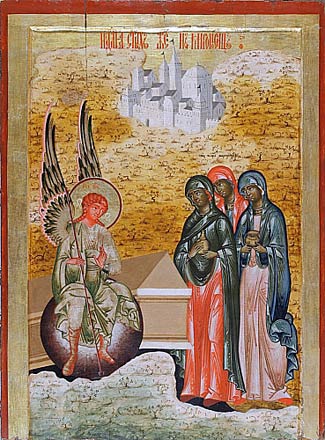
Joanna, Mary & Salome

August 3, 2020


May God’s Word be spoken. May God’s Word be heard. And may that point us to the Living Word who is Jesus Christ our Lord. Amen.


Today we get a little bit of Easter. I am sure it will come as no surprise that I love Easter. I love our Easter story. I even love today’s version of the Easter story. The complicated one where “afraid” is the last word of the text. 

I love it because it is stark, honest, and truthful. It doesn’t sugarcoat the situation or try to tie it up in a neat little package. It is real. Everything in our lives does not go swimmingly or brilliantly. Fear is real. Especially in this time. It is good to be reminded that if we are afraid, we are in good company. 

It is also important to note the context of their fear. No doubt they were afraid because of the significance of what they witnessed. And yet our pericope, our passage, for today is misleading if we think it means that fear has the last word. We know that the story does not end with the women being afraid. The story continues, because even though they are afraid they do go and share the news of Jesus’ resurrection. They live into my favorite definition of “courage” or “brave”: being afraid and doing it anyway. 

And we know the story does not end with their proclamation either. The story continues with us. I believe there is actually an important truth to discover about ourselves at the heart of this Easter story of the women at the tomb.  Now, in order to uncover that truth, it may help to know a bit of background about the culture of Jesus’ time. First off, the society of Jesus’ time was not democratic or egalitarian.  Hierarchy abounded. The Jews were subject to the authority of the Romans, and then Jewish women were subject to the authority of Jewish men. There were clear divisions and in Jewish society things were also divided by what was considered clean and holy or what was unclean and bad. Most of what related to the holy - worship, sacrifice, etc. was the purview of men.  That which was unclean - like birth and death were the purview of women.  This was not unique to Jewish culture. Much of the ancient world relegated the roles surrounding the beginning and the end of life to women.  It seemed logical.  Women gave birth after all, so why should they not also attend to the dead.  

So it is not notable that the women go to the tomb. What is notable is that WOMEN become the messengers of the Resurrection. Jesus doesn’t first appear to Peter or John or any of the other disciples, he appears to the women. He gives them the good news - and I mean the GOOD NEWS - to tell.  In fact, Mary Magdalene has often been referred to as the Apostle to the Apostles, for it is she who first proclaims the reality of the resurrection.  It is women who announce to the disciples the profound and beautiful truth that is at the heart of our faith: God’s love is stronger than death.  The authors of the Gospels should be given a lot of credit for being willing to tell this story, for it is quite a counter-cultural story.  It is a story that puts the figure of women (who would normally have been on the margins of society) into the center of the story and vests them with the powerful task of proclaiming the central message of the Christian faith.
This should come as no surprise of course, for the central theme of Jesus’ life and teachings was to share God’s love with everyone.  He ate with tax collectors and sinners. He healed lepers.  Again and again in his life and ministry did he reach out and bring in those on the margins of society.  Jesus was all about overturning the cultural norms.  He was all about proclaiming the profound truth that God’s love was meant for ALL people, EVERYWHERE - it wasn’t just for the men or for the wealthy or the powerful.

And so what does this mean for us? What does it mean for us that women are tasked with proclaiming the joyful news that Jesus has been raised from the dead?  It means that the truth of Easter and the reality of resurrection applies to all of us. God’s transforming love reaches out to all of us - no matter who we are, no matter where we are.  AND perhaps most importantly it means that ALL of us are called to proclaim the truth of God’s love with our words and our lives, just as the women did. 

No doubt we have stories of how God’s love has been a transformative force in our lives, and I hope that is true particularly in the midst of these challenging times.  I hope we have stories of ways God’s love has shown through the moments that have seemed very dark indeed or stories of how new life has been brought forth when we felt overwhelmed by the realities of death and suffering in the world. I hope we have stories of new opportunities that have surprised us when we had given up hope and all the doors seemed closed. I hope we have stories of the gift of love or new friendship when we were least expecting it. I hope we have stories of the sustaining support of a community of faith when we have faced hardship or struggle.  God’s love shines forth in our lives in countless ways. 

And today God calls us to follow the example of Joanna, Mary and Salome. God calls us to go forth and share that story, even when we may feel afraid. We are called to share the story that God’s love is more powerful than anything - even death.  And the stories of how that love has been transformative in our lives. The world is hungry for stories of love and joy. May we always have the courage to tell them.

AMEN. 


Friday, May 22, 2020

Swords into Plowshares


Rev. Molly F. James, PhD
DFMS Noonday Prayer via Zoom
Helena of Constantinople, May 22, 2020

May God’s Word be spoken. May God’s Word be heard. May that point us to the living Word who is Jesus Christ our Lord. Amen.
Today we remember Constantine’s mother, Helena whose leadership fixed the spot of the Church of the Holy Sepulchre in Jerusalem. As the story goes, a woman was healed by touching a cross that had been buried at a possible building site. Helena declared that to be the True Cross, and so that is where the Church was built. It is a day for honoring the Cross as the symbol of our faith, and it is a day when the Prophet Micah reminds us that God desires to turn swords into plowshares.

So, I would like to tell you the story of a cross I have that brings these two themes together. This cross is made from the firing pins of an AK-47. It was a gift to me from a friend and mentor. It comes from the Diocese of Lebombo in Mozambique. A parish I served and my diocese as a whole have had a longstanding companion relationship with Lebombo. Through that relationship I learned the remarkable story of what happened to the guns at the end of their civil war. Their bishop started a program that quite literally turned swords into plowshares. People were invited to trade in their guns for farming equipment and tools of industry. And the people did. Over 800,000 guns were turned in. Those guns were then turned into artwork, such as the cross I have. One of our bishops has a sculpture of a saxophone player that is made entirely of gun parts.

Because of the sheer size and weight of the cross, it is not one for everyday wear. I have worn it on multiple occasions as a testimony to a different way forward, to our Gospel call to seek peace and to transform tragedy and violence into beauty and new life. My diocese (Connecticut) has done a lot of work and witness against gun violence. My bishop is a founding member of Bishops United Against Gun Violence. We have marched and advocated for changes in policy at a local and a federal level. I have worn this cross at marches in Hartford and DC. I often wore it with a photo of one of the children killed at Sandy Hook elementary school in 2012. [See inside cover of our CT Stations of the Cross for 2013.]

As some of you may know, I had the opportunity to assist at his funeral in 2012. It was a difficult, heartbreaking day, of course. And yet, there were also moments of beauty and hope. The truth of Easter was spoken and felt, even though many of us felt like we were still living out Good Friday and Holy Saturday. One of the images from that day that will stay with me is the moment we walked out of the Church at the end of the service, singing “Joyful, Joyful, we adore thee.” Surrounding the lawn in front of the Church was a line of Boy Scouts in their shirtsleeves (in December!) standing at attention with their flags. They had been there for the entire service creating a human fence to ensure that if the rumors of Westboro Baptist coming to picket were true no one would not be able to get near the Church. That image has stayed with me as an icon of community care and support. Even in the midst of tragedy, the fundamental goodness and resiliency of the human spirit shines through.

Over and over again in our history and in our lives, God’s healing, redeeming love is at work transforming swords into plowshares. Transforming pain and tragedy into hope and new life. In these days when the realities of pain and suffering in our world are ever present, we can easily lose sight of all the signs of hope and new life that are present all around us. I hope that each of you have something like my cross in your workspace. Some small, tangible reminder of a time or a place or a way you have witnessed God’s love at work in the world. Keep those items nearby, and keep your eyes and your hearts open to discover more. They are there. Everyday. I promise.

Amen.


Monday, May 4, 2020

Monica: God is never far


Rev. Molly F. James, PhD
DFMS Noonday Prayer
Monica, May 4, 2020

May God’s Word be spoken. May God’s Word be heard. May that point us to the living Word, who is Jesus Christ our Lord. Amen.
Today we remember Monica, the mother of St. Augustine. Her life and faith are worth remembering in their own right, not just because of who her son became. Interestingly, she actually has a lot of hope to offer us. There is hope in her story because it is a very human one. She struggled as a mother. She wanted her son to become a Christian early in life. If you know much about Augustine, he had quite an interesting and complicated life and did not come to faith until much later in life.

Side note here, when I spent a summer working with a chaplain in a juvenile detention center, I had a group read some excerpts of Augustine’s Confessions. He has a great story of stealing bags and bags of pears from an orchard with a group of friends in his teenage years. The pears aren’t even good. He just does it for the joy of stealing. And yet he went on to become a Saint in the Church. Made for some interesting conversation.

Back to Monica. Her parenting did not go the way she wanted. She wanted her son to change his life, but it did not happen in the time frame she desired. And yet it happened. She also had hoped to be buried in Africa, but she did in Italy and managed to make her peace with that. In fact, she told Augustine, “You will bury your mother here. All I ask of you is that, wherever you may be, you should remember me at the altar of the Lord. Do not fret because I am buried far from our home in Africa. Nothing is far from God . . . ‘

Monica’s faithfulness is an example to all of us. A willingness to trust in God, to trust that God is never far from us. A willingness to trust that hope and faith are stronger than fear.

Our readings for today can be somewhat of a challenge on this front. Hannah prayers for a child, and Samuel is born. In Luke’s Gospel today, a mother is miraculously given back her son whom she thought had died. These lessons taken on their own can be problematic. No doubt we all have things we have hoped for and wished for, sometimes so deeply it hurts. And yet they do not happen as we wish they would.

If we had only our readings for today that could leave us feeling discouraged and desolate. For our lives so often do not match up to what we wish for. So it is good that we also have the example of Monica’s life and the rest of Scripture to remind us that we are not alone in things not going the way we might hope or desire.

From Rachel weeping for her children to Joseph being sold by his brothers to the Israelites slavery in Egypt to Job’s suffering and countless psalms to the Prophets to Jesus’ own family and life experiences, we know that we are not alone in experiences not going according to our plans or our hopes.

I would guess that none of us planned or hoped to be quarantined for all these weeks. None of us wished for a pandemic. None of us wished to lose dear friends and colleagues in the midst of it. None of us wished to have our lives turned upside down or so much fear and anxiety swirling. And so it is important for us to remember that we are not alone in our struggles. It is important to remember Monica’s wisdom that nothing is far from God. Indeed, God is with us in the midst of all of this. God is very near. We need not fear the future. We do not journey alone. God is always with us.

No matter how uncertain things may seem, no matter how often things do not go according to plan, we can find comfort in knowing that we are not alone. And we can trust that God is always at work. God’s redeeming love is bringing forth hope and new life even in the midst of whatever challenges we face. That is the Easter story. That is the heart of our faith. Thanks be to God. Amen.

Tuesday, April 14, 2020

Reflections on Bright Tuesday

Sunrise


Rev. Molly F. James, PhD
DFMS Noonday Prayer via Zoom
Tuesday in Easter Week, April 14, 2020

May God’s Word be spoken. May God’s Word be heard. And may that point us to the Living Word who is Jesus Christ our Lord. Amen.


I learned recently that in the Eastern Church, today is known as Bright Tuesday. It is Bright Week actually. All the way from Easter Sunday to the first Sunday after Easter. It is a “bright” day and a “bright” week. Our lives have been illuminated with profound truths. The light of God’s love is shining brightly indeed. It is shining in our lives and in the world. Just when we need it the most.

We have an invitation to carry the truths of Easter with us, to extend our celebrations beyond a single feast day. We have an invitation to carry the reality of the resurrection, the truth of God’s promises to us throughout this week, throughout this season and beyond.

As I may have shared with you, when I pick a Lenten discipline, I prefer to pick up something to take on. A new habit that I will endeavor to continue after Easter, not just a temporary act of self-deprivation for a season. For me, that has been a far more spiritually fruitful way to do Lent. And I find myself wondering if there is not an invitation in this “Bright Week” for us to take on an Easter discipline. To allow the light of God’s love and truth to shine in our hearts and through our lives. An invitation to see how we might more fully enter into the Easter story and carry it with us for the rest of the year.

I think we could all use a little more Easter right now. I think we could all use a reminder of how God’s love can transform moments of horror and pain into stories of new life and possibility. And so I think there is a two-fold invitation for us on this Bright Tuesday.

First, it is to truly let the Easter message take up residence in our hearts and minds. This may seem particularly challenging. We are in the midst of a pandemic. Fear and anxiety are dominant emotions. For lots of reasons, we are experiencing grief and loss. This time is challenging on so many fronts. It can seem counterintuitive or just like too much to ask for us to be filled with Alleluias and joyful. But I am not talking about superficial celebration or merely trying to be cheerful and happy even when we feel sad. I am not expecting us to paper over or pretend our grief is not real. I am asking us to ground ourselves, to firmly plant our feet in the truth of Easter. We need the hope and joy of Easter to be our foundation. If we can start there then we can keep our perspective in the midst of our grief. In fact, Easter can hold the key to the beginning of our healing.

Easter is a story of transformation. It is a story of how God’s love can heal and change things. Don’t forget that the resurrected Christ still had his wounds. After Easter everything didn’t just become wonderful, easy or simple for the disciples. That is not what Easter promises us. Easter promises us that there is always hope. Even when things seem at the bleakest. Even in the darkness when we have come to care for our dead friend whose body seems to have been stolen. Even when we are sure that the suffering is more than we can handle. Even when it seems that things could not possible get any worse. Even when the fear and the pain are overwhelming. Easter promises us that is not the end of the story. Easter promises us that the dawn comes. The light comes. It promises us that in the light will shine in our hearts, in our lives and in the world. It might not always shine as soon or as bright as we would like, but that does not mean it is not there.

After we have grounded ourselves in the promises of Easter, I think the second invitation on this Bright Tuesday is to follow Mary Magdalene away from the tomb. Remember that Mary is known as the Apostle to the Apostles. Quite a title for a woman who would have been on the margins of society and regarded as someone else’s property. She is the Apostle because she was the first to see Jesus, and she was sent to proclaim the promises of Easter to the world. Just as God has done down through the centuries from Moses to Elijah to Jeremiah and Isaiah, from Miriam to Rahab to Ruth to Elizabeth, God picked the unlikely candidate to deliver God’s message. So what does that mean for us? It means it is not about us. It is not about our status or our identity. It is not about what we have or what we don’t have. It is about God. About God’s message. About God’s love. All of us are qualified to share God’s love with the world. All of us. We only need to keep ourselves grounded in the amazing truth of Easter, of the reality of resurrection. If we are connected to the transforming power of God’s love, then it will be evident to everyone we meet.

The world needs that love. It needs that love in abundance. Take note of all the ways it is manifest in your life at this present moment. Through the support of a friend. In the flowers and trees blooming forth. In the myriad of ways we are able to stay connected and build relationships even at a distance. In all the acts of kindness and generosity that are happening each and everyday in our communities. May we be inspired and go forth, like Mary Magdalene, and share the glorious truth of Easter with the world. AMEN.

Monday, April 13, 2020

Mary Magdalene and Easter Monday

Embed from Getty Images

Rev. Molly F. James, PhD
DFMS Noonday Prayer via Zoom
Easter Monday, April 13, 2020

May God’s Word be spoken. May God’s Word be heard. May that point us to the living Word who is Jesus Christ our Lord. Amen.

You know that feeling when you wake up after something significant has happened in your life. There is that first moment when you wake up, and it is as though nothing is different. Your mind is slowly orienting itself to the day. Then realization comes. You remember. Sometimes that means you are filled with joy. You have a new job. Today is the first day of vacation. You are going on a trip. Today is a milestone for you or someone you love. A day of celebration. Other times you are filled with sadness. There was a brief moment where everything was okay, but then the awareness came. Now what you feel are waves of sadness or anger or frustration. You are feeling the weight of the loss all over again.

I was thinking today about that moment when we first wake up. I was thinking about Mary Magdalene and wondering what it was like for her to wake up on this Easter Monday morning. I am sure it was better than waking up on Easter morning. On Easter she woke up in the dark, if she even slept at all. She gathered her things and went to the tomb to anoint Jesus’ body. She went to do that thing that women have done for centuries. She went to care for the dead. She went to do one final act of loving service for her Lord and teacher. Of course, we know how the story goes. Many of us likely heard it yesterday. Jesus isn’t there and although it takes a little while for Mary to understand what had happened, she becomes the first person to see the resurrected Jesus. She is the first to witness and know the truth of the resurrection. Easter Day did not go at all how she was expecting. Everything changed, for the better.

So what must it have been like for her to wake up on this Easter Monday? Did she have that moment of realization? Did she wake up first remembering the horrors of Friday? Did she wake up filled with grief and sadness? How long did it take for her to remember what happened yesterday? How long before she could be comforted by the conviction that everything had changed, that Jesus had risen from the dead? No doubt she got to a place of joy and hope, replaying that moment of recognition in the Garden outside the tomb. Jesus was alive again!

And yet, along with that sheer joy and sense of celebration, there is a tinge of heartache and sadness. Mary knows that the resurrection did not erase the events of Good Friday. Jesus still has his wounds. The Roman authorities are still angry and will likely be seeking out Jesus’ followers to persecute them. Our Gospel reading reminds us how scared the authorities were of what would happen if people knew that Jesus had been raised from the dead.

Mary knows that everything is different. She knows that God has the power to do transformational things for her and for the world. She knows that death is not the end. She knows that hope and love are stronger than death. And yet, she does not know how the story will end. Jesus has told her that she cannot hang on to him. He will not be staying with her. There is joy, so much joy, and there is also sadness and perhaps even a little fear for the future.

Well, that resonates for me today. I am finding a lot of comfort in the story of Mary Magdalene on this Easter Monday. We are in a similar state. Easter has happened, although the day probably did not go at all how we might have thought it would or wanted it to go. We have received wonderful news. We have had the powerful, inspiring, comforting truth of the primacy of God’s love, of the sheer power of God’s love in the face of humanity’s worst. We have had that truth affirmed for us. And now it is a new day and a new week. We want to hold onto that truth with the same fierceness with which Mary wanted to grab Jesus’ feet and keep him with her.

But neither Mary’s life nor our lives are stagnant. We cannot just stop everything and stay there. There is work to do. There is living to do. Even though we do not yet know what the future holds. We do not know when we will see the end of rising infection rates and death tolls, although there seem to be glimmers that all our collective efforts are having an impact. We do not know when we will see an end to our quarantines. We do not know when we will go back to work in our offices, to worship in our churches, to gather with friends and family, to simply be able to do an errand because we wanted to and without any personal protective equipment.

And so here we are on Easter Monday, in the very good company of Mary Magdalene and the other women, feeling grounded and filled with hope that we know the reality of resurrection. We know it is true. We know it is real. And we are waiting, with a little (or maybe even a lot) of anxiety for the future to unfold. We are waiting to see how the story will go.

I wish I knew already, as I am sure Mary did. I do know two important truths, which I hope comforted Mary as they can comfort us. First, is that God is at work. We may not know what tomorrow will bring, but we do know that God is here. God is with us. God’s life giving, loving Spirit is present with us through whatever challenges come. Second, we are not alone. Mary did not go to the tomb alone. We do not travel this journey alone. We have each other. And what a difference it makes to know that we do not travel alone. We are blessed with companions on the way who will comfort and inspire us. Who will share our burdens and encourage us.

It is Easter Monday. It is a joyful day. It is a complicated day. It is a day of waiting. And yet we can find solace in the truths of our faith and draw strength from the reality that we are not alone. AMEN.