Showing posts with label women. Show all posts

Monday, August 3, 2020

Proclaiming love and resurrection in the midst of fear


Rev. Molly F. James, PhD

DFMS Noonday Prayer via Zoom

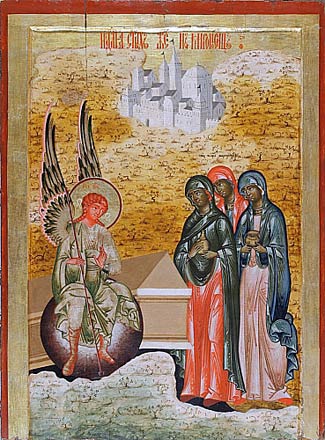
Joanna, Mary & Salome

August 3, 2020


May God’s Word be spoken. May God’s Word be heard. And may that point us to the Living Word who is Jesus Christ our Lord. Amen.


Today we get a little bit of Easter. I am sure it will come as no surprise that I love Easter. I love our Easter story. I even love today’s version of the Easter story. The complicated one where “afraid” is the last word of the text. 

I love it because it is stark, honest, and truthful. It doesn’t sugarcoat the situation or try to tie it up in a neat little package. It is real. Everything in our lives does not go swimmingly or brilliantly. Fear is real. Especially in this time. It is good to be reminded that if we are afraid, we are in good company. 

It is also important to note the context of their fear. No doubt they were afraid because of the significance of what they witnessed. And yet our pericope, our passage, for today is misleading if we think it means that fear has the last word. We know that the story does not end with the women being afraid. The story continues, because even though they are afraid they do go and share the news of Jesus’ resurrection. They live into my favorite definition of “courage” or “brave”: being afraid and doing it anyway. 

And we know the story does not end with their proclamation either. The story continues with us. I believe there is actually an important truth to discover about ourselves at the heart of this Easter story of the women at the tomb.  Now, in order to uncover that truth, it may help to know a bit of background about the culture of Jesus’ time. First off, the society of Jesus’ time was not democratic or egalitarian.  Hierarchy abounded. The Jews were subject to the authority of the Romans, and then Jewish women were subject to the authority of Jewish men. There were clear divisions and in Jewish society things were also divided by what was considered clean and holy or what was unclean and bad. Most of what related to the holy - worship, sacrifice, etc. was the purview of men.  That which was unclean - like birth and death were the purview of women.  This was not unique to Jewish culture. Much of the ancient world relegated the roles surrounding the beginning and the end of life to women.  It seemed logical.  Women gave birth after all, so why should they not also attend to the dead.  

So it is not notable that the women go to the tomb. What is notable is that WOMEN become the messengers of the Resurrection. Jesus doesn’t first appear to Peter or John or any of the other disciples, he appears to the women. He gives them the good news - and I mean the GOOD NEWS - to tell.  In fact, Mary Magdalene has often been referred to as the Apostle to the Apostles, for it is she who first proclaims the reality of the resurrection.  It is women who announce to the disciples the profound and beautiful truth that is at the heart of our faith: God’s love is stronger than death.  The authors of the Gospels should be given a lot of credit for being willing to tell this story, for it is quite a counter-cultural story.  It is a story that puts the figure of women (who would normally have been on the margins of society) into the center of the story and vests them with the powerful task of proclaiming the central message of the Christian faith.
This should come as no surprise of course, for the central theme of Jesus’ life and teachings was to share God’s love with everyone.  He ate with tax collectors and sinners. He healed lepers.  Again and again in his life and ministry did he reach out and bring in those on the margins of society.  Jesus was all about overturning the cultural norms.  He was all about proclaiming the profound truth that God’s love was meant for ALL people, EVERYWHERE - it wasn’t just for the men or for the wealthy or the powerful.

And so what does this mean for us? What does it mean for us that women are tasked with proclaiming the joyful news that Jesus has been raised from the dead?  It means that the truth of Easter and the reality of resurrection applies to all of us. God’s transforming love reaches out to all of us - no matter who we are, no matter where we are.  AND perhaps most importantly it means that ALL of us are called to proclaim the truth of God’s love with our words and our lives, just as the women did. 

No doubt we have stories of how God’s love has been a transformative force in our lives, and I hope that is true particularly in the midst of these challenging times.  I hope we have stories of ways God’s love has shown through the moments that have seemed very dark indeed or stories of how new life has been brought forth when we felt overwhelmed by the realities of death and suffering in the world. I hope we have stories of new opportunities that have surprised us when we had given up hope and all the doors seemed closed. I hope we have stories of the gift of love or new friendship when we were least expecting it. I hope we have stories of the sustaining support of a community of faith when we have faced hardship or struggle.  God’s love shines forth in our lives in countless ways. 

And today God calls us to follow the example of Joanna, Mary and Salome. God calls us to go forth and share that story, even when we may feel afraid. We are called to share the story that God’s love is more powerful than anything - even death.  And the stories of how that love has been transformative in our lives. The world is hungry for stories of love and joy. May we always have the courage to tell them.

AMEN. 


Friday, June 19, 2020

Juneteenth, Ida Wells, and Adelaide Case


Rev. Molly F. James, PhD

DFMS Noonday Prayer via Zoom 

Adelaide Case, June 19, 2020


May God’s Word be spoken. May God’s Word be heard. May that point us to the living Word who is Jesus Christ our Lord. Amen. 


On the recommendation of her fourth grade teacher, we got Katherine a book called “The book of Gutsy Women: Favorite Stories of Courage and Resilience.” It was created by Hillary and Chelsea Clinton. It is stories of women from all around the world who have been gutsy and done remarkable things. It arrived yesterday. I was looking at last night. Katherine looked over my shoulder and said, “Will you read about Ida B. Wells, she’s a favorite?” And so I did. I read about Ida’s refusal to give into the organizers desire for a segregated Women’s March in 1913. I read about her work as a journalist to tell the stories of the lynchings of friends and strangers. Of her work to help found the NAACP. Of her efforts to ensure that the voices of women and of black people were heard. 


I guarantee that when I was nine years old I did not know who Ida B. Wells was. It gives me great hope that Katherine already did and wanted to learn more. She is growing up with a more accurate and full understanding of our complicated American history. I had childhood books about women who did great things, but they were largely or exclusively about white women. Ida wasn’t there. 


I have been thinking about that contrast of Katherine’s and my childhood books on this day, this day that is Juneteenth and a day we honor Adelaide Case, the first woman to teach at an Episcopal Seminary. It is a day we celebrate the end of chattel slavery in the United States. We celebrate that the good news of the emancipation proclamation finally reached the state of Texas. And it is a day we honor the importance of education in our tradition. 


But these two celebrations also highlight the failures and shortcomings of our institutional system. Here we are 155 years after the end of the Civil War, after the end of slavery was finally realized in all the States, and the vision of equality that was celebrated on that day has not been realized. Ida Wells marched in 1913, over 100 years ago for women’s equality. It took seven more years for women to get the vote, and even longer, decades in some places, for women of color to get the right to vote. And we know that getting the right vote and actually being able to exercise that right are not the same thing. To this day, 100 years after women got the right to vote, there are still problems with voter suppression, often based on race or age. Adelaide Case became a seminary professor in 1941, almost 80 years ago. And if you look at the current landscape of theological education, the faculty is still overwhelmingly male, and overwhelmingly white. The dreams of Juneteenth, the dreams of Ida Wells, the dreams of Adelaide Case, have not been realized. We still have work to do - we who hold positions of power and privilege have work to do. We who are white have our own internal work to do. Our own education, our own transformation, our own personal unlearning of the structures of white supremacy. AND we have work to do as leaders and those who sit at the tables of power to change our systems and our structures. 


I have hope for the future, because I am watching my children grow up with a different mindset. I have hope because they are learning things now that I didn’t learn until I was an adult. 


Martin Luther King, Jr. often reminded the world that the arc of history bends toward justice. On this historic day, when we see how much work there is still to do, 155 years later, that bend can seem very slow indeed. But then I look at my children, and I think that it is possible for that arc to bend further, and faster, because the generations coming up behind us are strong, resilient, and motivated. They are going to push us, and inspire us all, into a more just and more beautiful future. AMEN.  


Saturday, April 27, 2019

Women Preaching the Resurrection


Rev. Molly F. James, PhD
Chapel of Our Lord, Episcopal Church Center
Wednesday in Easter Week


May the words of my mouth and the meditations of all our hearts be acceptable in your sight O Lord, our Strength and our Redeemer.  Amen.


A meme has been going around Facebook in the last couple of weeks, particularly shared by my fellow clergy women that says, “In the interests of Biblical accuracy all the preaching about the resurrection this Easter Sunday will be done by women.” This makes us smile and laugh. It makes us smile because it is true, and there is some pride for us in it. But behind the laughter is a bit of the struggle in the fact that people need to be reminded that the first people to know about and believe in the resurrection were women. Mary Magdelene is known as the Apostle to the Apostles.  
But it didn’t take long for the Church to gloss over that fact and then to spend centuries saying women cannot even speak in Church. Sadly there are still many Christian communities where in the interests of “biblical accuracy” women are still prohibited from preaching or holding leadership positions. Discrimination is real. Still.


Note our readings from today. Acts tells us of the ongoing importance the reality of Jesus’ resurrection held for his followers. John tells us of his appearance to Simon Peter and the other fishermen. It is a story designed to ensure that we believe in the reality of the resurrection. But . . . did you notice? There are no women in it. No doubt they were there. On the periphery, perhaps cooking over the fire, but apparently their presence did not warrant a mention. It is such a timeless tale. The women did the work. They were first. They had the important information to share. And who gets most of the credit? Or sometimes all of the credit? The men.


I am sure many of us can relate to this with stories from our own lives when we have felt invisible or ignored by those in power and authority. But just in case you have forgotten the systemic reality of sexism. Let me remind you of the fact that women in the Obama White House (a place one would think would be a bastion of feminism and progressive values) had to institute a strategy of “amplification” to make sure that there ideas and voices were heard in meetings. As described in the Washington Post, “After one woman offered an idea, if it wasn’t acknowledged, another woman would repeat it and give her colleague credit for suggesting it.”


It has only been five days since Easter, and already our sacred texts have forgotten the women. Let’s not follow suit. For all the intellectual reasons that we know supporting women and girls matters and how it makes life better for everyone. And because there is a profound individual, personal lesson for all of us, male and female, in the Easter story and its women preachers.


Let’s start with Jesus. He is Jesus. Fully God and fully human. So he could have appeared to anyone anywhere on Easter morning. He didn’t. He appeared to Mary Magdelene and the other women. The women who had come to care for his body. In the Ancient Near East caring for the dead was all women’s work, because it was unclean. Birth and death were the realm of women because they were messy. And that is where Jesus showed up. Just like at his birth, God showed up right in the middle of the messiness of real life. Jesus showed up in a way that honored and empowered the women in their work. He sought them ought and gave them a message, perhaps one of the most important messages ever, to share with the world.


Jesus did not appear first to his 11 disciples. He did not go see all the guys. He chose the women. He chose those on the margins of society whose voices often went unheard. They are not the ones that society or the rules of the day would have elected to be important messengers. And that is probably precisely why Jesus chose them. Jesus was not interested in upholding the status quo. He was interested in transformation.


And this matters for each of us. In two important ways. First off, no doubt there are days when we are pretty sure that we are not worthy of the responsibility we have been given. Days when we feel like we are on the margins struggling to be noticed. On those days let us remember that Jesus is with us. We are worthy. We are beloved of God. We belong to God, and just as Jesus chose the women to bear his good news to the world, so to have we been chosen to be evangelists (literally bringers of good news) to the world as well.


Second, there is an invitation to follow in Jesus’ footsteps. To be someone who empowers and amplifies the voices of those who have been ignored. How might we be a force for transformation? How might we amplify each other’s voices in a world that often clings to a mythical idea of the past or fears change? How might we join with Jesus in helping people to hear and believe in the reality of resurrection?


Just like in the Easter stories, the world needs the message those women had to share. Our headlines are far too full of violence, hatred, and division. The reality of the resurrection. The overwhelming power of God’s redeeming love is real. May we have the courage to proclaim that truth with our words and our lives.

AMEN.