Monday, November 16, 2020

Pearls and Treasure

Field in Maine


Rev. Molly F. James, PhD

DFMS Noonday Prayer via Zoom

Commemoration of Margaret of Scotland


May God’s Word be spoken. May God’s Word be heard. May that point us to the living Word who is Jesus Christ our Lord. Amen. 


One of the gifts in the midst of all of the challenges of this pandemic is that I get to hear my friends preach. Even if we both have Sunday morning duties or even if we are hundreds of miles apart, the wonders of online worship means we can be present to each others’ ministry in ways that were not previously possible. I had the opportunity to hear a friend preach on this parable of the treasure and the pearl when  came up in our lectionary this summer. I have long thought of myself, of humanity as the buyer in this story. A good Protestant work ethic, a type A, slightly workaholic personality who is highly driven means that I saw this story as reinforcing the idea that we are supposed to sacrifice. We are the ones who are supposed to give all we have, all we can for the building up of the kingdom. 


My friend offered a different interpretation. One that turned my understanding on its head. He invited me to consider the possibility that rather than being the buyer, what if I am the treasure? What if I am the pearl? Oh. That is a very different thing. 


If I am the treasure. If we, each and everyone of us, are the pearl of great price then this is not a parable about how hard we should work or how much we should sacrifice. It is a parable about how beloved we are of God. It is about the joy God finds in us. Oh. That is very different indeed. 


I don’t know about you all, but I needed the reminder of that all important truth this week. The days are full. There is much important and meaningful work to be done. Some of it is easier to do remotely, but much of it is missing the intangible benefits of conversation and collegiality that come from being in the same place as friends and co-workers. The virus is surging again, and many think cases will not peak until January. There are wonderful hopeful signs in terms of treatments and a vaccine, but it is clear that we still have a long road ahead of us. There are divisions in our country, and we have much important and meaningful healing and reconciliation to do. So many bridges need building. Anyone else exhausted yet? 


That is why I needed that reminder. That all important beautiful reminder that we - each and everyone of us - is beloved of God. We bring God joy. Our “worth” is that of treasure and the most magnificent of pearls. Our worth is beyond measure. We do not earn that worth. We are beloved. We bring God joy just by being. Just by who we are. God loves us because we belong to God, because we are of God. 


What a gift. What a blessing. Let us rest a moment in that truth. Let it sink into your heart, into your bones.


I don’t think this interpretation is giving us permission to just stop and do nothing. All the other truths of our faith still apply. We are followers of Jesus. We are called to bear God’s reconciling, redeeming Love to the world. We are called to do good works and care for people’s needs like Margaret of Scotland who we remember today. 


This interpretation of the parable just invites us to start differently. It invites us to be gentle with ourselves and with all those we meet. Perhaps this parable can help us in the moments when we find ourselves getting aggravated or annoyed with those with whom we disagree. What if instead of focusing on everything that is frustrating us, we remember that this person is also a pearl of great price, that they too are beloved of God? What if we try to see them as God does and to see what about that person brings God joy? Of course this does not mean we compromise our own morals or principles, it just means that we have compassion for people. 


The world needs more compassion. And it can begin with us. We can do our part each and every day by having more compassion for ourselves and for each other. We can see the world with God’s eyes. With eyes that seek out beauty, joy, and goodness wherever it can be found. AMEN. 


Friday, November 13, 2020

Lessons about tradition and companionship from Seabury


Rev. Molly F. James, PhD

DFMS Noonday Prayer via Zoom

Commemoration of Samuel Seabury

May God’s Word be spoken. May God’s Word be heard. May that point us to the living Word who is Jesus Christ our Lord. Amen. 

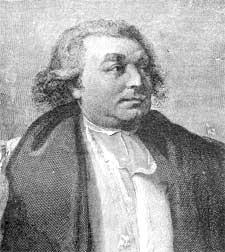
As I think most of you know, I am a priest in the Diocese of Connecticut.  While I was ordained by the Diocese of Maine, I have lived in Connecticut for all of my ordained ministry. This means Samuel Seabury is an almost mythical figure. His portrait has a prominent spot in our diocesan offices, artifacts from his life and ministry abound. Our diocesan archives has his mitre, and I think some of his hair! His desk is the altar at Berkeley Divinity School. I think his chalice has been used at the consecration of all his successors. And so on . . .


We could focus on the life of Seabury and his significance in the history of our Church, but there are lots of texts that have already done that far more thoroughly than I could do in a homily. Rather I would like to focus on what his consecration as the first American bishop might mean for us now, as the staff and volunteers of the DFMS and as individual people of faith. 


I think there are two profound and important lessons that his consecration can offer us. The first is that being connected to and in relationship with our tradition matters. Think about it. At the end of the Revolutionary War, our Church could have done the same thing the new national government did. It could have severed all ties with United Kingdom. It could have struck out on its own and said it was going to do its own thing. That might have been easier. No transatlantic travel involved. Leaders could have just written their own Prayer Book with whatever they wanted in it. Even when Seabury got to England and discovered that he couldn’t be ordained a bishop there without swearing an oath to the crown, he could have decided to just get on a boat and go home. He did not. He went to Scotland. He sought out another branch of the Church that had been ordained in historic succession, where he would not be required to swear an oath to the crown. 


Seabury sought to stay in line with, in relationship with, the tradition he loved. He did not want to sever all the ties with the past. Our history matters. There is so much wisdom to be carried forward. We cannot do that if we ignore or toss out all that we have inherited. And Seabury’s venture to Scotland even ended up enriching our tradition. Our American Prayer Book is one that draws on the linguistic riches of both the English and the Scottish books. 


Staying connected to tradition is as important for us as it was for Seabury and his compatriots. One of the many things I love about our Prayer Book is that it contains prayers and promises   that have been prayed by the faithful for centuries. This gift grounds me and widens my perspective. Especially in these challenging times, it reminds me that I am not the only one who has faced hard times. Our ancestors in the faith have struggled. And they also found comfort and sustenance to carry on in the midst of it all. They have found inspiration and perspective. 


in these beloved, familiar words. We can all be reminded that there is more to life than whatever is troubling us in this particular moment. 


Which brings us to the second lesson from Seabury’s consecration, a reminder that we cannot go it alone. Seabury could not become a bishop without three other bishops participating in his ordination service, a requirement we still hold to today. Again, Seabury could have gone off on his own. The men (yes, all men) who elected him could have decided to establish a new church with singular leadership. They did not. They honored our connection to tradition. They chose a path that says even the most senior leadership in our Church is not a solo activity. In this time when we are all working in our own spaces, quite literally separated from our neighbors and our colleagues, it is all the more important for us to remember that we are a part of a team. We cannot, and we should not go it alone. Isolation can be lonely and troubling for our souls. It is also likely to make us less generative, less creative, less adaptive - all the things we need to be in the midst of our current challenges. 


So on this day let us give thanks for the thread, the connection that traces back from us to Seabury, all the way back to the birth of our Church. May we give thanks for a polity (a Church structure) that does not let us do it all on our own. In whatever challenges we are facing today and in the days ahead, may we not forget all spiritual riches which we have inherited. Remember that we are not alone. We stand in a long line of faithful who have overcome great challenges, and we are blessed, deeply blessed to walk our journey with colleagues and friends who enrich us daily. AMEN.


Sunday, November 8, 2020

Hope as we run the race


Embed from Getty Images

Rev. Molly F. James, PhD

St. Alban’s, Simsbury, CT 

Morning Prayer via Zoom

November 8, 2020

1 Thessalonians 4:13-18; Matthew 25:1-13


May God’s Word be spoken. May God’s Word be heard. May that point us to the living Word who is Jesus Christ our Lord. Amen. 

When I was in preschool my mom ran a marathon. It was a big deal. She had taken up running in adulthood and had done small races here and there. But nothing close to this length. She trained for months in advance. My dad, brother, and I went along to be there at the finish line, of course. It turned out that we were not the only ones who came to support my mom that day. 

One of her dear friends, Martha, who had never run more than a mile in her life, had a surprise in store. She planned to join my mom at Mile 25 and run the final mile with my mom. It was a beautiful gesture, and my mom was incredibly honored and surprised to see her. Particularly since it turned out Martha had miscalculated where to join my mom, and she met her at Mile 21. Not Mile 25. She had planned to run with my mom for a mile. She ended up running with my mom for five miles. They kept each other going and my mom met her goal of finishing in under four hours. 


I don’t know about you all, but I feel like Martha this week. The map is mixed up and the finish line is much further away than I thought it was. It is not just that it took (or in some races is still taking) a long time to count votes and decide races. I realized this week that I naively thought we were more united as a country. I thought our map would be different. 


No matter how we may individually be feeling about the results of the recent election. No matter how you do the analysis. No matter how you do the math. The conclusion is clear; our country is strongly divided about the best path forward. In the face of this division, I find myself grieving, because the pain and the fear are so evident. Because I have not done enough. We have not done enough. 


I grieve because the road ahead is longer and more challenging than what I was wishing for in my optimism and my privilege. I grieve because I naively thought it would be easier than this. I thought somehow we could more quickly realize God’s kingdom. That our good intentions were enough to set us up to become the Beloved Community that Martin Luther King, Jr. preached about. 


Like most things in life, it turns out that the situation is more complicated. And it turns out that change cannot just be something we hope happens out there. It has to be in here too. In fact it has to start here, in our own hearts and minds, in our houses and our communities. 


It is easy to put the blame or responsibility out there. To hear the story of my mom’s friend and say, “Well, too bad she didn’t plan better. I would have double checked the map and not made that mistake.” It is easy to look at our Gospel lesson about the foolish bridesmaids and say, “How silly were they? Don’t they know that they should have planned ahead?” Really. Just a little planning and everyone would have had lamps for the night. It is so simple. 


Or so it seems. So we might wish. But the work of healing, of reconciliation, of caring for those in need, of being agents of transformation in the world, the work of building up God’s kingdom is not simple or easy.


I would imagine I am not the only one who is grieving this week, and while there may be some differences in what we are grieving, I think it would be fair to say that we are all grieving because the state of the world is not as we would like it to be. We would like the pandemic to end. We grieve for those who have died, for those who are suffering now. We grieve for those who have lost jobs and who are on the brink of (or already experiencing) homelessness. We grieve for those who do not have enough to eat. We grieve for the ways that systemic racism has divided us and caused long lasting harm. We grieve for the fact that the bodies of so many on the margins, of those who do not share my heritage, my class, my privilege, those bodies, have been sacrificed. We grieve that we do not seem to be able to talk in a civil and compassionate way across difference. The list goes on. The chasms seem so enormous. 


But then I turn to our text from Thessalonians that reminds us not to grieve as though we have no hope. Ah yes. I needed that reminder. Actually, I think there are two important facts for us here in this text. First, that it is okay to grieve. When loss happens, whether that is the loss of a person, a relationship, or just a dream that did not come to fruition, we need to grieve. We need to acknowledge the depth of our pain, the ache we feel. Something is missing. We cannot ignore or gloss over that fact. It is okay. Our grief is a sign of who and what matters to us. We do not grieve over something unimportant and superfluous. We grieve over the loss of that which gives our life meaning. 


Second, our text from Thessalonians reminds us that we have hope. Indeed we do. We have a beautiful hope, a hope founded in faith. A hope that is not contingent on news headlines or on our own actions. A hope that stands at the heart of our tradition. A belief that God is always at work in the world. Even in the midst of our deepest, darkest moments of fear and sadness. God is at work bringing about new life, new possibility. It is the story at the heart of our Scriptures, at the heart of our faith. God’s healing, transforming, reconciling love is stronger than anything in this world, even death. 


Sometimes the hope can be hard to see, hard to find, and it is there. Always. May you glimpse it in the midst of daily life. In the warmth of the sunshine, even as the weather turns cooler. In the splendor of creation. In reading or hearing something that offers you a new insight or a new perspective. In a conversation with a dear friend. In smiles. In laughter. In the tenacity and joy of children. In all the ways that we are adapting and staying connected even in the midst of all the current challenges. 


Oh, my friends, there is much to grieve these days. Be gentle with yourselves in this time. Be gentle with each other. Ground yourself in faith. We have hope. A deep and real hope. A hope that speaks of the depth and breadth of God’s love. A love that we can make manifest, a kingdom we can help build, through our words and our actions each and every day. AMEN. 


Thursday, November 5, 2020

Beloved Sheep


Rev. Molly F. James, PhD

DFMS Noonday Prayer via Zoom

November 5, 2020

Phil. 3:3-8a; Psalm 105:1-7; Luke 15:1-10


May God’s Word be spoken. May God’s Word be heard. May that point us to the living Word who is Jesus Christ our Lord. Amen. 

“Which one of you, having a hundred sheep and losing one of them, does not leave the ninety-nine in the wilderness and go after the one that is lost until he finds it?”

Okay, so my first thought on this passage was, really, God? Don’t you understand we are weary. We are anxious. We do not yet know how things will go. There is much to be fearful about and most of us have not had anything that would qualify as a true vacation since 2019. Now you want us to do more? You want us to go off searching for someone. Isn’t 99 enough? I mean on most grading scales that is still at least an A if not an A+. 

But then I took a deep breath. I turned the text over in my mind. I thought, Oh. I think I might have it all backwards . . . What if in this story we are not the shepherd? What if we are the sheep? Things look very different then. 

If I am the one who is lost, then, yes, please God, seek me out. Please forget everything I said about 99 being good enough. 

I feel like I needed this passage this week. I needed to be reminded that I matter that much to God. I needed to be reminded that God is indeed our shepherd. I needed to be reminded that I belong to a flock. 

It would be so easy to get ourselves down any number of roads, possibly very scary roads of what ifs about what could happen tomorrow or next week or next month. We could tie ourselves up in knots and skyrocket our blood pressure. That does not serve us or our communities right now. 

What we need today is to breathe a little more deeply. We need to be present. We need to rest in the truth that we are beloved of God. Really. So beloved that God would seek us out. We are that beloved. 

We need to remember that we are in a flock. We do not travel this journey alone. We are safer together. We are happier together. We can do more because we have each other. 

And then we also need to remember that God is not partisan. We are all one flock. We are one people. One human race. Even those people with whom we might vehemently disagree on issues of policy or on who the best candidate is. They too are beloved of God. 

My friends, this election has put in stark relief the divisions that are present in our nation right now. There is much work ahead of us. We have not yet realized the Beloved Community. God’s Kingdom has not come. But it is coming. It is our daily prayer. And we - all of us together, the whole flock - are part of making that happen. 

I am convinced that it is possible for us to journey together into a different future. It is possible because we are beloved of God. It is possible because we do not journey alone. 

May we hold fast to the love God has for each one of us, and may that love flow through our words and actions into our communities and the world. Today and everyday. Amen.


Thursday, October 29, 2020

Meaning and Joy

Dawn


Rev. Molly F. James, PhD

DFMS Noonday Prayer via Zoom

Martyrs of Uganda, October 29, 2020

Psalm 124; 1 Peter 3:14-22; Matthew 10:37-42


May God’s Word be spoken. May God’s Word be heard. May that point us to the living Word who is Jesus Christ our Lord. Amen. 

On occasion I teach Christian Ethics classes and in the course of that look at a variety of Christian perspectives on life and death. One of the passages that has stayed me with me from that work is from the writing of scholar and ethicist Stanley Hauerwas. He writes:


“As a matter of fact, Christians do not believe life is sacred. I often remind my right-to-life friends that Christians took their children with them to martyrdom rather than have them raised as pagans. Christians believe there is much worth dying for.”


I could not help but think of that passage today as we remember Bishop James Hannington and the Martyrs of Uganda. Hannington and so many others are in a long line of forbearers in the faith who have been willing to give their lives. Those who have believed that faith is something worth dying for. 


I don’t know about you, but that thought and the stories of the martyrs give me pause. At first, of course, I want to push back on those stories. I want to say did they really have to die? I want to find a happier ending to the story. Or I want to flag the story with a cautionary note. I want to say there is a really problematic strand in the Christian tradition that has glorified suffering and martyrdom at the expense of those on the margins. A tradition that has told women, people of color, LGBTQ people, the poor, anyone who is different from those in power that they should be grateful for their suffering because it brings them closer to God. No. That is not a message we want to reinforce. That kind of systemic injustice is what we are supposed to change and transform as Christians, not passively accept. 


Okay, now that I have gotten my resistance and my caveats out of the way. I am still left with the all important question of these stories of martyrdom - “What do I believe is worth dying for?”


That is a hard question. Of course it is. None of us wants to think that we would ever be asked to die for our faith. I certainly hope it does not come to that for any of us. 


There is something compelling about the stories of the martyrs. They seem to have such a clear sense of priorities, such a clear sense of what really matters. Their depth of faith and clarity of mind and heart are inspirational. Even if we are not likely to have to follow in their footsteps, perhaps we can still draw on that inspiration. 


Perhaps, rather than asking ourselves what is worth dying for, we should be asking ourselves what is worth living for? What is it that gives our life meaning? 


As you all know, I am fond of quoting Jeremy Taylor, the 17th century Bishop best known for his book Holy Living, Holy Dying. In a funeral sermon for Lady Carberry, he told the congregation, “Go home and think to die, and what you would choose to be doing when you die, that do daily.” He wanted them to remember that life is precious and short. We never know how long we have. So, we should be thoughtful about where we spend our time, our energy, and our resources. 


If we do not have some time each day, even if it is a small window, a tiny glimpse, where we feel connected to God, where we experience joy, where we have a sense that we matter and what we do matters, then perhaps it is time to reassess our calendars and our practices? 


We probably cannot get rid of all the things in the calendar that do not bring us joy - bills need to be paid, garbage needs to be taken out, difficult conversations will need to be had - but we can be attentive to the balance. We can be attentive to always allowing the mundane or menial tasks to crowd out the meaningful and the life giving. 


In these days, when there is so much stress and anxiety and the To Do list seems never ending, may we have the grace to remember that it is okay - actually it is more than okay - it is essential - to set aside time in our day for joy and meaning. We need it. It is what is going to get us through today and whatever lies ahead. Amen. 


Tuesday, October 27, 2020

Remembering we are loved

Garden at Harkness Memorial Park in CT


Rev. Molly F. James, PhD

DFMS Noonday Prayer via Zoom

October 27, 2020

Eph. 5:21-33; Psalm 128;Luke 13:18-21


May God’s Word be spoken. May God’s Word be heard. May that point us to the living Word who is Jesus Christ our Lord. Amen. 


“Wives, be subject to your husbands, as you are to the Lord. For the husband is the head of the wife just as Christ is the head of the church, the body of which he is the Savior. Just as the church is subject to Christ, so also wives ought to be, in everything, to their husbands.” So, it may not come as much of a surprise to you that I find this to be a challenging reading.  It seems to go against my own values, my own understanding of what marriage is supposed to be in today's world.  I want to start arguing with the text. I want to argue that it was written for another time and another place. Its author was trying to promote the social mores of his day. I want to argue that his vision of marriage does not fit my own ideas, those of our current world, or the modern Church. I want to point out to the author that the woman's marriage vow in the Book of Common Prayer has not contained the word “obey” since the 1892 Prayer Book. 

So, I could make these points. Yet where does this arguing get me? The author is not here to argue back. Nor I do not have the right to go editing or changing this text, nor is it likely the 5th chapter of Ephesians is going to be removed from the Christian Canon, just because I find it problematic! This arguing only gets ME upset. If it accomplishes anything, it keeps me from really reading the text, from really listening to what they text is trying to tell me. It keeps me from seeing the breadth and depth of this text. 

The broader message at the heart of this text that is valuable for all of us is about our relationship with God and our relationships with each other. Note that the text actually starts with the line, “Be subject to one another out of reverence for Christ.” 

The language about human marriage, about human partnership is an analogy. The language of the intimacy of partnership is the best way we have of describing our relationship with God. And the values that underlie this passage, that underlie a marriage at its best, are, in fact, applicable to all deep and strong relationships. 

A marriage at its best is a relationship that is grounded in love, respect, and care.   Founded on trust. Where each is faithful. Where we put the needs of the other above our own. Where we value the good of the whole over any solitary gain for ourselves. Where forgiveness and grace abound. It is a relationship that brings out the best in the other.  A relationship of mutual joy. A partnership where each brings strengths and gifts that enable mutual flourishing. 

This is to be our relationship with God and our deep and meaningful, relationships with each other. This also means it is God’s relationship with us. I think that is the part we might need reminding of these days. It can be easy to talk about our love for God and the obligations that come with that. We can be measuring ourselves up, striving to do more. I think sometimes we forget that relationships are a two way street. We forget to acknowledge and really let into our hearts the truth of God’s love for us.  God loves us with a profound, deep, and unending love. Ultimately Ephesians acknowledges that this love, this partnership is a mystery- it is beyond words. A love deeper and more beautiful than we can describe or fully comprehend. This love can only be lived. 

Lived with joy and passion. Lived with gratitude. Lived without fear. We are loved by God, utterly and completely.  It is an unending love. No matter what; we are loved.  

We are called to live out the truth of God's love in our lives. We are called to “walk in love as Christ loved us.” We are called to love ourselves, to love our neighbors. We are called to show God's love to the world. To be an example of grace and forgiveness. To be an example of light and love. Even in the face of hate, even in the face of darkness. We are called to live out the truth that God loves us.

Yet so often we do not live as though this is true. We often live in fear. We live in fear of our mistakes, afraid of our shortcomings, afraid we are not worthy of this love. We live afraid of the future, afraid of the “What ifs?” And in our fears we seem to forget the truth, the foundation of our faith. We are loved. Our sins are only scary if forgiveness is not possible. The future is only scary if God is not in it. Yet Christ tells us over and forgiveness is possible. Grace abounds. And God does not abandon us. The future will contain challenges- there are no guarantees that the road will be easy - yet we are promised that God will always be with us. ALWAYS. The truth of God's presence, and God's love in our lives is an enduring, eternal truth. 

So let us live into this truth in our lives. May it give us quiet confidence. May it give us strength to move forward in spite of our fears, in spite of the challenges we face. May we be open to God's daily reminders of how much we are loved. Each and every day may we live into and proclaim with our lives the deep and profound assurance that each of us is loved by God.  AMEN. 


Wednesday, October 21, 2020

Peace in the midst of chaos


Rev. Molly F. James, PhD

DFMS Noonday Prayer via Zoom

October 21, 2020

Eph. 3:4-12; Psalm 122; Luke 12:39-48

May God’s Word be spoken. May God’s Word be heard. May that point us to the living Word who is Jesus Christ our Lord. Amen.

Verse 7 of our Psalm for today says, “Peace be within your walls * and quietness within your towers.” Ha! I thought when I read this. Peace? God, you are funny. Home life is slightly organized chaos while we all try to work from home and educate children in the midst of a pandemic. Life in our wider communities seems unstable and worrisome as cases are rising again in so many places, including my own state. Our national life seems to be in turmoil as there is bitter division and deep fears as we approach Election Day. And the whole world is still in the grips of a pandemic.


And that list did not include any of the challenges and difficulties that were around before we went into quarantine, like systemic racism or climate change or the ever widening gap between rich and poor. Peace? Really God, I want to say, You have got to be kidding me. How can we possibly find peace at a time like this.


But blessedly I have some wise people in my life whose voices intervene in moments like these. “Molly,” they say, “Take a deep breath. Pause. Reflect. You are getting yourself in a frantic state that is not actually going to help anything. Remember that story about Mary and Martha? You are doing your Martha thing. Time to find your Mary. Sit. Rest. Trust.” Ah. Right.


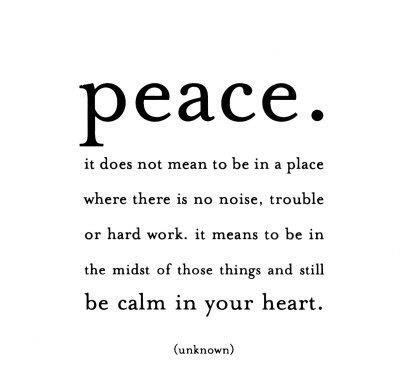
And I think of that oft quoted wisdom pictured above.


Oh, I think, maybe that is what God means. “Peace be within our walls” is not about some magical other world where nothing bad happens. It is not about all our present difficulties just disappearing at the snap of a finger. It is about us finding peace in our souls in the midst of it all. It is about us holding on to that peace, that strength, that resilience to get us through this time.


C.S. Lewis writes of this same kind of experience in A Grief Observed. He writes, “When I lay these questions [of why his wife died or why he is suffering] before God I get no answer. But a rather special sort of ‘No answer.’ It is not the locked door. It is more like a silent, certainly not uncompassionate, gaze. As though He shook His head not in refusal but waiving the question. Like, ‘Peace, child; you don’t understand.’”


In the midst of everything that is going in our world, we, like Lewis, are given a gift of peace that we may not fully understand, but here is the important thing for us to remember - it is God's peace. It is bigger than all of us, bigger than the things of the world, bigger than our fear.


It is not a peace of easy answers or simple solutions. It is the peace that comes from letting go. The peace that comes when we stop trying to figure everything out. It is the peace that comes when we choose trust over fear. When we chose love over indifference. When we chose possibility over certainty.


That is what God offers us. A gift of peace. It is not a gift that will always come easily to us. It is far too easy for us to be sucked into the 24 hour news cycle or find ourselves catastrophizing all the what ifs of tomorrow or next week or next year.


And so we need to keep up the practices that help us slow down. That center us. That remind us we are beloved of God and that we can indeed find peace amidst the chaos. We need time for prayer. Time to nourish our bodies. Time for rest. Time for laughter. Time for that which brings us joy. Time for that which restores our souls and connects us to the grace that is the “foundation of everything.”


The world may seem frantic and harried. There are times when it can seem like the fear is going to get the best of us. But it need not. We have a choice. We have an invitation, an opportunity to experience the beautiful gift of knowing the peace of God in our hearts. It is my prayer that in the midst of all the challenges and the struggles of these days we remember that the peace is not contingent on what happens out there. It can always be found in our hearts, when we are connected to God and each other. Amen.