Showing posts with label reflection. Show all posts

Thursday, June 17, 2021

Reflections on Identity


Rev. Molly F. James, PhD

DFMS Noonday Prayer via Zoom

June 17, 2021

Marina the Monk


May God’s Word be spoken. May God’s Word be heard. May that point us to the living Word who is Jesus Christ our Lord. Amen. 


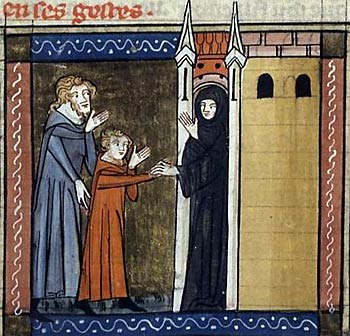
Today we remember Marina/Marinos the Monk, a 5th Century monastic. Marina was born as Miriam. Her faith was strong and at the age of marriage, she chose a monastic life rather than marriage. She shaved her head, doned male clothes, and joined her father at a monastery. It is unclear whether Marina was simply rejecting marriage, desiring to live as a monastic, but there were no convents, or truly needed to live life out as man because that matched his internal identity. The intrigue of this story could easily make Marina one of these people to add to your list for the parlor game of “If you could have dinner with five people, dead or alive, who would they be and why?” Even if we cannot know or fully understand the circumstances of Marina’s life, I do believe that the story provides us with much food for thought and opportunities for reflection on our own lives. 


I believe that there is a fundamental invitation here for us to think about identity. In what ways or times in our lives have we felt the need to be like Marina? When have we felt the need to hide some essential piece of our identity in order to fit in with a community or group? Of course, there is a certain amount of that we do all the time. We don’t share intimate personal details with a seatmate on an airplane the way we would at our best friend’s kitchen table. Having boundaries and knowing what information we should share and where is an important life skill. Like Marina, we have likely had times when holding back some piece of personal information was what kept us safe. As the saying goes, “Don’t bleed with sharks.” It is okay to be protective of ourselves, and to be discerning about how fully we share about ourselves in the communities of which we are a part. Being able to share the truth of who we are requires trust. So it is okay to be sure that is there before we open up. Especially if we find ourselves in communities like Susanna did in our first reading today - a situation where the deck is stacked against us and no matter what we say or do, we cannot convince those in power and authority of the truth of our experience. 


That’s one side of the invitation - for us to reflect on how we navigate our own identities, particularly in situations where we do not have power. The times in our lives when we are Marina. The other side of it is to think about the times in our lives when we are the monks or Marina’s father. What do we do when we are the ones with power and authority? When we are the ones responsible for creating the culture and environment. The monks assumptions about Marina and their rigid enforcement of how they believed things should be meant that Marina spent 10 years as a beggar at the monastery’s gate because they erroneously assumed Marina had impregnated a woman - only to learn upon Marina’s death that was a biological impossibility. So there is an important question here for us. When have we been like the monks? When have we been like the elders in Susanna’s story? When have we made assumptions about someone’s identity that have cost them dearly? When have we lost out on someone’s wisdom, insight, perspective because we were too quick to judge, too rigid in our assumptions, and too stuck in our own worldview? I would guess that we have many stories - from small moments when we were just moving too quickly to pay full attention, to big moments when deeply embedded ideas have cost us an opportunity or a relationship. Hopefully, today we have a reminder that it does not always have to be that way.


We have the opportunity and possibility - especially when we are in positions of power to shift the culture. We have the opportunity to transform a culture from rigid to open. We have the opportunity to foster community where people feel comfortable to bring as much of their identity as they choose. Where the realities of disclosure are decided by individuals themselves and not by those in power. Where diverse perspectives and experiences are honored, and where we are consistently open to learning and change. 


It is my hope and prayer that together we can find more and more ways to join with God in creating a world where people do not feel the need to hide the truth of their identity. A world where our diversity is recognized as a source of beauty and strength. Amen. 


Sunday, August 19, 2018

Bread of Life


Rev. Molly F. James, PhD
Christ Church Cathedral, Hartford, CT
August 19, 2018, Proper 15B
Proverbs 9:1-6; Psalm 34:9-14; Ephesians 5:15-20; John 6:51-58

May God’s Word be spoken. May God’s Word be heard. May that point us to the living Word who is Jesus Christ our Lord. Amen.

I don’t know about you all, but I often get highly suspicious that the Holy Spirit is trying to tell me something when I begin to hear the same message from multiple sources. First off I think we are supposed to be learning something about bread, right? I mean it has been occurring over and over again in our Gospel readings for the past few weeks.

Again and again Jesus tells us that he is the bread of life. What does that mean? What is the bread of life? Well, in today’s Gospel, Jesus tells us that the bread of life is the stuff of eternal life. It is the stuff that lasts. It is not flimsy or lacking substance. And this is where the message gets real and important for me. This is where it is no longer just about literal bread (although that is important too, and there will be more on that later), it is also about metaphorical bread. It is about that which sustains our souls. That which inspires us and gives us joy.

And this is where I think the Holy Spirit has been up to something. Two weeks ago, I spent a remarkable week at Yale Divinity School at a conference on the Theology of Joy and the Pedagogy of the Good Life. This conference is connected with work the Yale Center for Faith and Culture has been doing on the Theology of Joy, as well as a course they have been teaching, particularly to Yale undergrads on what makes a “Life Worth Living.” As you might imagine, there were lots of excellent presentations and conversations at a conference on Joy and the Good Life. I left that week feeling renewed and inspired. I also left reminded of how very important it is for each of us to be regularly asking ourselves, “What is it that makes life worth living for me, and am I living that life now? What do I need to do differently to be living a life that is more inline with my own values?”

In our American Society, land of rugged individualism and manifest destiny, it can be tempting to think this question of a life worth living is about what each of us desires as individuals. If we listen to the images and sound bytes of Madison Avenue, we can think that the life worth living is something that can be purchased at our nearest car dealer or big box retailer. But we know better than that. We know that a life worth living is not something you can find on a shelf or that will arrive on your front steps in a cardboard box. Our reading from Ephesians reminds that we can be easily tempted to waste our precious life: “Be careful then how you live, not as unwise people but as wise, making the most of the time, because the days are evil.”

Temptations abound, and yet we seek to be wise and faithful followers of Jesus, we seek the bread of life. We seek that which is eternal and everlasting. We seek that which is real. We seek that which transforms. The question for us is not just about what makes a life worth living, as in “What do I desire?” No, for us, as followers of Jesus it is about how we are living a life that is worthy of who God calls us to be. We know it is not just about us. It is about relationship, about relationship with God and with each other. It is about a living a life of love. A life that feels rooted and connected. A life that inspires others to seek out the eternal Bread of Life.

So back to the bread. In a few minutes, when we celebrate communion, you will notice something a little different. Today we are having real bread. I want to share a bit with you about the recipe and why I chose to make it. I think it might help provide a tangible connection to our readings and the call we have to live more deeply into our faith lives.

As I think you all know by now, I am someone who likes to get things done. Efficiently and to a high standard, of course, being my preferred combination. Funny thing about making bread, especially this bread recipe. Efficiency is not possible. This bread cannot be hurried or made more efficiently. It requires time and investment, if I want to have delicious bread that is a joy to eat. This bread recipe is from Chef Mark Bittman, and it is his no knead bread. It does not require constant attention. It requires time. You mix the dough and then you let it rise for 18 - 24 hours. Then you bake it in a hot Dutch Oven. The result is a crusty boule with a soft and chewy middle. It has quickly become a favorite bread in our house, as long as we can remember far enough in advance to make the dough. And I have found a profound spiritual lesson in the act of making it. This bread recipe invites me to slow down, to pay attention, and to savor the present. I would guess that I am not the only one who could occasionally benefit from the gift of slowing down, of taking time for reflection, time to invest in something worth doing well, because the result nourishes body and soul.

So, I hope that in our readings today, and particularly in the bite of bread you receive at communion, you find an invitation to reflect on what gives you sustenance, what feeds your soul, what is that bread of life that gives meaning to you? What is God’s invitation to you to live more fully into who you are called to be? I hope you find that reflection fruitful, and I hope that you continue to find more ways to live a life more deeply connected to our Lord, who gives us the bread of eternal life. AMEN.